11:25
Rate of Reaction Maxwell-Boltzmann distribution curve Grade 12 Chemistry
Miss Martins Maths and Science
Overview
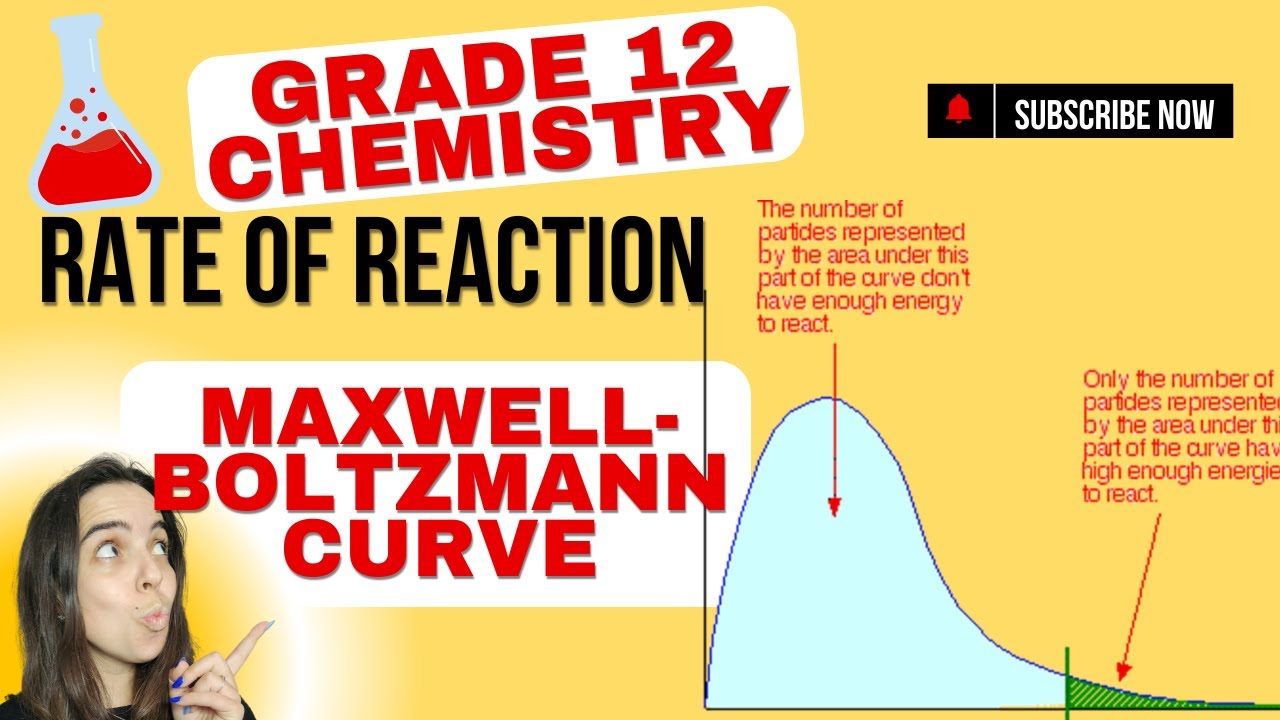
This video explains the Maxwell-Boltzmann distribution curve, which visually represents the range of kinetic energies among particles in a substance at a specific temperature. It connects this curve to collision theory, highlighting that only particles with energy equal to or exceeding the activation energy can cause effective collisions and thus a reaction. The video then elaborates on how increasing temperature, adding a catalyst, or increasing concentration shifts the distribution or lowers the activation energy, leading to more effective collisions and a faster reaction rate.
How was this?
Save this permanently with flashcards, quizzes, and AI chat
Chapters
- Gas molecules are in constant random motion.
- At a given temperature, particles have a range of kinetic energies, meaning they move at different speeds.
- The average kinetic energy of particles is related to the temperature.
Understanding that particles have varying energies is fundamental to explaining why reactions occur at different rates under different conditions.
One particle might have 10 joules of kinetic energy, while another has 11 joules, even at the same temperature.
- The curve plots kinetic energy on the x-axis and the number of particles with that energy on the y-axis.
- The area under the curve represents the total number of particles in the system.
- The curve shows that most particles have an average kinetic energy, while a few have very low or very high kinetic energy.
This curve provides a visual model to understand the distribution of energies within a population of particles, which is crucial for understanding reaction rates.
The peak of the curve indicates the most common kinetic energy, while the tails show the number of particles with very low or very high energies.
- For a reaction to occur, reactant particles must collide effectively.
- Effective collisions require particles to have kinetic energy equal to or greater than the activation energy.
- The area under the Maxwell-Boltzmann curve to the right of the activation energy line represents the particles capable of effective collisions.
This concept links the microscopic behavior of particles (their energy) to the macroscopic outcome of a chemical reaction.
If the activation energy is 50 joules, only particles with 50 joules or more can react upon collision.
- A catalyst speeds up a reaction by lowering the activation energy.
- Lowering the activation energy means a larger proportion of particles have sufficient energy for effective collisions.
- This increases the number of effective collisions per unit time, thus increasing the reaction rate.
Catalysts are vital in industrial processes and biological systems for making reactions occur at practical rates.
Lowering the 'pass mark' (activation energy) from 50% to 30% allows more students (particles) to pass the exam (react).
- Increasing temperature increases the average kinetic energy of all particles.
- The Maxwell-Boltzmann curve shifts to the right and the peak lowers, indicating a broader distribution of higher energies.
- A higher temperature results in a larger area under the curve beyond the activation energy, leading to more effective collisions.
Temperature is a common variable used to control the speed of chemical reactions.
At a higher temperature, the curve shifts so that more particles possess energy greater than the activation energy compared to a lower temperature.
- Increasing concentration means more reactant particles per unit volume.
- This leads to a higher peak on the Maxwell-Boltzmann curve, as there are more particles overall.
- With more particles, there are more frequent collisions, and a greater number of these will be effective, increasing the reaction rate.
Concentration is another key factor that can be manipulated to influence how quickly a reaction proceeds.
In a higher concentration solution, the curve's peak is higher, representing more particles, thus increasing the likelihood of effective collisions.
Key takeaways
- The Maxwell-Boltzmann distribution shows that particles in a sample have a range of kinetic energies, not a single value.
- A reaction occurs only when particles collide with sufficient energy (activation energy) and proper orientation.
- The area under the Maxwell-Boltzmann curve beyond the activation energy represents the fraction of particles capable of reacting.
- Catalysts increase reaction rates by lowering the activation energy, making more collisions effective.
- Increasing temperature increases the average kinetic energy, shifting the distribution and increasing the number of effective collisions.
- Increasing concentration increases the number of particles, leading to more frequent collisions and a higher rate of effective collisions.
- All factors (catalyst, temperature, concentration) that increase the rate of reaction do so by increasing the frequency of effective collisions.
Key terms
Maxwell-Boltzmann distribution curveKinetic energyActivation energyCollision theoryEffective collisionCatalystTemperatureConcentration
Test your understanding
- How does the Maxwell-Boltzmann curve visually represent the different kinetic energies of particles at a specific temperature?
- What is the relationship between activation energy and the likelihood of an effective collision according to collision theory?
- Explain how a catalyst influences the Maxwell-Boltzmann distribution and the rate of a reaction.
- How does an increase in temperature alter the Maxwell-Boltzmann curve and consequently affect the reaction rate?
- What is the effect of increasing the concentration of reactants on the Maxwell-Boltzmann distribution and the rate of reaction?