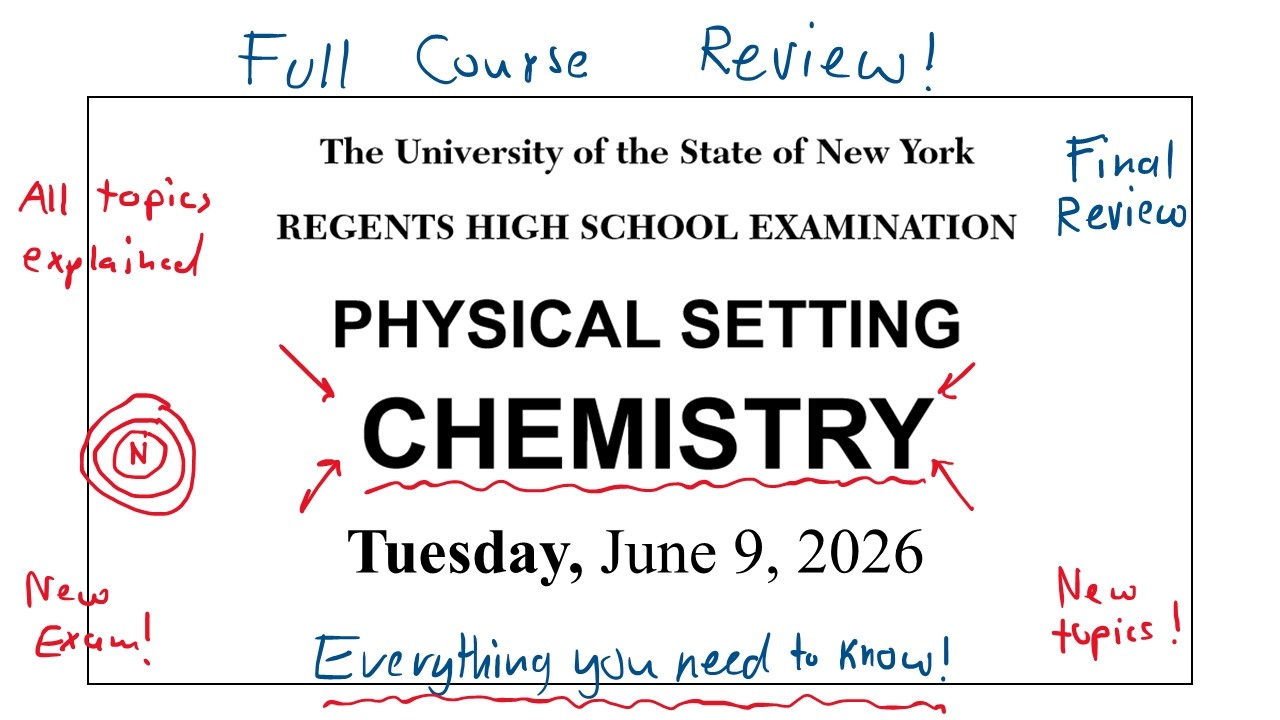
JUNE 2026 Ultimate Chemistry Regents Review | EVERYTHING YOU NEED TO KNOW (every topic reviewed)
Shsat review
Overview
This video provides a comprehensive review of key chemistry concepts for the June 2026 Regents exam. It covers atomic structure, including subatomic particles, ions, and isotopes. The video then delves into the periodic table, explaining its organization, trends like atomic radius and electronegativity, and the properties of metals, nonmetals, and metalloids. Chemical bonding is explored, differentiating between ionic and covalent bonds, and introducing concepts like polarity and Lewis structures. The latter half of the video focuses on chemical reactions, including types of reactions, balancing equations, stoichiometry, and mole concepts. Finally, it touches upon states of matter and intermolecular forces, concluding with naming conventions for ionic and covalent compounds.
Save this permanently with flashcards, quizzes, and AI chat
Chapters
- Atoms are composed of protons (positive charge, in nucleus, mass ~1 amu), neutrons (no charge, in nucleus, mass ~1 amu), and electrons (negative charge, orbit nucleus, negligible mass).
- The nucleus, containing protons and neutrons, is small, dense, and positively charged, accounting for most of the atom's mass.
- Electrons occupy shells or orbitals around the nucleus, contributing to the atom's volume but little to its mass.
- A neutral atom has an equal number of protons and electrons.
- Changes in the number of electrons create ions: losing electrons forms positive ions (cations), and gaining electrons forms negative ions (anions).
- Changes in the number of neutrons result in isotopes, which have different masses but are the same element (e.g., Carbon-13 and Carbon-14).
- The atomic number (number of protons) defines an element; changing the number of protons changes the element entirely.
- Average atomic mass is calculated by weighting the masses of an element's isotopes by their natural abundance.
- Electrons exist in energy shells or orbitals around the nucleus; further shells have higher energy.
- An atom in the ground state has electrons in their lowest possible energy levels.
- Electrons can absorb energy to move to a higher energy level (excited state) and release energy (often as light) when returning to the ground state.
- The electromagnetic spectrum describes waves with different wavelengths, frequencies, and energies; shorter wavelengths and higher frequencies correspond to higher energy.
- The periodic table is arranged by increasing atomic number, with elements organized into periods (rows) and groups (columns).
- Elements are classified as metals (left side, good conductors), nonmetals (right side, insulators), and metalloids (along the 'staircase', properties of both).
- Key periodic trends include atomic radius (decreases across a period, increases down a group), electronegativity (increases across a period, decreases down a group), and ionization energy (increases across a period, decreases down a group).
- Valence electrons, in the outermost shell, determine an element's reactivity and chemical behavior.
- Ionic bonds form between metals and nonmetals through the complete transfer of electrons, creating charged ions that attract each other (e.g., NaCl).
- Covalent bonds form between two nonmetals by sharing electrons to achieve a stable electron configuration (octet rule, except for hydrogen which aims for two).
- Bonds can be single, double, or triple, representing the sharing of 2, 4, or 6 electrons, respectively.
- The goal of most chemical reactions is for atoms to achieve a stable electron configuration, typically with eight valence electrons (an octet).
- Polar covalent bonds occur when electrons are shared unequally due to a significant electronegativity difference between atoms (e.g., H-F).
- Nonpolar covalent bonds involve equal sharing of electrons, often between identical atoms or atoms with similar electronegativity (e.g., C-H).
- Molecular geometry (shape) influences overall molecular polarity; symmetrical molecules can be nonpolar even if they contain polar bonds (e.g., CO2).
- Lewis structures visually represent the bonding and lone pair electrons in a molecule.
- Intermolecular forces (IMFs) are attractions between molecules: hydrogen bonding (strongest, requires H bonded to N, O, or F), dipole-dipole attractions (between polar molecules), and London dispersion forces (weakest, between nonpolar molecules).
- Stronger IMFs lead to higher boiling points because more energy is needed to overcome the attractions between molecules.
- Ionic compounds are named by combining the metal's name with the nonmetal's name ending in '-ide' (e.g., Sodium Chloride). Transition metals may require Roman numerals to indicate charge.
- Covalent compounds use prefixes (mono-, di-, tri-, etc.) to indicate the number of atoms of each element, with the second element ending in '-ide' (e.g., Carbon Dioxide).
- Chemical reactions involve the rearrangement of atoms, classified into synthesis, decomposition, single replacement, double replacement, and combustion.
- Balancing chemical equations ensures that mass is conserved, meaning the number of atoms of each element is the same on both the reactant and product sides.
- The mole is a unit representing 6.022 x 10^23 particles (Avogadro's number), used to relate the microscopic world of atoms to macroscopic measurements (grams).
- Stoichiometry uses mole ratios from balanced equations to predict the amount of product formed or reactant consumed in a reaction.
- Molar mass is the mass of one mole of a substance, calculated by summing the atomic masses of its constituent atoms.
- Percent composition expresses the percentage by mass of each element in a compound and is fixed for a given molecular formula.
- The empirical formula represents the simplest whole-number ratio of atoms in a compound, derived by dividing the molecular formula's subscripts by their greatest common factor.
- Stoichiometric calculations can involve converting between grams, moles, and particles using molar mass and Avogadro's number.
- Matter exists in distinct states: solid, liquid, and gas, each with different levels of particle arrangement and movement.
- Solids have the lowest entropy (disorder), with particles tightly packed in a fixed, ordered structure (crystal lattice) and minimal movement (vibration only).
- Liquids have higher entropy than solids; particles are still close but can move past each other, lacking a fixed shape.
- Gases have the highest entropy, with particles far apart, moving randomly and rapidly, and having no defined shape or volume.
Key takeaways
- The identity of an element is determined solely by its number of protons; changes in electrons create ions, and changes in neutrons create isotopes.
- Electron behavior, specifically their energy levels and movement, dictates atomic energy states and is linked to the emission and absorption of light.
- The periodic table is a powerful tool for predicting chemical properties and trends based on an element's position.
- Chemical bonds (ionic and covalent) are formed by the transfer or sharing of valence electrons, aiming for stability.
- Molecular shape and the electronegativity of atoms determine whether a molecule is polar or nonpolar, influencing its interactions.
- Intermolecular forces dictate the physical properties of substances, such as boiling point, with hydrogen bonding being the strongest type.
- Chemical reactions obey the law of conservation of mass, requiring balanced equations to accurately represent the transformation of matter.
- The mole concept provides a bridge between the microscopic world of atoms and the macroscopic world of measurable quantities like grams, essential for stoichiometry.
- Understanding the different states of matter (solid, liquid, gas) and their associated entropy levels is key to describing physical changes.
Key terms
Test your understanding
- How does changing the number of protons, neutrons, or electrons affect the identity and properties of an atom?
- Explain the relationship between electron energy levels, light absorption/emission, and the electromagnetic spectrum.
- How do atomic radius, electronegativity, and ionization energy change across a period and down a group on the periodic table, and why?
- What is the fundamental difference between ionic and covalent bonding, and how does electronegativity play a role in determining bond type?
- How does the molecular geometry of a compound influence its overall polarity, even if the individual bonds are polar?
- Describe the three main types of intermolecular forces and explain why stronger forces lead to higher boiling points.
- Why is it essential to balance chemical equations, and what does the mole concept allow us to do in chemical calculations?
- What is the difference between a molecular formula and an empirical formula, and how is the empirical formula determined?
- How do the properties of solids, liquids, and gases relate to the arrangement and movement of their particles and their entropy?