57:57
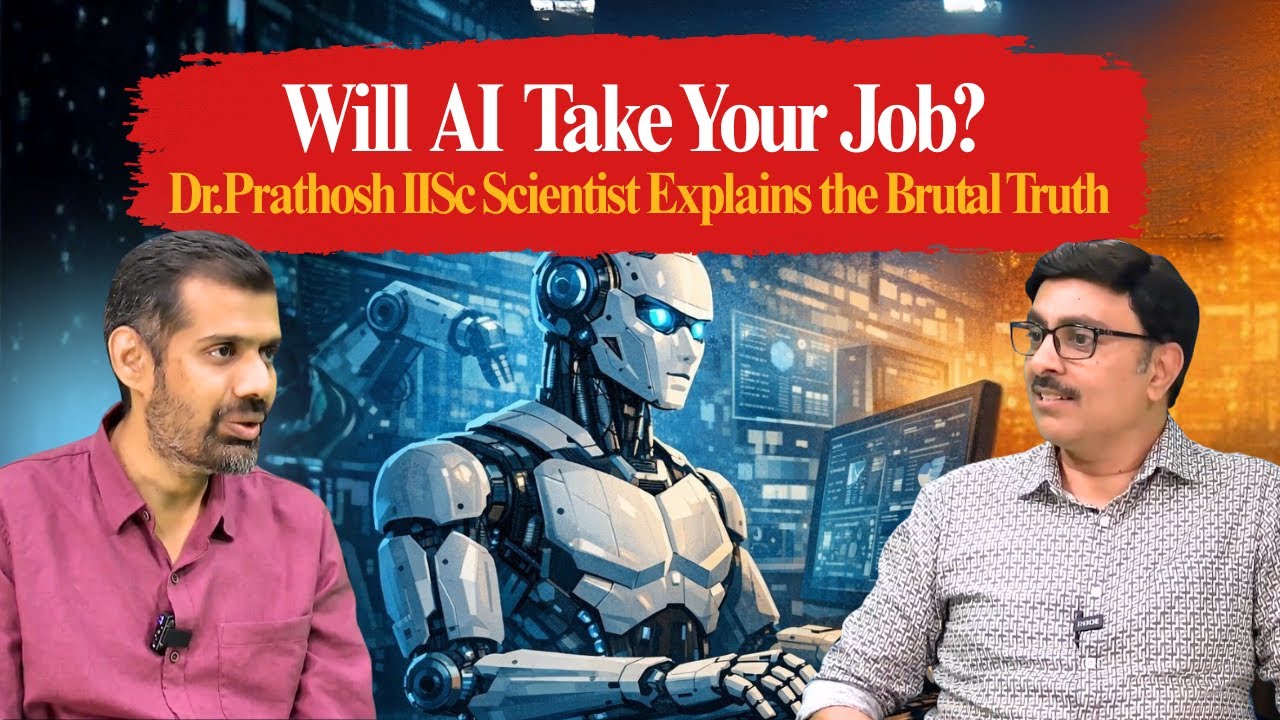
“The End of Jobs? AI, Humans & the New World Order” | Dr.Prathosh A P, AI Scientist, IISC
MKR unplugged - ಕನ್ನಡ
Overview
This video discusses the profound impact of Artificial Intelligence (AI) on the job market and the future of human work. Dr. Prathosh A P, an AI scientist, explains how AI is evolving from automating physical labor to performing intellectual tasks, leading to a significant shift in economic value. He argues that while AI poses a real threat to many knowledge-based jobs, it also presents opportunities for humans to adapt and thrive by focusing on problem-solving and leveraging AI as a tool. The discussion touches upon the concentration of power in AI development, the ethical implications, and the potential for a new economic order.
How was this?
Save this permanently with flashcards, quizzes, and AI chat
Chapters
- AI is rapidly advancing beyond automating physical tasks to performing complex intellectual and creative work previously exclusive to humans.
- Historically, economic value shifted from physical labor to knowledge and information; AI is now devaluing intellectual labor.
- Professions relying on coding, writing, translation, art, and even complex reasoning like mathematics and software engineering are increasingly susceptible to AI automation.
- The scalability and efficiency of AI systems make them a more attractive option for businesses seeking to cut costs and maximize profits.
Understanding this shift is crucial for individuals to recognize the potential obsolescence of current skills and to proactively prepare for a changing job landscape.
AI systems are now capable of solving long-standing mathematical problems, with AI even being listed as a co-author on academic papers.
- The power in the AI revolution is concentrating in the hands of a few major tech companies, primarily in the US and China, who develop and control these advanced systems.
- The recent surge in AI capabilities is due to the convergence of massive internet-scale data availability and significant advancements in computing power (e.g., GPUs).
- The emergence of 'intelligence' in AI systems at this scale is an unexpected phenomenon, even to the technologists who build them.
- The development of AI is an ongoing 'arms race' with continuous improvements and new capabilities emerging, showing no signs of saturation.
Recognizing where power and innovation lie in AI development helps understand the global economic and technological landscape and its future direction.
Companies like Google and OpenAI own vast 'GPU farms' and are investing heavily in compute power, enabling AI models trained on trillions of data points.
- While AI is replacing jobs across many sectors, including physical labor through robotics, human adaptability is key to survival.
- The economic model based on jobs and knowledge asymmetry is unsustainable; a new order will emerge.
- Human beings have a unique ability to think about the future and an innate survival instinct, which will drive adaptation.
- The focus should shift from learning specific tools (which become redundant) to developing transferable problem-solving skills.
This chapter offers a hopeful perspective, emphasizing human resilience and the importance of adapting skills to navigate the inevitable societal and economic transformations.
Just as humans survived the Industrial Revolution and the threat of nuclear warfare, they will find ways to adapt to the AI revolution.
- AI's capabilities, including creativity and complex reasoning, challenge traditional notions of human uniqueness and value.
- The core of human value and reward will increasingly lie in identifying and solving problems for others.
- AI should be viewed as a powerful tool to augment human problem-solving abilities, not as a replacement for human ingenuity.
- Careers built on specific, learnable tools are at risk; careers built on the fundamental skill of problem-solving are more resilient.
This reframes the individual's approach to career development, shifting the focus from mastering tools to cultivating a mindset of continuous problem-solving.
Instead of learning to be a programmer, one should learn to solve problems, using AI as a tool to achieve that, which is a more valuable and transferable skill.
Key takeaways
- AI is fundamentally reshaping the economy by automating intellectual and creative tasks, making knowledge-based skills less valuable.
- The power in AI development is consolidating with a few major technology companies due to massive data and computing resources.
- Human survival and success in the AI era depend on adaptability and the ability to learn and evolve.
- The most valuable skill for the future will be problem-solving, leveraging AI as a tool rather than competing with it.
- Relying on a single, tool-specific skill set is a risky career strategy; focus on transferable problem-solving capabilities.
- New economic models will emerge that may not be centered around traditional employment.
- AI's creative capabilities, demonstrated in art, music, and scientific discovery, are already surpassing human benchmarks in some areas.
Key terms
Artificial Intelligence (AI)Knowledge EconomyIntellectual LaborScalabilityCompute PowerGPUs (Graphics Processing Units)Emergence PhenomenonProblem-Solving SkillsAdaptabilityNew World Order
Test your understanding
- How has the economic value proposition shifted from the Industrial Revolution to the current AI era?
- What technological advancements have enabled the current rapid progress in AI capabilities?
- Why is problem-solving considered a more resilient skill than mastering specific tools in the age of AI?
- What are the potential implications of AI's increasing capabilities on the future of education and traditional professions?
- How can individuals best prepare themselves to thrive in a future economy increasingly shaped by AI?