Understanding Modulation! | ICT #7
Sabin Civil Engineering
Overview
This video explains the fundamental concept of modulation in communications technology. It details why modulation is necessary, particularly for efficient transmission of signals over long distances using antennas. The video covers both analog modulation techniques like Frequency Modulation (FM) and Amplitude Modulation (AM), and then transitions to digital modulation methods such as Amplitude Shift Keying (ASK), Frequency Shift Keying (FSK), and Phase Shift Keying (PSK). Finally, it introduces Quadrature Amplitude Modulation (QAM) as an advanced technique for increasing data transfer speed and efficiency, highlighting its application in modern technologies like 4G.
Save this permanently with flashcards, quizzes, and AI chat
Chapters
- Modulation is essential in communications to transmit signals efficiently, especially over long distances.
- Human hearing is limited to a specific frequency range (20 Hz to 20 kHz).
- Transmitting low-frequency signals directly requires impractically large antennas because antenna size is inversely proportional to wavelength (and thus proportional to frequency).
- Modulation involves impressing a message signal onto a high-frequency carrier signal, similar to attaching a message to a projectile for better range.
- In modulation, a property of the high-frequency carrier signal (amplitude, frequency, or phase) is varied according to the message signal.
- Frequency Modulation (FM) varies the carrier's frequency based on the message signal's amplitude.
- Amplitude Modulation (AM) varies the carrier's amplitude based on the message signal's value.
- Analog modulation techniques are susceptible to noise, which degrades signal quality, and are largely obsolete for modern digital systems.
- Digital modulation converts digital bit streams (0s and 1s) into electromagnetic waves for transmission.
- Amplitude Shift Keying (ASK) changes the carrier's amplitude to represent digital bits (e.g., high amplitude for '1', low for '0').
- Frequency Shift Keying (FSK) changes the carrier's frequency to represent digital bits (e.g., high frequency for '1', low for '0').
- Phase Shift Keying (PSK) changes the carrier's phase (often by 180 degrees) to represent transitions between digital bits (e.g., '0' to '1' or '1' to '0').
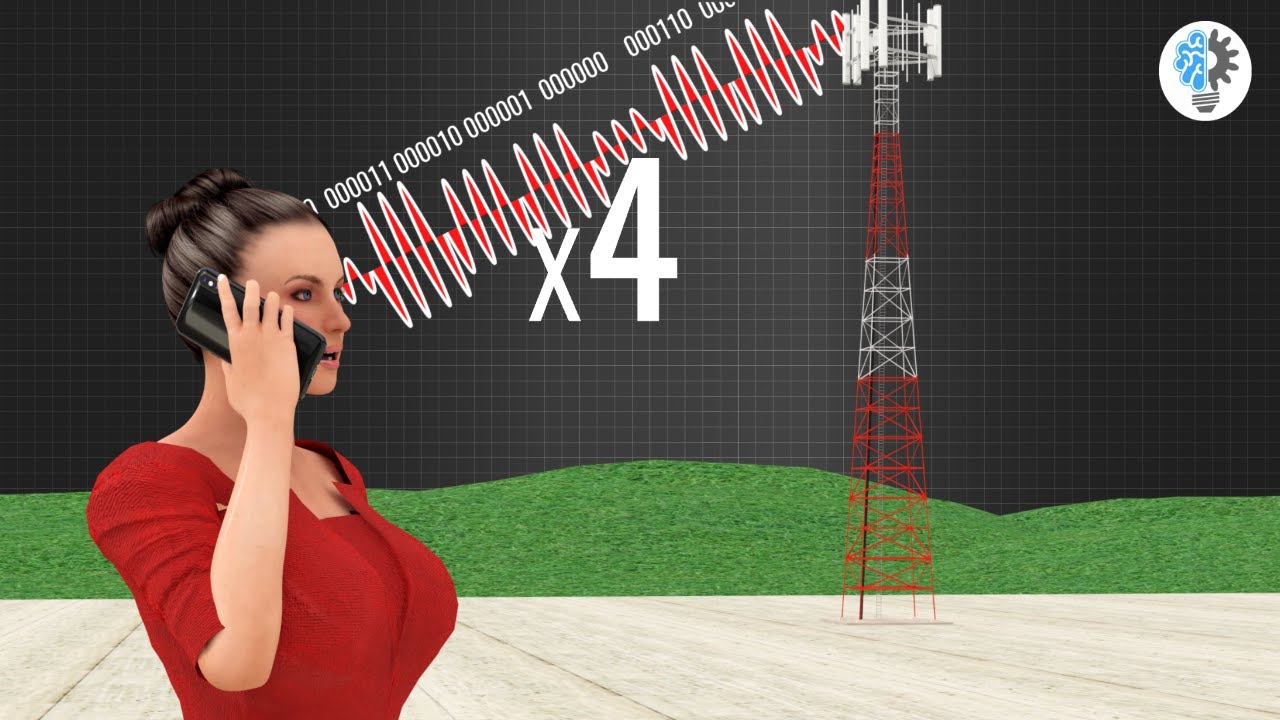
- QAM combines amplitude and phase modulation to significantly increase data transfer speed and efficiency.
- It uses two carrier signals, 90 degrees out of phase (quadrature), to transmit two independent signals simultaneously.
- These two modulated signals are mixed (multiplexed) into a single signal for transmission.
- Digital QAM encodes multiple bits per symbol by adjusting both the amplitude and phase of the carrier wave.
- For example, 16-QAM can transmit 4 bits per symbol, and 64-QAM (used in 4G) transmits 6 bits per symbol, increasing data rates considerably compared to simpler methods.
- Modulation techniques are not limited to radio or cellular communication.
- They are fundamental to television broadcasting, Wi-Fi, and optical fiber communication systems.
- The continuous development of modulation techniques drives improvements in data transfer speed and efficiency across various communication technologies.
Key takeaways
- Modulation is necessary to transmit low-frequency signals efficiently over long distances using practical antenna sizes.
- The core principle of modulation is altering a property of a high-frequency carrier wave based on a lower-frequency message signal.
- Analog modulation (like FM and AM) varies amplitude, frequency, or phase but is prone to noise.
- Digital modulation techniques (ASK, FSK, PSK) encode binary data by changing carrier properties, forming the basis of digital communication.
- QAM is an advanced technique that uses both amplitude and phase modulation simultaneously to dramatically increase data transmission rates.
- Higher-order QAM (like 16-QAM and 64-QAM) allows more bits to be sent per transmission signal, boosting efficiency.
- Modulation is a foundational technology used across a wide range of communication systems, including radio, cellular, Wi-Fi, and television.
Key terms
Test your understanding
- Why is modulation essential for transmitting signals like sound over radio waves, considering antenna size limitations?
- How does Frequency Modulation (FM) differ from Amplitude Modulation (AM) in how it encodes information?
- What is the primary advantage of digital modulation techniques over analog ones in modern communication?
- How does Quadrature Amplitude Modulation (QAM) achieve higher data transfer rates compared to simpler digital modulation methods like FSK or PSK?
- Explain the role of the carrier signal in the process of modulation.