8:15
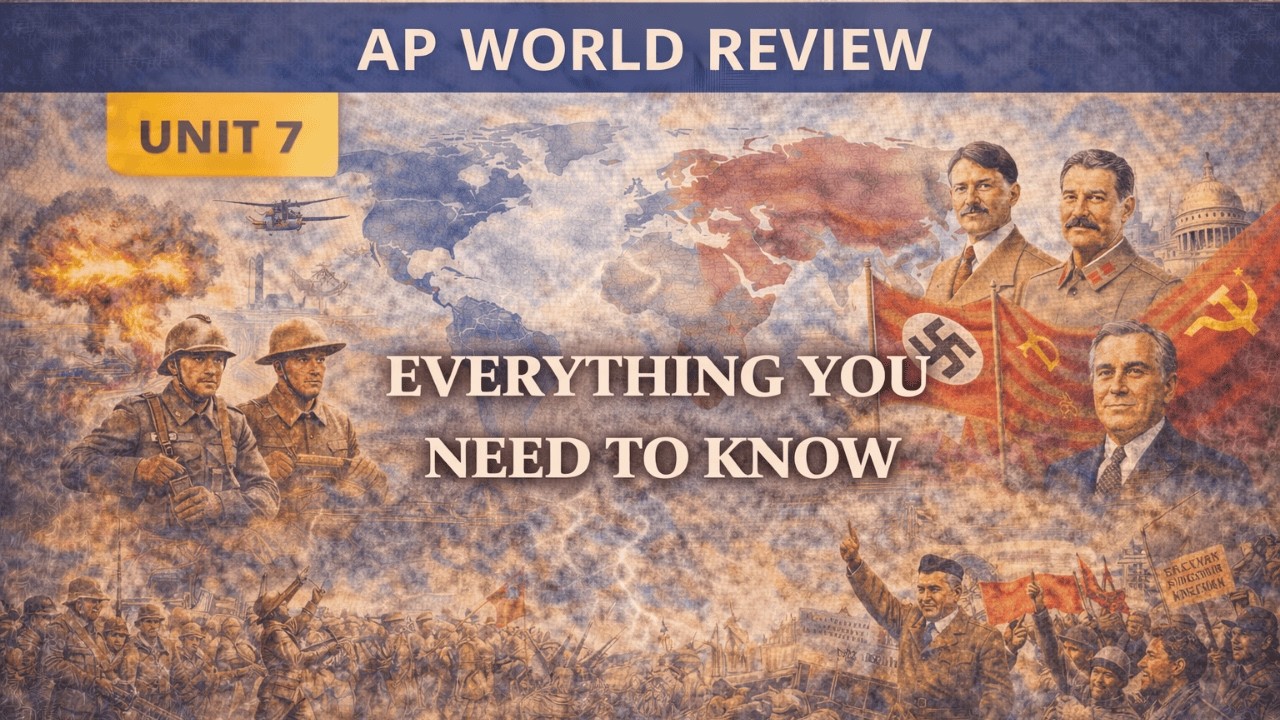
AP World Review Unit 7 EVERYTHING You NEED to Know
AP World History Review
Overview
This video reviews Unit 7 of AP World History, covering the period from 1900 to the present, with a focus on the major global conflicts: World War I, World War II, and the Cold War. It explains the causes and consequences of each war, including the rise of new technologies, total war, and the redrawing of global maps. The summary also touches upon the interwar period, the rise of totalitarianism, the Holocaust, decolonization, and the eventual collapse of the Soviet Union, emphasizing how these events shaped the modern world.
How was this?
Save this permanently with flashcards, quizzes, and AI chat
Chapters
- World War I was primarily caused by militarism, complex alliances, imperial rivalries, and intense nationalism (M.A.I.N.).
- The assassination of Archduke Franz Ferdinand served as the immediate trigger, drawing European powers into conflict through their alliance systems.
- WWI was a 'total war,' involving the mobilization of entire nations' economies and populations, and introduced new, devastating technologies like machine guns and poison gas.
- The war was global, with colonial troops fighting for European powers, and resulted in the collapse of major empires (Ottoman, Austro-Hungarian, Russian).
Understanding the M.A.I.N. causes and the nature of total war in WWI is crucial for grasping how industrial capabilities and interconnected alliances could escalate a regional conflict into a global catastrophe.
The assassination of Archduke Franz Ferdinand of Austria-Hungary by a Serbian nationalist in 1914.
- The Treaty of Versailles imposed harsh penalties on Germany, fostering resentment and failing to establish lasting peace.
- The interwar period was marked by the Great Depression, which undermined faith in democratic governments and capitalism.
- In Russia, the Bolshevik Revolution led to the establishment of the Soviet Union under communist rule, with Stalin implementing forced industrialization.
- Fascist and Nazi regimes rose in Italy and Germany, promoting extreme nationalism, state power, and aggressive expansionism.
The unresolved issues from WWI and the subsequent economic instability created fertile ground for extremist ideologies and aggressive regimes, directly setting the stage for another global conflict.
Adolf Hitler's Nazi regime rearming Germany in violation of the Treaty of Versailles and pursuing expansionist policies.
- WWII began with Axis aggression (Germany, Italy, Japan) in Asia and Europe, utilizing Blitzkrieg tactics.
- The war became truly global with Germany's invasion of the Soviet Union and Japan's attack on Pearl Harbor, bringing the US into the conflict.
- It was a total war on an unprecedented scale, with women playing vital roles and fighting occurring across multiple continents.
- The war witnessed horrific atrocities, most notably the Holocaust, and concluded with the US using atomic bombs, ushering in the nuclear age.
WWII's immense scale, technological advancements in warfare, and unparalleled human cost, including genocide, fundamentally reshaped global power dynamics and introduced the existential threat of nuclear weapons.
The systematic genocide of 6 million Jews and other minorities by the Nazis during the Holocaust.
- The post-WWII era saw the US and Soviet Union emerge as superpowers with opposing ideologies (capitalism vs. communism), leading to the Cold War.
- The Cold War was an ideological struggle characterized by proxy wars (Korea, Vietnam), espionage, propaganda, and a nuclear arms race.
- Europe was divided by an 'Iron Curtain,' and the US implemented containment policies like the Truman Doctrine and Marshall Plan.
- Following WWII, decolonization movements gained momentum in Africa and Asia, leading to the independence of many nations, some through violent struggle.
- Newly independent nations often navigated a path between the superpowers, forming the Non-Aligned Movement.
The bipolar world order of the Cold War influenced global politics, fueled regional conflicts, and coincided with the dismantling of European colonial empires, creating new geopolitical challenges.
The formation of rival military alliances: NATO led by the US and the Warsaw Pact led by the Soviet Union.
The dissolution of the Soviet Union dramatically altered the global political landscape, ending a decades-long ideological struggle and ushering in a new era of international relations.
The fall of the Berlin Wall in 1989, symbolizing the end of Soviet influence in Eastern Europe.
Key takeaways
- The interconnectedness of nations through alliances and economic ties can escalate local conflicts into global wars.
- Economic hardship and political instability create opportunities for the rise of extremist ideologies and totalitarian regimes.
- Technological advancements in warfare have consistently increased the scale and brutality of human conflict.
- The aftermath of major wars often leads to significant shifts in global power and the redrawing of political boundaries.
- Ideological conflicts, like the Cold War, can shape global politics for decades, even without direct large-scale warfare between the main antagonists.
- Decolonization reshaped the global map, but newly independent nations often faced challenges of instability and external influence.
- Internal weaknesses within a state's political and economic system can lead to its collapse, regardless of external pressures.
Key terms
MilitarismAlliancesImperialismNationalismTotal WarTreaty of VersaillesGreat DepressionTotalitarianismFascismBlitzkriegHolocaustCold WarContainmentProxy WarsDecolonizationGlasnostPerestroika
Test your understanding
- What were the M.A.I.N. causes of World War I, and how did they interact?
- How did the Treaty of Versailles contribute to the conditions that led to World War II?
- What made World War II a 'total war' on a larger scale than World War I?
- Explain the concept of the Cold War and how it was fought without direct military confrontation between the US and USSR.
- What factors led to the collapse of the Soviet Union and the end of the Cold War?