37:55
#38. Trust, AI, and Digital Operations
The IT Crowd Podcast
Overview
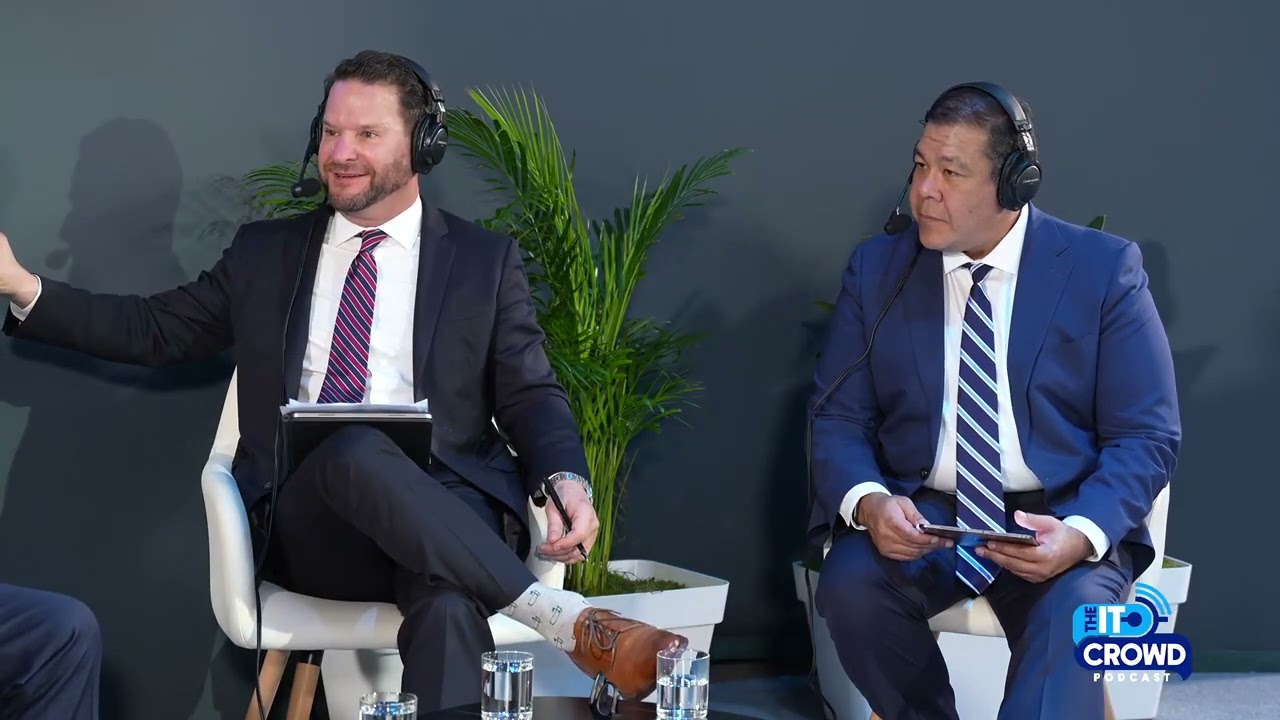
This podcast episode, recorded at the Baker Hughes annual meeting, explores the convergence of Information Technology (IT) and Operational Technology (OT) in the industrial and energy sectors. Guests Laura von Beers and Arav Yalagada discuss how digital solutions, including AI, are transforming operations, enhancing efficiency, and improving asset reliability. They emphasize the critical role of trust, domain expertise, and a 'human-in-the-loop' approach to integrating new technologies, addressing challenges like data silos and change management, and ultimately driving innovation and value for customers.
How was this?
Save this permanently with flashcards, quizzes, and AI chat
Chapters
- The Baker Hughes annual meeting in Florence showcases passion and expertise in technology.
- Guests Laura von Beers and Arav Yalagada are introduced, representing digital technology services and industrial solutions.
- The event highlights innovation and the collaborative efforts of various teams.
- The theme of the year's show is 'The Energy Equation', focusing on the link between energy sources and industrial outcomes.
Understanding the context of the discussion and the expertise of the speakers is crucial for grasping the subsequent technical and strategic insights.
The hosts compliment the Baker Hughes team's preparedness and the overall energy and scale of the annual meeting.
- The core of industrial and energy solutions lies in the digital link between energy sources and industrial outcomes.
- Arav identifies as an 'IT guy wearing an OT suit,' highlighting the blend of skills.
- Innovation in OT must be deliberate and consider equipment lifecycle and safety, unlike the faster pace of IT.
- Combining deep OEM domain knowledge with IT advancements like AI creates unique customer solutions.
This chapter explains the fundamental shift in industrial operations, where traditional operational technology is increasingly integrated with modern information technology.
Laura explains that you cannot 'go fast and break things' in OT, contrasting it with the IT domain, but emphasizes the need to merge these approaches for innovation.
- Trust is paramount in manufacturing and industrial operations; quality is non-negotiable.
- Operators must trust the insights provided by digital technologies and AI.
- Baker Hughes shifts from product-centric to problem-centric discussions with customers.
- Solutions are framed around solving customer problems like asset reliability and process efficiency.
This section addresses a key barrier to technology adoption: the need for users to rely on and believe in the outputs of new digital systems.
Instead of selling a 'product,' Baker Hughes discusses how they help customers understand the remaining useful life of heavy assets like turbines or compressors.
- Customers face challenges like data silos, cybersecurity concerns, and the pace of organizational change.
- Baker Hughes' services business uses digital solutions to monitor and service its own complex, critical equipment.
- Deep domain knowledge is essential to contextualize data analytics and ensure solutions are practical.
- The 'human-in-the-loop' approach combines AI insights with human expertise for accurate decision-making.
This chapter delves into the practical hurdles of implementing digital solutions and how Baker Hughes navigates them through a blend of technology and human expertise.
The 'Eye Center' monitors equipment 24/7, using algorithms and human analysts to identify potential issues before they become critical failures.
- Integrating IT and OT applications presents inherent complexity, similar to enterprise IT systems.
- Baker Hughes offers flexibility through out-of-the-box solutions and a customizable platform approach.
- The platform provides IT components (user experience, cloud hosting, data storage) for customers to build customized value.
- This evolutionary journey acknowledges that solutions are not perfect from the start and require adaptation.
Understanding how a company provides flexible integration options is key to appreciating its ability to meet diverse customer needs in complex environments.
Customers can choose between a ready-to-use application or a platform where they can program interfaces for tailored solutions.
- The industry has an abundance of historical OT data, now being brought to the cloud.
- The next step is automating the transformation of insights into action, leveraging AI at scale.
- Combining IT and OT data, including service work orders and root cause analysis, unlocks new potential.
- The rapid pace of technological development, exemplified by ChatGPT, suggests future innovations will happen quickly.
This section looks ahead, discussing the potential of unlocking vast amounts of data with AI to drive unprecedented levels of automation and insight.
Integrating maintenance spare parts data with asset-specific data (like shaft wear and tear) in a single repository provides crucial context for predictive maintenance.
- Emerging technologies like Generative AI and Agentic AI may be overhyped for specific industrial applications.
- Physical AI and autonomous systems are not yet scaled for widespread use in this domain.
- Real-world use cases for hyped technologies are often more hidden or niche.
- Technologies like robotics and AI are being used in the 'Eye Center' for tasks like identifying oil leaks, improving safety and efficiency.
Distinguishing between genuinely impactful technologies and overhyped trends is crucial for strategic investment and development.
While Generative AI might be overhyped for direct industrial use, AI is used in the 'Eye Center' to trigger robotic inspections for issues like oil leakage.
- The exponential growth in technology is enabled by the availability of data and IT tools.
- Consumerization of IT allows massive scale tools to be applied in OT environments.
- AI will augment, not replace, human jobs by allowing focus on critical tasks.
- The unique domain knowledge in industries like energy is highly valuable and will be enhanced by AI.
This concluding thought reassures learners about the future of work, emphasizing how AI will empower human capabilities rather than eliminate them.
AI will help people focus their attention on the most important aspects of their work, rather than automating jobs entirely, leading to more impact and opportunities.
Key takeaways
- The convergence of IT and OT is fundamentally reshaping industrial operations, driven by the need for efficiency and data-driven insights.
- Trust is the bedrock of digital transformation; operators must have confidence in the accuracy and utility of AI-generated information.
- A 'human-in-the-loop' approach is essential, combining advanced analytics with deep domain expertise to ensure practical and reliable solutions.
- Addressing customer challenges like data silos and organizational change requires flexible, integrated solutions and robust change management strategies.
- While AI offers immense potential, its application must be grounded in real-world needs and integrated thoughtfully, not just adopted because it's a new trend.
- The future of industrial technology lies in leveraging abundant data and AI to augment human capabilities, leading to increased efficiency and new opportunities.
- Baker Hughes focuses on solving customer problems rather than just selling products, demonstrating a shift towards value-based solutions.
Key terms
IT (Information Technology)OT (Operational Technology)Digital TransformationAI (Artificial Intelligence)Human-in-the-loopData SilosAsset IntegrityProcess OptimizationGenerative AIAgentic AIOEM (Original Equipment Manufacturer)
Test your understanding
- How does the convergence of IT and OT change the way industrial operations are managed?
- Why is trust considered a critical factor when implementing AI and digital solutions in industrial settings?
- What is the 'human-in-the-loop' concept, and why is it important for integrating AI in operational technology?
- How does Baker Hughes address common challenges like data silos and change management when deploying digital solutions for customers?
- What is the difference between overhyped and underrated emerging technologies in the context of industrial applications, and why does it matter for businesses?