47:54
Module 3 - Visual Perception Recording
Chris Gade
Overview
This video explores visual perception, transitioning from biological psychology to cognitive psychology. It begins with an activity demonstrating the speed and accuracy of our visual system, then delves into the historical debate between constructivist (top-down) and ecological (bottom-up) approaches to perception. The lecture focuses on color vision, explaining the trichromatic and opponent-process theories, and introduces Gestalt principles and phenomena like color constancy and optical illusions to illustrate how the mind actively constructs our visual reality.
How was this?
Save this permanently with flashcards, quizzes, and AI chat
Chapters
- Visual perception is a key area within cognitive psychology, focusing on how the mind processes sensory information.
- It builds upon sensation, which is the raw reception of stimuli, by adding interpretation and meaning.
- The lecture will focus specifically on visual perception, acknowledging that cognitive psychology covers broader topics like attention and problem-solving.
- Our visual system is remarkably efficient, capable of processing a large amount of information from a brief exposure.
Understanding visual perception is fundamental to cognitive psychology, explaining how we make sense of the world around us and forming the basis for more complex cognitive processes.
A brief flash of an image is shown, and learners are asked to recall as many details as possible, demonstrating the brain's ability to quickly grasp the gist of complex visual scenes.
- The constructivist approach (now linked to top-down processing) suggests perception is shaped by our expectations, prior knowledge, and mental models.
- The ecological approach (now linked to bottom-up processing) posits that perception is primarily driven by the raw sensory data from the environment.
- Early psychologists debated whether perception was more about the brain interpreting input or the environment dictating perception.
- Top-down processing involves using existing knowledge to interpret sensory information, while bottom-up processing relies on analyzing the basic features of the stimuli.
This foundational debate highlights the two primary ways our brains process information, influencing how we understand and interact with sensory input.
The initial image flash activity implicitly demonstrates both: bottom-up processing allows us to see the basic shapes and colors, while top-down processing helps us quickly identify objects like 'people' or 'boats' based on our prior knowledge.
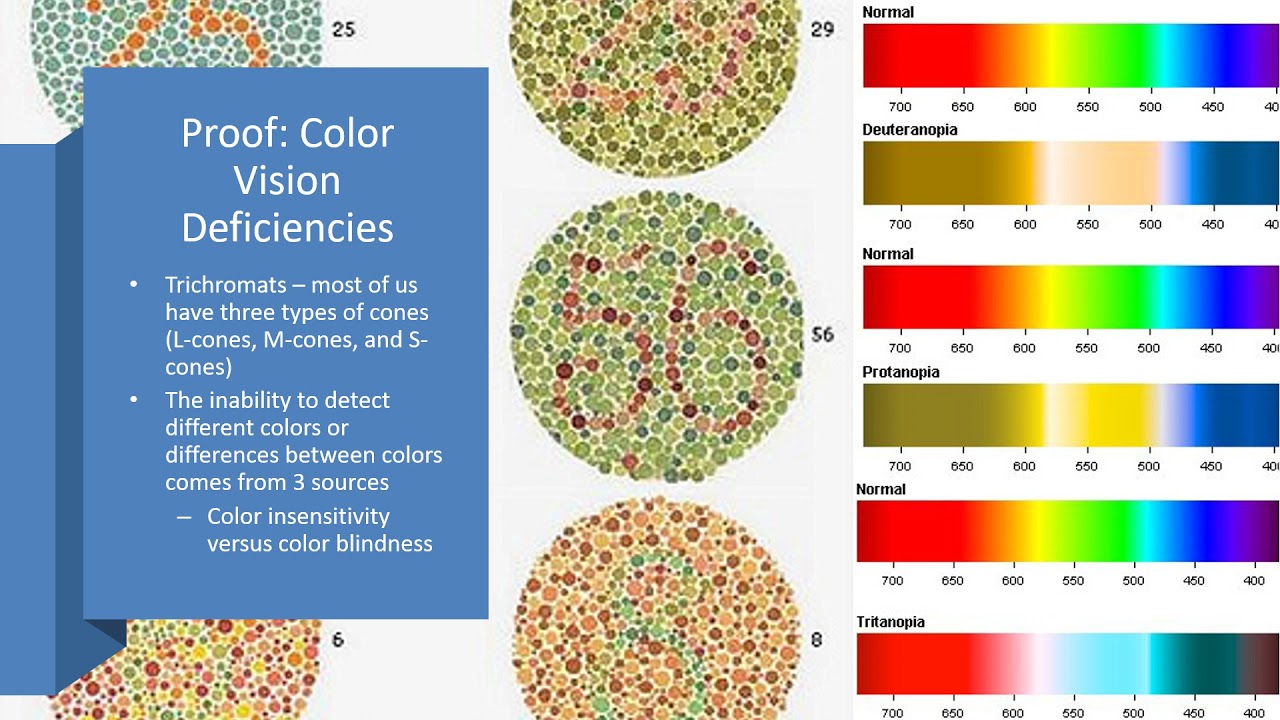
- The Young-Helmholtz trichromatic theory proposed that the eye contains three types of cone cells, each sensitive to different wavelengths of light (red, green, blue).
- This theory explains how combinations of these three cone responses can create the perception of a wide spectrum of colors.
- Evidence for trichromacy comes from observations of color blindness, where deficiencies in one or more cone types lead to difficulties distinguishing certain colors.
- The opponent-process theory suggests that color vision also involves cells that process opposing color pairs (red-green, blue-yellow, black-white), explaining phenomena like afterimages that trichromacy alone cannot.
- Modern understanding integrates both theories, with cones providing initial wavelength information and subsequent neural pathways processing opponent colors.
Understanding color vision theories reveals the complex biological and neural mechanisms underlying our perception of color and how deficiencies can arise.
Staring at a colored flag and then looking away to see a colored afterimage demonstrates the opponent-process theory, as the fatigued cells create a complementary color perception.
- Color constancy is the ability to perceive the color of an object as relatively stable despite changes in lighting conditions.
- This phenomenon shows that our perception of color is not solely based on the wavelengths hitting our eyes but also on the brain's interpretation of the surrounding light.
- The Retinex theory suggests that color perception results from the interaction between retinal input and the brain's 'mind's eye' making adjustments based on ambient light.
- This top-down adjustment allows us to see consistent colors, even when lighting conditions might otherwise distort them, though it can lead to misperceptions in specific stimuli.
Color constancy illustrates how our brain actively interprets and adjusts sensory information, demonstrating that perception is a constructive process rather than a passive reception of data.
Two squares that appear to be different colors due to surrounding light, but are revealed to be identical when isolated, exemplify color constancy and the influence of context on perception.
- Gestalt psychology emphasizes that 'the whole is greater than the sum of its parts,' meaning we perceive organized wholes rather than just collections of individual elements.
- Gestalt principles, such as proximity, similarity, continuity, and connectedness, describe automatic rules our minds use to group and interpret visual elements.
- These principles help us organize incomplete or ambiguous visual information into coherent and meaningful perceptions.
- The mind actively 'fills in the gaps' to create complete images, demonstrating a strong top-down influence on perception.
Gestalt principles explain fundamental ways our brains organize visual information, revealing the inherent patterns and rules we unconsciously apply to perceive order in the world.
Seeing three pairs of lines instead of six individual lines (law of proximity) or perceiving a continuous line with a wave crossing it instead of separate up-and-down segments (law of continuity) are examples of Gestalt grouping.
- Optical illusions, such as the Müller-Lyer and Ponzo illusions, demonstrate how our perception of size and depth can be manipulated by visual cues.
- These illusions highlight the powerful influence of top-down processing, expectations, and contextual information on our visual experience.
- Phenomena like Ames rooms exploit these perceptual principles to create dramatic distortions of size and space.
- Understanding these illusions helps us appreciate the active, interpretive nature of perception and how easily it can be influenced.
Optical illusions provide compelling evidence for how our brains construct reality, revealing the underlying mechanisms and potential biases in our visual perception.
The Müller-Lyer illusion, where two lines of equal length appear different due to outward- or inward-facing fins, demonstrates how perceived depth cues can alter size perception.
Key takeaways
- Perception is an active, interpretive process, not just a passive reception of sensory data.
- Our visual system is highly efficient, capable of rapid and complex interpretation of stimuli.
- Top-down processing (using expectations and prior knowledge) and bottom-up processing (analyzing sensory input) work together to create our perception.
- Color vision is explained by both the trichromatic theory (cone sensitivity to wavelengths) and the opponent-process theory (processing opposing color pairs).
- Color constancy shows our brain adjusts color perception based on ambient lighting to maintain stability.
- Gestalt principles describe innate rules our minds use to organize visual elements into coherent wholes.
- Optical illusions reveal the constructive nature of perception and how easily it can be influenced by context and expectation.
Key terms
Cognitive PsychologyPerceptionSensationTop-Down ProcessingBottom-Up ProcessingTrichromatic TheoryOpponent-Process TheoryColor ConstancyGestalt PrinciplesOptical Illusions
Test your understanding
- How does visual perception differ from visual sensation?
- Explain the core difference between top-down and bottom-up processing in perception.
- What evidence supports the trichromatic theory of color vision, and what phenomena does the opponent-process theory better explain?
- How does color constancy demonstrate the constructive nature of perception?
- Describe one Gestalt principle and provide an example of how it organizes visual information.
- How do optical illusions like the Müller-Lyer illusion challenge our understanding of objective reality?