Relative Dating vs Absolute Dating (Updated)
Color Me Scientifically
Overview
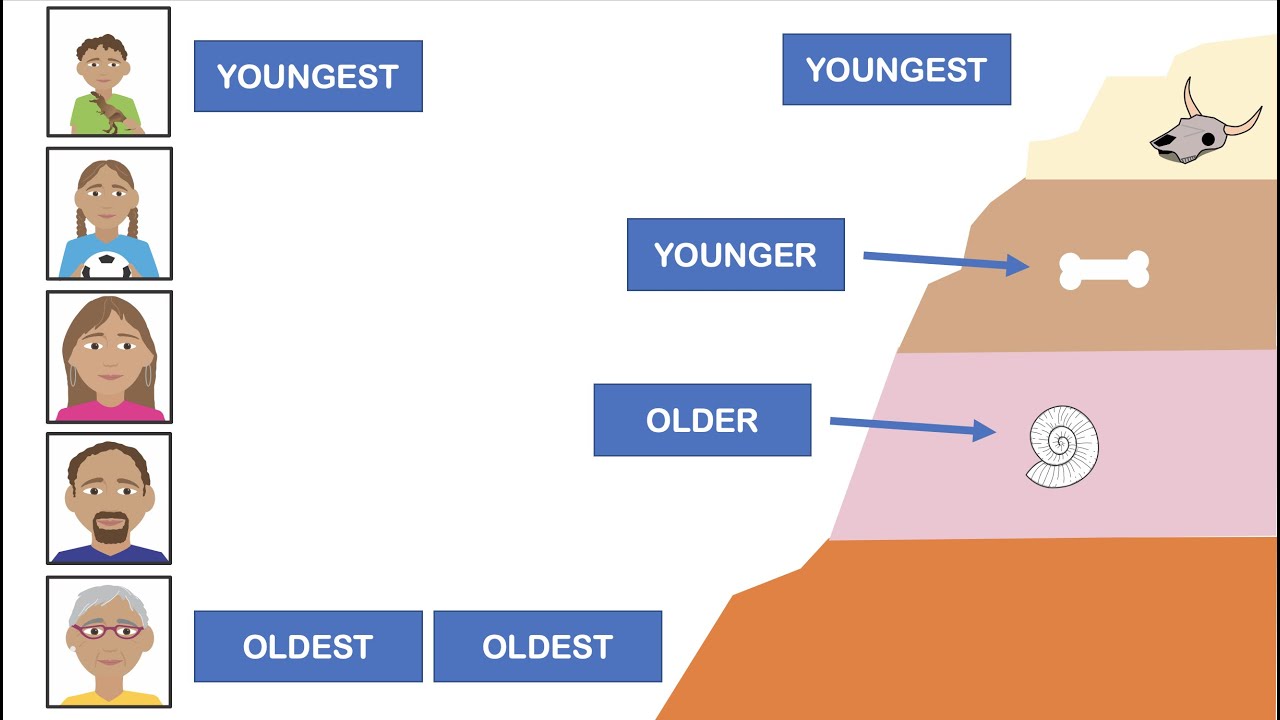
This video explains the fundamental differences between relative dating and absolute dating, two key methods used in geology and archaeology to determine the age of rocks, fossils, and historical events. Relative dating orders events or objects chronologically based on their position or sequence, without assigning specific numerical ages. Absolute dating, conversely, uses scientific techniques like radiometric dating to determine precise numerical ages. The video illustrates these concepts with relatable examples like family members and layered bean dip, and delves into the principles of radiometric dating, including isotopes and half-life, using uranium-lead and carbon-14 dating as examples.
Save this permanently with flashcards, quizzes, and AI chat
Chapters
- Relative dating involves arranging objects or events in chronological order based on their sequence, not by assigning specific dates.
- In geology, this principle is applied to rock layers, where older layers are found at the bottom and younger layers are at the top, a concept known as the law of superposition.
- Fossils found in lower rock layers are older than those found in upper layers.
- Stratigraphy is the scientific study of these rock layers.
- Absolute dating assigns a specific numerical age to an object or event.
- Radiometric dating is a primary method for absolute dating, utilizing the decay of radioactive isotopes within rocks or fossils.
- Isotopes are different forms of the same element with varying numbers of neutrons; some are stable, while others are radioactive and decay over time.
- The ratio of parent isotopes (like uranium-238) to daughter isotopes (like lead-206) in a sample can be measured to determine how long the decay process has been occurring.
- Uranium-lead dating is a common method used for very old rocks, involving the decay of uranium-238 into lead-206 over billions of years.
- The half-life of a radioactive isotope, such as uranium-238's 4.5 billion years, is the time it takes for half of the parent isotope to decay into the daughter isotope.
- Carbon-14 dating is used for organic materials (once living) and is effective for dating events within the last 50,000 years.
- Carbon-14 dating relies on the decay of carbon-14, an isotope found in living organisms.
Key takeaways
- Relative dating establishes the order of events or objects without providing specific dates, relying on principles like superposition.
- Absolute dating provides precise numerical ages for objects and events.
- Radiometric dating is a key technique for absolute dating, measuring the decay of radioactive isotopes.
- Isotopes are variations of elements that are essential for radiometric dating.
- The half-life of a radioactive isotope is a critical factor in calculating absolute ages.
- Uranium-lead dating is suitable for very old geological samples, while carbon-14 dating is used for more recent organic materials.
- Both relative and absolute dating methods are complementary tools for understanding Earth's history and the past.
Key terms
Test your understanding
- How does relative dating differ from absolute dating in terms of the information they provide about age?
- What is the law of superposition, and how does it apply to relative dating in geology?
- Explain the basic principle behind radiometric dating and why isotopes are important for this method.
- What is a half-life, and how is it used to calculate the absolute age of a rock?
- Under what circumstances would a scientist choose carbon-14 dating over uranium-lead dating?