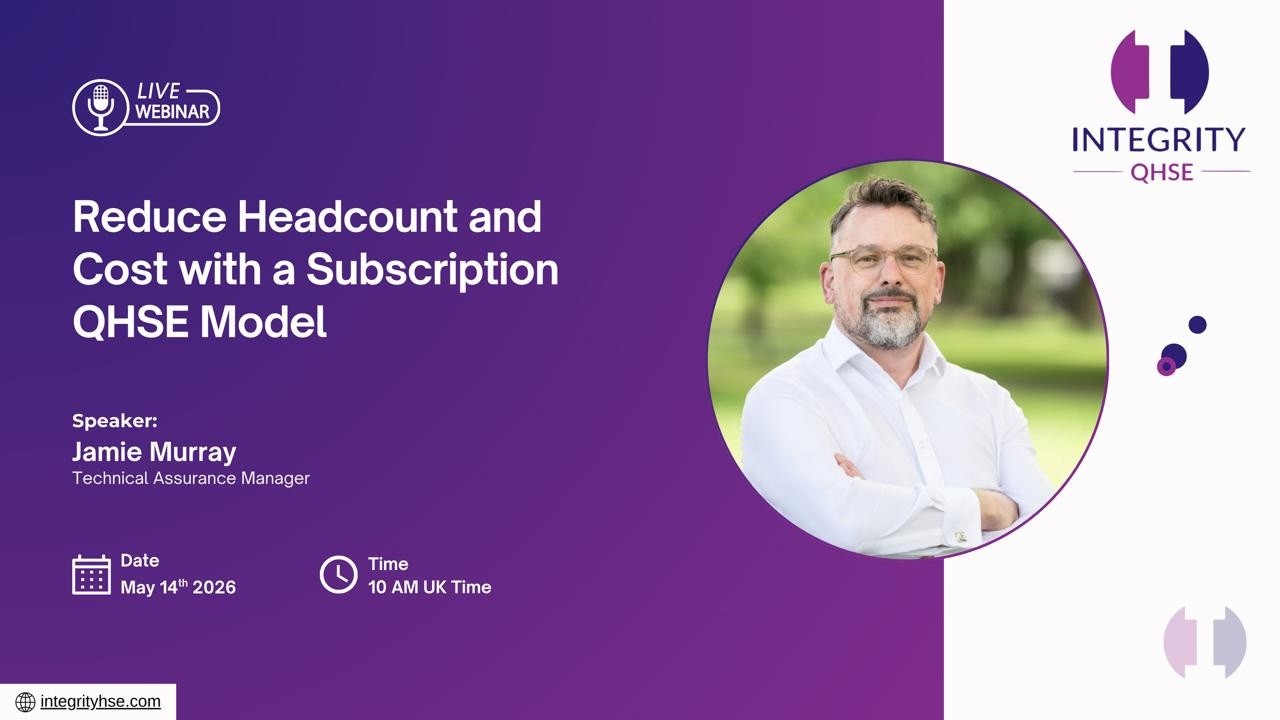
Reduce Headcount and Cost with a Subscription QHSE Model
Integrity HSE
Overview
This video introduces a subscription-based Quality, Health, Safety, Security, and Environment (QHSE) model as a flexible alternative to traditional fixed-headcount QHSE functions. It highlights the hidden costs and limitations of fixed QHSE teams, such as variable demand for expertise, administrative burdens, and the paradox of compliance. The presentation explains how a subscription model offers scalable support, allowing businesses to adjust QHSE capability based on fluctuating risks and projects, ultimately leading to cost reductions and performance improvements. The STAR model (Startup, Turnaround, Accelerated Growth, Realignment, Sustaining Success) is used to illustrate how different business stages require tailored QHSE support, emphasizing that the goal is to match capability and cost to the organization's specific condition.
Save this permanently with flashcards, quizzes, and AI chat
Chapters
- Organizations face a tension between operational priorities and compliance requirements, often leading to QHSE being a secondary concern.
- QHSE roles are broad and complex, requiring expertise across multiple disciplines, which is difficult to maintain with limited in-house staff.
- The administrative burden from ISO requirements and audits can disproportionately consume resources, shifting focus from actual risk management to certification.
- Certification and accreditations can become the primary metric of success, overshadowing genuine risk reduction and safety performance.
- Businesses have an unlimited appetite for assurance and growth but are constrained by finite resources like budget, time, and competence.
- The law acknowledges this scarcity, expecting clear arrangements and competent support proportionate to actual risk, not perfection.
- Reactive QHSE functions lead to sporadic, unpredictable effort with massive spikes, contrasting with the desired stable, predictable rhythm of prevention and improvement.
- The challenge lies not in wanting better QHSE, but in resourcing it sensibly and proportionately to actual business conditions.
- A subscription model provides ongoing access to QHSE capability each month with the flexibility to adjust support levels as risk changes.
- It establishes a baseline of support for core requirements, with the ability to scale up for specific needs like projects, audits, or growth surges.
- This model offers a spectrum of support, from ad hoc consultancy and project-based assistance to retained advisors and fractional QHSE managers.
- The goal is to match support to the organization's specific risks, complexity, and internal capacity, moving beyond a one-size-fits-all approach.
- In a fixed model, expert attention is often spread thinly across administrative tasks and competing demands.
- A subscription model allows for proactive direction of expert attention to high-value controls, supervision, and critical decision-making where risk is highest.
- Cost savings are achieved through reduced fixed overhead, avoidance of recruitment and churn costs, less idle time, and elimination of single-point dependencies.
- This model can also reduce hidden costs associated with incidents, rework, delays, and management distraction by bringing better capability in earlier.
- Performance gains come from improved control effectiveness, supervision proportional to risk, faster mobilization during risk spikes, and better data visibility.
- The key is balancing and proportioning QHSE resources to actual business conditions, not just outsourcing for the sake of it.
- The subscription model is most effective when it responds to the organization's real situation, offering a 'best fit' solution rather than a rigid structure.
- External QHSE capability should strengthen internal ownership rather than replace it, focusing attention where it matters most.
- The STAR model (Startup, Turnaround, Accelerated Growth, Realignment, Sustaining Success) provides a framework for matching QHSE support to the business's current context.
- Startups need foundational compliance and senior judgment without the overhead of a full-time function.
- Turnarounds require rapid diagnosis, corrective action, and independent, focused expertise to address identified problems.
- Accelerated growth demands scalable systems, mobilization support, and standardization across new projects or sites.
- Realignment focuses on simplification, role clarity, and better targeting of assurance to streamline bloated systems, while Sustaining Success needs independent assurance and challenge to prevent complacency.
Key takeaways
- Fixed QHSE headcount often leads to inefficient resource allocation due to variable demand for expertise and administrative overhead.
- A subscription QHSE model offers flexibility to scale support up or down based on fluctuating risks and business needs.
- The economics of attention suggest that expert focus can be more effectively directed in a subscription model towards high-value controls and critical decisions.
- Subscription models can reduce direct costs (overhead, recruitment) and indirect costs (incidents, rework, distraction).
- Performance improvements stem from better control effectiveness, proportional supervision, and faster response to risk spikes.
- The STAR framework helps organizations identify the most appropriate QHSE support model based on their current business stage (Startup, Turnaround, Growth, Realignment, Sustaining Success).
- The ultimate goal is to match QHSE capability and cost to the actual business condition, strengthening internal ownership rather than replacing it.
Key terms
Test your understanding
- What are the primary hidden costs associated with maintaining a fixed QHSE team?
- How does a subscription QHSE model allow for better allocation of expert attention compared to a fixed model?
- Explain the concept of 'proportionality to risk' and how it relates to resourcing QHSE functions.
- Using the STAR model, how would the QHSE support needs differ for a startup versus a company in accelerated growth?
- What is the core principle behind deciding whether to use a subscription QHSE model, according to the video?