DNA Replication (Updated)
Amoeba Sisters
Overview
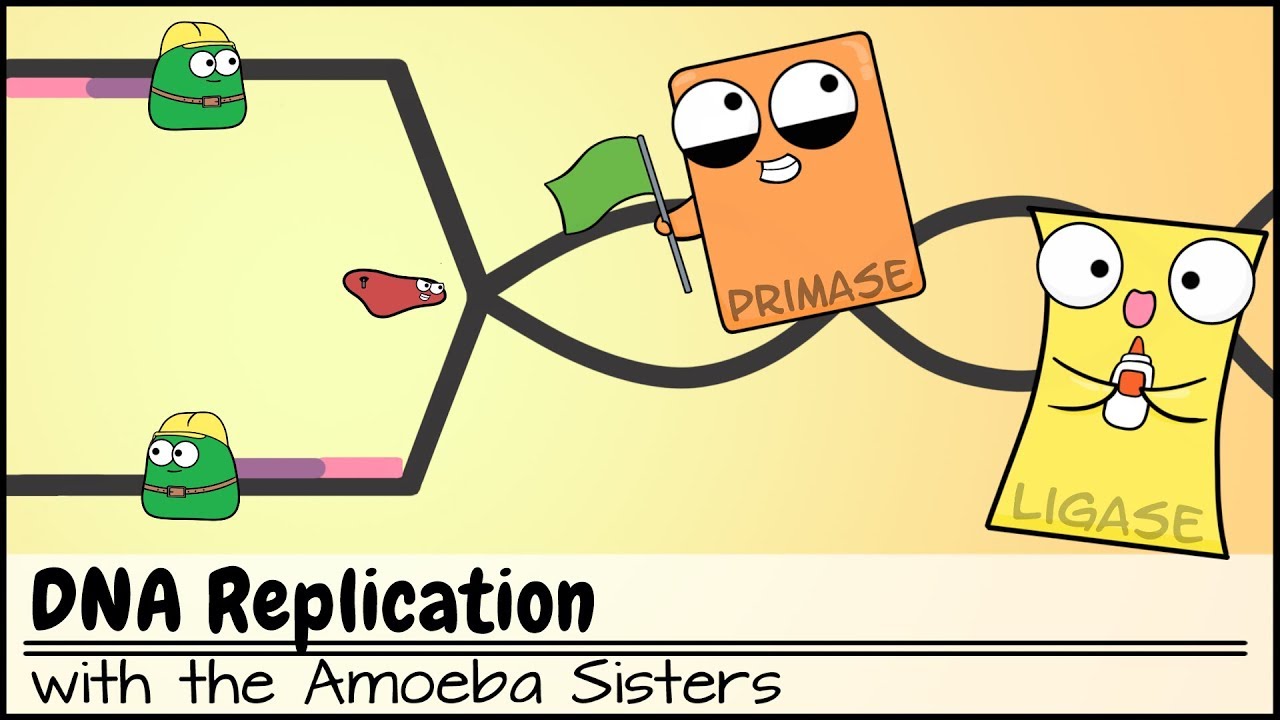
This video explains the process of DNA replication, which is how cells create an identical copy of their DNA before dividing. It details the 'where' and 'when' of replication, introduces the key enzymes involved (helicase, DNA polymerase, primase, ligase), and describes the step-by-step mechanism. A crucial concept explained is the 5' to 3' directionality of DNA synthesis, leading to the distinction between the leading and lagging strands, and the formation of Okazaki fragments. The video also touches upon the semi-conservative nature of replication and the proofreading capabilities of DNA polymerase, highlighting the importance of accurate DNA copying for cellular function and its implications in medicine.
Save this permanently with flashcards, quizzes, and AI chat
Chapters
- DNA is the molecule that directs cell functions and codes for traits.
- DNA replication is the process of making an identical copy of DNA.
- Replication occurs in the nucleus of eukaryotic cells and in prokaryotic cells (which lack a nucleus).
- Cells replicate DNA before dividing to ensure daughter cells receive a complete set of genetic information, specifically during the interphase stage in eukaryotes.
- Many key players in DNA replication are enzymes, often identified by the '-ase' suffix.
- Helicase: The 'unzipping enzyme' that breaks hydrogen bonds between DNA strands.
- DNA Polymerase: The 'builder enzyme' that synthesizes new DNA strands.
- Primase: The 'initializer enzyme' that creates RNA primers, which DNA polymerase needs to start synthesis.
- Ligase: The 'gluer enzyme' that joins DNA fragments together.
- Replication starts at a specific site called the 'origin', often identified by DNA sequences.
- Helicase unwinds the DNA at the origin.
- Single-stranded binding proteins (SSB Proteins) attach to the separated strands to prevent them from rejoining.
- Topoisomerase manages DNA supercoiling, preventing over-winding that could hinder replication.
- DNA strands are complementary, with adenine pairing with thymine (A-T) and guanine with cytosine (G-C).
- DNA strands are anti-parallel, running in opposite directions.
- DNA strand directionality is described as 5' (five prime) to 3' (three prime) or 3' to 5', based on the numbering of carbons in the sugar backbone.
- DNA polymerase can only build a new strand in the 5' to 3' direction.
- Primase adds RNA primers to both DNA strands.
- DNA polymerase synthesizes the new 'leading strand' continuously in the 5' to 3' direction, following the unwinding helicase.
- On the 'lagging strand', DNA polymerase must synthesize the new strand in short fragments (Okazaki fragments) because it can only build in the 5' to 3' direction, moving away from the replication fork as it opens.
- Primers on the lagging strand are replaced with DNA bases, and Ligase glues the Okazaki fragments together.
- DNA replication is 'semi-conservative', meaning each new DNA molecule consists of one original strand and one newly synthesized strand.
- DNA polymerase has a proofreading function to correct errors during synthesis, minimizing mutations.
- Accurate DNA replication is vital to prevent incorrect protein synthesis and potential cellular dysfunction.
- Understanding DNA replication has led to medical treatments targeting harmful cells like bacteria and cancer cells.
Key takeaways
- DNA replication is essential for cell division, ensuring genetic material is passed accurately to daughter cells.
- Specialized enzymes like helicase, DNA polymerase, primase, and ligase work in a coordinated manner to replicate DNA.
- The anti-parallel structure of DNA and the 5' to 3' synthesis limitation lead to continuous replication on the leading strand and discontinuous replication (Okazaki fragments) on the lagging strand.
- DNA replication is semi-conservative, with each new DNA molecule containing one original and one new strand.
- Proofreading by DNA polymerase is critical for maintaining the accuracy of the genetic code and preventing harmful mutations.
- Knowledge of DNA replication mechanisms is foundational for developing medical treatments targeting rapidly dividing cells.
Key terms
Test your understanding
- What is the primary function of DNA polymerase during replication?
- Why is the lagging strand synthesized discontinuously in Okazaki fragments?
- How does the anti-parallel nature of DNA strands influence the replication process?
- What is the significance of the semi-conservative nature of DNA replication?
- Explain the role of primase and why its product is necessary for DNA polymerase to function.