30:04
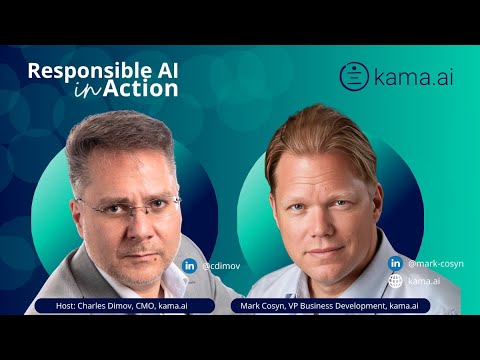
Responsible AI in Action Ep. 2 - Human in the Loop: Why Trustworthy AI Needs People | Mark Cosyn
kama ai
Overview
This video discusses the critical role of human involvement in the development and deployment of trustworthy Artificial Intelligence (AI). It contrasts traditional 'human-in-the-loop' approaches focused on model training with a more integrated 'human-AI partnership' model. The discussion emphasizes that while automation is a goal, highly regulated, complex, or context-dependent processes require human oversight and expertise to ensure quality, mitigate risks, and maintain brand integrity. The concept of 'hybrid AI' is presented as a balanced approach where AI tools augment human capabilities, leading to more robust and reliable AI systems.
How was this?
Save this permanently with flashcards, quizzes, and AI chat
Chapters
- KMA.AI was founded in 2018 with a graph-based approach to AI, focusing on contextual values relevant to human goals.
- The founder's background in highly regulated industries like architecture and engineering highlighted the need for expert collaboration.
- The speaker joined KMA.AI due to its unique and simple approach to responsible AI governance.
- The company aims to bridge the gap between AI capabilities and the practical needs of organizations.
Understanding the origins and philosophy of KMA.AI provides context for their approach to human-AI collaboration and responsible AI.
The speaker's experience in the architecture, engineering, and construction industry, where groups of experts collaborate on complex projects, informs the understanding of human collaboration in AI.
- Traditional 'human-in-the-loop' often means humans training AI models, which can be a limited, one-off process.
- KMA.AI proposes a continuous 'human-AI partnership' where humans actively contribute to ongoing processes.
- This hybrid approach balances automated models with human expertise, especially in high-risk or regulated areas.
- Organizations need to create their own governance frameworks and identify 'knowledge assets,' which include key people and their expertise.
This chapter redefines a common AI term, shifting the focus from AI training to a more integrated and continuous human-AI collaboration, which is crucial for effective and responsible AI deployment.
Instead of just training models, KMA.AI connects people involved in a specific project or process to continually contribute, creating a hybrid human-AI system.
- AI adoption exists on a spectrum, from fully automated models to hybrid approaches.
- Organizations should identify 'knowledge assets' (people and documents) and create risk registers to guide AI implementation.
- High-risk processes, regulated areas, or sensitive interactions (like FAQs) may require more human oversight or a hybrid model.
- KMA.AI's platform allows integration with various AI models, focusing on connecting humans to critical processes rather than replacing them entirely.
Understanding AI applications as a spectrum allows organizations to make informed decisions about where and how to integrate AI, prioritizing human involvement where risk or complexity demands it.
A frequently asked question (FAQ) about a highly sensitive or regulated topic might be a process where a hybrid AI approach is necessary, involving human review or input.
- The project aimed to help remote Canadian communities establish safe drinking water systems.
- A key challenge was the scarcity of experienced water system operators to guide these communities.
- KMA.AI's approach facilitated a partnership between AI tools and human subject matter experts (experienced operators).
- This model built trust and enabled the replication of successful processes, demonstrating the power of human-AI collaboration in critical infrastructure.
This real-world example illustrates how a human-AI partnership can solve complex societal problems by leveraging human expertise alongside AI capabilities, especially when human experts are in short supply.
Facilitating the installation of community water systems in 4,000 small Canadian communities by connecting them with experienced water system operators through an AI-assisted platform.
- As AI agents become more prevalent, maintaining brand integrity is crucial.
- Pushing automation too far without considering quality and governance can damage a brand.
- Companies that have over-relied on AI have sometimes had to rehire human staff to restore quality and brand perception.
- Human oversight is essential for highly contextual processes where AI might err, especially in customer-facing applications like chatbots.
Protecting brand reputation is paramount, and this section highlights how unchecked AI adoption can jeopardize it, underscoring the need for a balanced approach that prioritizes quality and trust.
An organization that hired back employees after realizing their AI chatbot on their website was negatively impacting their brand integrity and customer interactions.
- While AI agents are advancing, fully autonomous systems are still years away for many industries.
- Human-in-the-loop will likely evolve into a premium offering, providing access to expert knowledge and wisdom.
- This hybrid model offers economic automation benefits while building trust and accessibility to human experts.
- The ability to connect with and learn from human experts will remain a sought-after feature, enhancing human networks and collaboration.
This forward-looking perspective suggests that human involvement in AI will persist, transforming into a valuable, perhaps premium, component that enhances both AI capabilities and human connection.
A future scenario where users can opt for a premium service that combines AI efficiency with direct input or oversight from leading human experts in a specific field, akin to a premium subscription service.
Key takeaways
- Responsible AI requires a continuous partnership between humans and AI, not just humans training AI.
- AI adoption should be viewed on a spectrum, with human oversight critical for high-risk, regulated, or complex processes.
- Identifying and integrating 'knowledge assets,' including human experts, is key to effective AI governance.
- Hybrid AI, where AI augments human capabilities, offers a balanced approach to automation and trustworthiness.
- Brand integrity and customer trust can be severely impacted by over-reliance on AI without adequate quality control and human oversight.
- The role of humans in AI is likely to evolve into a premium, sought-after component rather than disappear entirely.
- Organizations must develop their own governance frameworks tailored to their specific needs and risk profiles.
Key terms
Responsible AIHuman-in-the-LoopHuman-AI PartnershipHybrid AIKnowledge AssetsRisk RegisterAgentic AIBrand IntegrityGovernance Framework
Test your understanding
- How does KMA.AI's concept of 'human-AI partnership' differ from traditional 'human-in-the-loop' training?
- Why is it important to consider a spectrum of AI applications rather than aiming for full automation in all cases?
- What are 'knowledge assets' in the context of AI governance, and why are they important?
- How can over-reliance on agentic AI impact an organization's brand integrity?
- In what ways might the role of humans in AI evolve in the future, according to the discussion?