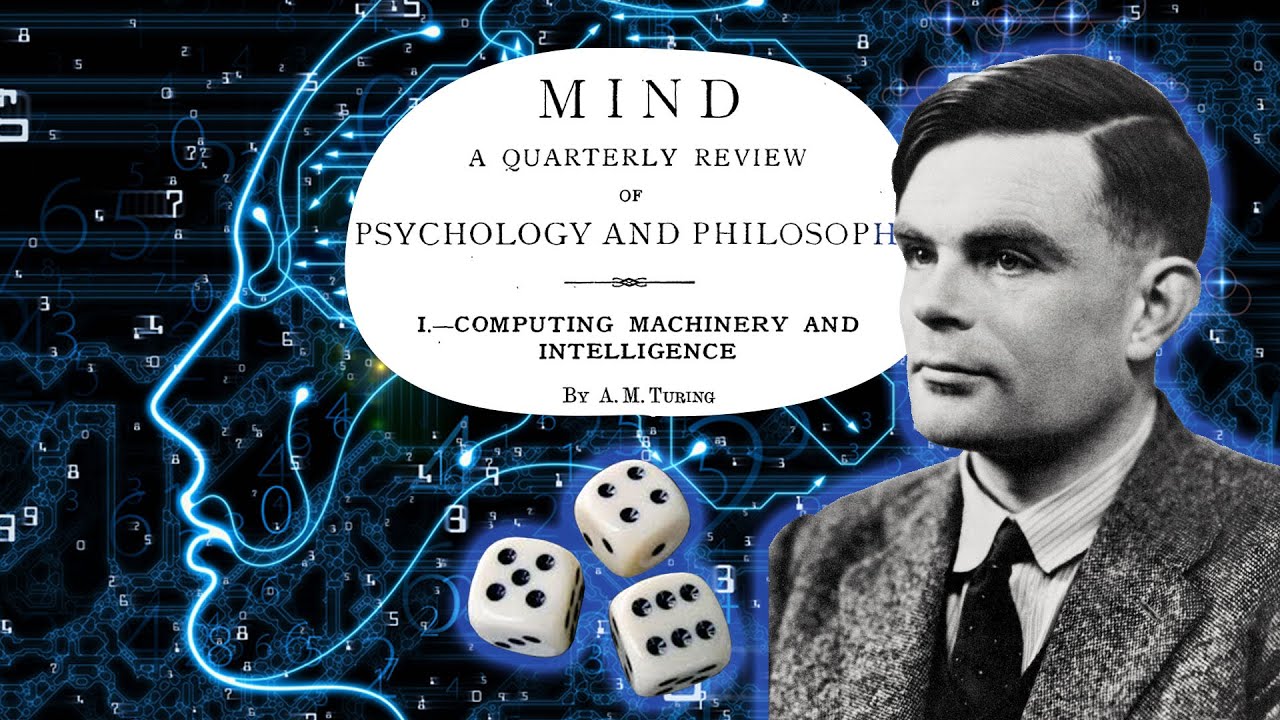
Alan Turing | Computing Machinery and Intelligence
Aleksa Gordić - The AI Epiphany
Overview
This video explores Alan Turing's seminal 1950 paper, "Computing Machinery and Intelligence," which grappled with the question of whether machines can think. It introduces the Turing Test (originally the imitation game) as a proposed method for assessing machine intelligence, detailing its rules and Turing's own predictions. The summary also delves into Turing's definitions of 'machine' and 'thinking,' his hypothesis that the human mind can be modeled as a discrete state machine, and addresses several objections to machine intelligence, including theological, mathematical, consciousness, and learning-based arguments. Finally, it touches upon Turing's forward-thinking ideas on machine learning, comparing them to child development and evolutionary processes.
Save this permanently with flashcards, quizzes, and AI chat
Chapters
- Alan Turing is a foundational figure in computer science and artificial intelligence.
- His 1950 paper, "Computing Machinery and Intelligence," directly asks: 'Can machines think?'
- Turing acknowledged the difficulty in defining 'thinking' and 'intelligence' precisely.
- The Turing Test, or imitation game, involves a judge interacting via text with a human and a machine.
- The machine's goal is to fool the judge into believing it is human.
- Communication is restricted to text to avoid inferring gender or other characteristics.
- Turing predicted that by 2000, computers with 1 gigabyte of storage could fool an average interrogator 30% of the time after five minutes of questioning.
- Turing defined 'machine' not as any arbitrary device, but specifically as a digital computer.
- Digital computers can be implemented mechanically, electronically, acoustically, or photonically.
- He proposed that the human mind could be modeled as a discrete state machine, implying software running on hardware.
- This view suggests thoughts are computations, aligning with a functionalist or computational theory of mind.
- Theological objections argue only humans have souls and thus can think, which Turing dismissed as dogma.
- The 'heads in the sand' objection is based on fear rather than logic.
- Mathematical objections (like the halting problem) point to inherent computer limitations, but Turing argued human intellect might also have limits.
- The consciousness objection questions if machines can truly feel or be aware, to which Turing responded that we can't definitively prove consciousness in others either.
- Arguments from 'various disabilities' (e.g., inability to fall in love, create novelty) were countered by Turing's belief in future machine capabilities, now exemplified by machine learning.
- Lady Lovelace's objection, stating machines can only do what they are programmed to do, was a precursor to the Chinese Room argument.
- Turing suggested creating 'child machines' and educating them, rather than programming fully formed minds.
- This approach parallels machine learning, where systems learn from data and experience.
- He compared this learning process to evolution, with initial states as hereditary material and education as mutation/selection.
- Turing also anticipated reinforcement learning through reward and punishment mechanisms.
Key takeaways
- The Turing Test offers a practical, behavioral measure for machine intelligence, focusing on indistinguishability from humans.
- Turing's definition of a 'machine' is broad, encompassing any digital computer, not just current electronic ones.
- The idea that the mind can be modeled as software running on the brain's hardware is a core hypothesis explored by Turing.
- Many philosophical objections to AI, such as those concerning consciousness and creativity, were anticipated by Turing himself.
- Turing's paper laid the groundwork for modern machine learning by suggesting systems could learn and develop rather than being explicitly programmed for every task.
- The debate around whether machines can truly 'think' or merely simulate thinking remains a central topic in AI ethics and philosophy.
- Analogies between machine learning and child development or evolution help illustrate complex AI concepts.
Key terms
Test your understanding
- How does the imitation game (Turing Test) attempt to measure machine intelligence, and what are its key constraints?
- What did Turing mean by 'machine,' and how did he hypothesize the human mind could be understood computationally?
- Explain the core idea behind the mathematical objection to machine intelligence and how Turing responded to it.
- What is the significance of Turing's suggestion to create 'child machines' that learn, in the context of modern AI?
- Why is the distinction between simulating thought and actually thinking a persistent challenge in artificial intelligence?