10:44
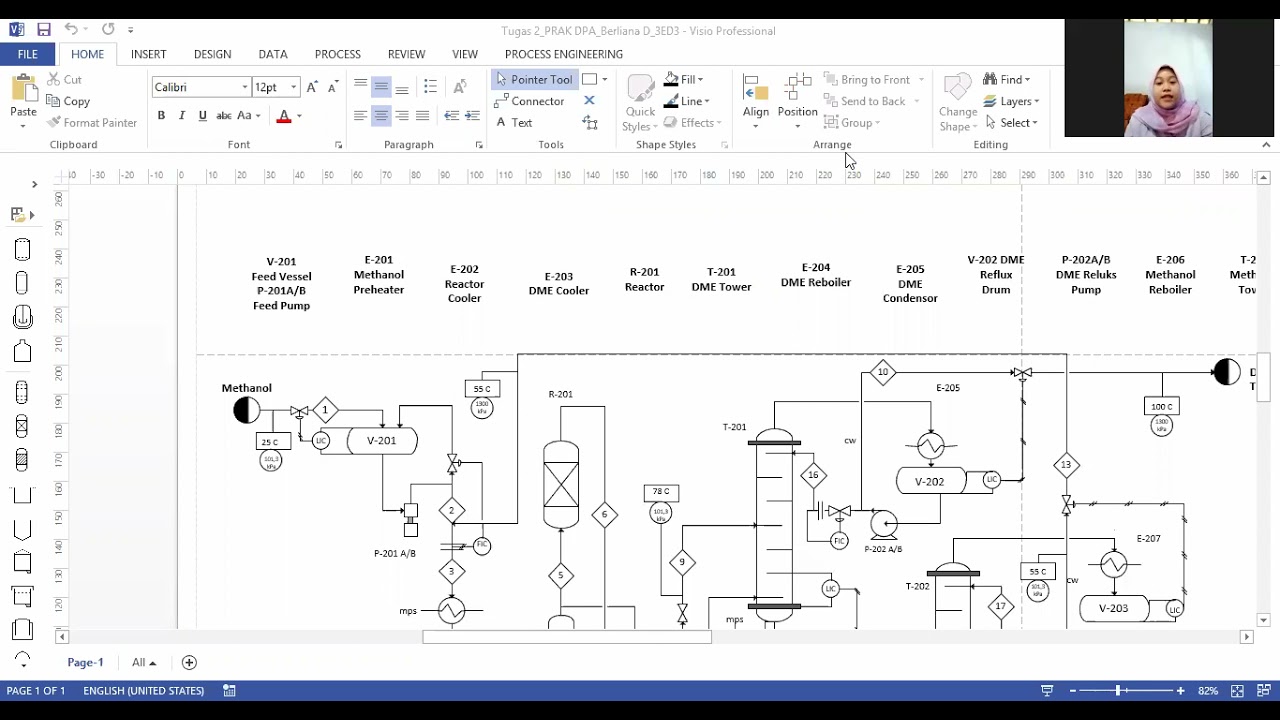
PFD Produksi DME menggunakan Dehidrasi Metanol
Berliana Dwiyanti
Overview
This video explains the production of Dimethyl Ether (DME) through the dehydration of methanol using a silica-alumina catalyst. It details the chemical reaction, the process flow diagram (PFD), and the equipment involved. The process involves preparing the methanol feedstock, reacting it in a fixed-bed reactor at high temperatures, and then purifying the DME product through distillation to separate it from unreacted methanol and water. The unreacted methanol is recycled back into the process.
How was this?
Save this permanently with flashcards, quizzes, and AI chat
Chapters
- DME is produced from methanol dehydration.
- Two methods exist: using sulfuric acid catalyst or silica-alumina catalyst.
- This process uses silica-alumina (Al2O3-SiO2) catalyst, known as the Sanders method.
- The reaction occurs in the vapor phase at 250-400°C in a fixed-bed reactor.
Understanding the basic reaction and catalyst choice is crucial for comprehending the subsequent process steps and their operational parameters.
The chemical reaction is 2 CH3OH → CH3OCH3 + H2O.
- The reaction has a theoretical conversion of 80%.
- It is a reversible reaction with no side reactions.
- Advantages include a simple process, minimal equipment, low initial investment, and high conversion.
- A significant disadvantage is the high operating temperature required.
Knowing the reaction's efficiency, reversibility, and trade-offs helps in evaluating the economic and technical feasibility of the DME production process.
The process achieves a high conversion rate of 80%.
- Liquid methanol at 25°C and 101.3 kPa is the raw material.
- It is fed into a vessel (V201) and then pumped (P201AB).
- Methanol is mixed with a recycle stream from the methanol distillation column (T202).
- The mixture is preheated to 180°C using steam in a heat exchanger (E201).
Proper preparation ensures the methanol is at the correct temperature and pressure, and mixed with recycled material, to optimize the subsequent reaction.
The methanol feed is heated to 180°C in the methanol preheater (E201) using steam.
- The preheated methanol enters the reactor (R2001) containing the solid silica-alumina catalyst.
- Methanol dehydrates to form DME and water.
- The reactor operates under non-adiabatic and non-isothermal conditions.
- The exothermic reaction's heat is used to vaporize liquids in other parts of the process (E204, E206).
This is the core stage where the desired product is synthesized, and understanding its conditions is key to controlling the reaction and managing energy.
The reaction occurs in a fixed-bed reactor (R2001) filled with silica-alumina catalyst.
- The reactor output is condensed.
- The condensed mixture is fed into a distillation column (T201) to separate DME from methanol and water.
- DME is taken as the overhead product.
- The bottom product, a mixture of methanol, water, and some DME, goes to further processing.
Separating the valuable DME product from unreacted materials and byproducts is essential for product quality and process efficiency.
DME is separated as the top product in the DME Tower (T201).
- The bottom stream from the DME tower (T201) is cooled and fed to a methanol distillation column (T202).
- In T202, methanol is separated as the overhead product and recycled back to the feedstock preparation stage.
- The bottom stream from T202, mainly water with some methanol, is sent to wastewater treatment.
- DME product is stored in a tank (100°C, 1300 kPa).
Recycling unreacted methanol improves overall process yield and reduces waste, while proper wastewater treatment is necessary for environmental compliance.
Methanol from the bottom of the DME tower is sent to the methanol distillation column (T202) for recovery and recycle.
Key takeaways
- The Sanders method for DME production involves vapor-phase dehydration of methanol over a silica-alumina catalyst at high temperatures.
- The reaction is exothermic and reversible, with a theoretical conversion of 80%.
- Process efficiency relies on effective heat exchange and separation techniques, particularly distillation.
- Recycling unreacted methanol is a critical step for maximizing yield and economic viability.
- The purification train separates DME as the primary product, recovers methanol for reuse, and directs water to wastewater treatment.
Key terms
Dimethyl Ether (DME)Methanol DehydrationSilica-Alumina CatalystSanders MethodFixed-Bed ReactorVapor Phase ReactionExothermic ReactionDistillationRecycle StreamProcess Flow Diagram (PFD)
Test your understanding
- What is the primary chemical reaction occurring during DME production via methanol dehydration?
- Why is a silica-alumina catalyst preferred in this specific DME production process?
- How does the process ensure efficient separation of DME from unreacted methanol and water?
- What is the purpose of the recycle stream in the DME production process?
- Explain the role of the different distillation columns (T201 and T202) in the overall PFD.