21:05
IELTS Writing Task 2 Advantages and Disadvantages | BAND 9 Sample Answer Step-by Step
IELTS with Juva
Overview
This video provides a step-by-step guide to writing a Band 9 essay for the IELTS Writing Task 2 "Advantages and Disadvantages" question type. It emphasizes the importance of planning, structuring the essay logically, using advanced vocabulary and grammar, and providing concrete examples. The guide walks through paraphrasing the prompt, stating a clear opinion, developing body paragraphs with supporting reasons and examples for both advantages and disadvantages, and concluding effectively. It also highlights common pitfalls to avoid, such as not stating an opinion or failing to provide examples, and stresses the necessity of proofreading for a high score.
How was this?
Save this permanently with flashcards, quizzes, and AI chat
Chapters
- Identify the question type by looking for 'advantages' and 'disadvantages' in the prompt.
- Recognize that the question requires a balanced discussion of both pros and cons, and a clear personal opinion.
- Understand that the goal is to assess English writing ability, not to trick with vocabulary.
- Note the requirement to write at least 250 words and provide reasons and examples.
Correctly identifying the essay type and its requirements is crucial for addressing the prompt fully and achieving a high score.
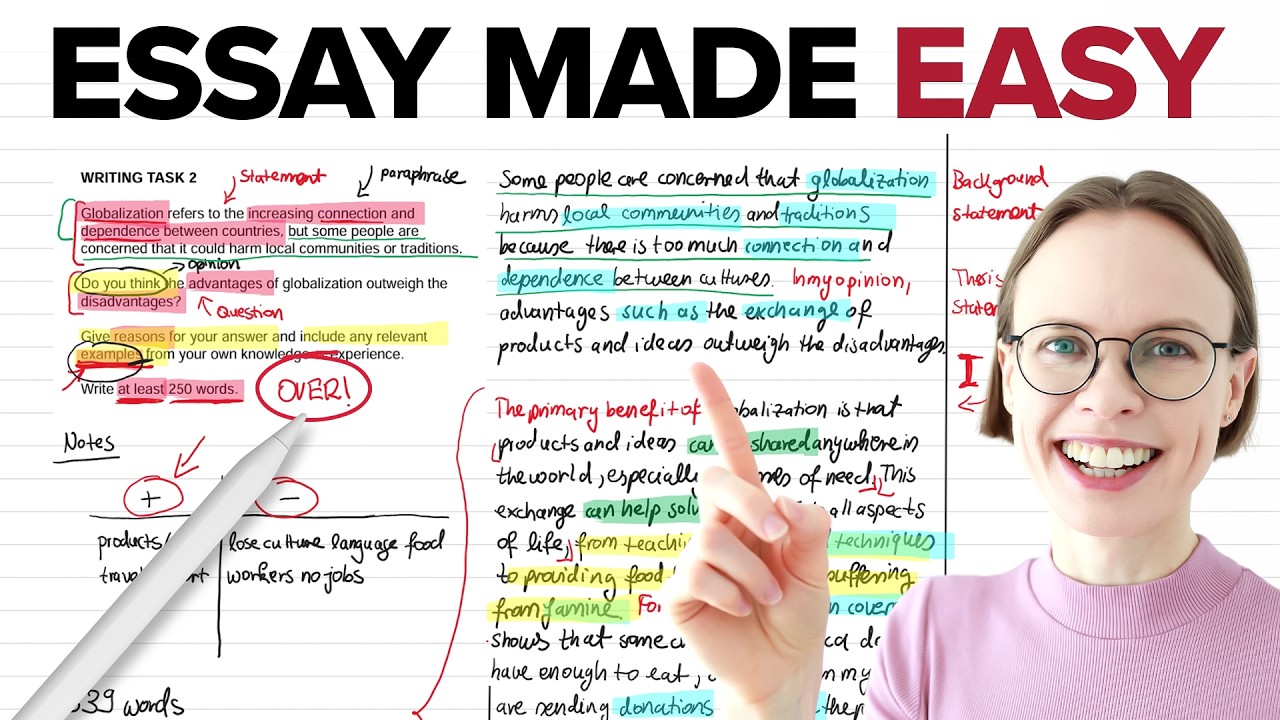
The example question: 'Do you think the advantages of globalization outweigh the disadvantages?'
- Planning is essential for a well-structured essay and to avoid scoring lower.
- Use a table with '+' for advantages and '-' for disadvantages to brainstorm points.
- Jot down keywords or short phrases, not full sentences, to remember ideas.
- Decide whether advantages or disadvantages outweigh the other to form your opinion.
Effective planning ensures a clear, organized response that directly addresses the prompt, preventing a disorganized or incomplete essay.
Creating a two-column table with keywords like 'products ideas' and 'travel comfort' for advantages, and 'culture loss' and 'workers no jobs' for disadvantages.
- The introduction must paraphrase the statement from the question.
- It must also clearly state your opinion (thesis statement).
- Paraphrase only words that can be reasonably rephrased; use key terms from the prompt when necessary.
- Using a template for sentence starters can help incorporate advanced vocabulary and structure.
A strong introduction sets the stage, demonstrates understanding of the prompt, and clearly signals your essay's direction and your stance.
Paraphrasing the statement about globalization and then stating, 'In my opinion, advantages such as the exchange of products and ideas outweigh the disadvantages.'
- Start each body paragraph with a clear topic sentence using a high-scoring sentence starter.
- Explain the advantage with general statements and then provide specific, concrete examples.
- Use advanced vocabulary and complex grammatical structures (e.g., passive voice, conditional tenses).
- Include a concluding sentence for each paragraph to summarize the main point.
Well-developed body paragraphs provide the evidence and reasoning needed to support your opinion, demonstrating your ability to elaborate on ideas.
Discussing how globalization allows product/idea sharing, using examples like sharing surgical techniques or sending donations to famine-stricken areas, and noting how English facilitates travel communication.
- Use linking words like 'however' to transition to the disadvantages section.
- Present disadvantages clearly, again supported by specific examples.
- Vary sentence structures and vocabulary to showcase linguistic range.
- Ensure disadvantages are discussed with similar depth to advantages to maintain balance.
Addressing disadvantages thoroughly shows a comprehensive understanding of the topic and strengthens the overall argument by acknowledging counterpoints.
Explaining the loss of cultural individuality with the example of kimonos being replaced by business suits in Japan, and discussing job losses due to outsourcing to countries like India and the Philippines.
- Summarize the main advantages and disadvantages discussed.
- Restate your opinion clearly, reinforcing your stance.
- Ensure paragraphs are balanced in length and content.
- Proofread carefully for errors in spelling, grammar, and punctuation.
A strong conclusion reinforces your argument and leaves a final positive impression, while proofreading catches errors that can lower your score.
Concluding with a summary like, 'In sum, while globalization can threaten traditions and jobs, it also allows for valuable idea exchange, and I feel the advantages outweigh the disadvantages.'
Key takeaways
- Effective IELTS Task 2 essays require careful planning, including brainstorming and deciding on a clear stance.
- Paraphrasing the prompt and using clear topic sentences are crucial for demonstrating understanding and guiding the reader.
- Supporting every point with specific, concrete examples is mandatory for a high score.
- Employing advanced vocabulary, varied sentence structures, and correct grammar significantly boosts your band score.
- Balancing the discussion of advantages and disadvantages, and ensuring paragraphs are of similar length, demonstrates a well-rounded argument.
- Templates can be useful tools for structuring essays and incorporating high-scoring language, but should be adapted to the specific topic.
- Thorough proofreading at the end is essential to catch and correct errors that could negatively impact your score.
Key terms
GlobalizationAdvantages and DisadvantagesParaphrasingThesis StatementTopic SentenceSignpostingAdvanced VocabularyComplex GrammarProofreadingBand Score
Test your understanding
- What are the two essential components of an introduction for an advantages/disadvantages essay?
- Why is it important to provide concrete examples for both advantages and disadvantages?
- How can using templates contribute to a higher band score in IELTS Writing Task 2?
- What is the significance of balancing the discussion between advantages and disadvantages in the body paragraphs?
- Why should a test-taker always allocate time for proofreading their essay?