9:27
Introduction to Cells: The Grand Cell Tour
Amoeba Sisters
Overview
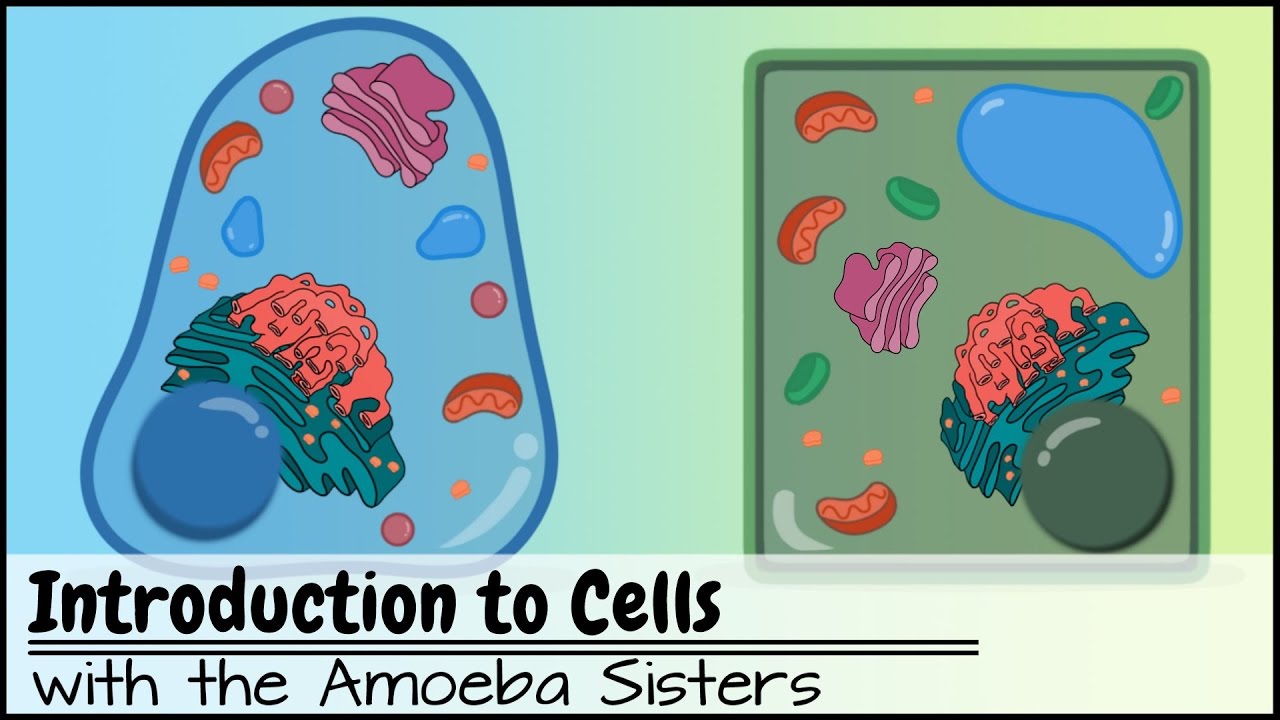
This video introduces the fundamental concept of cells as the basic units of life, exploring the modern cell theory and differentiating between prokaryotic and eukaryotic cells. It then embarks on a metaphorical 'Grand Cell Tour,' detailing the functions of key organelles within eukaryotic cells, such as the cell membrane, cytoplasm, cytoskeleton, ribosomes, nucleus, endoplasmic reticulum, Golgi apparatus, and mitochondria. The tour also highlights distinctions between plant and animal cells, including chloroplasts, vacuoles, and cell walls, and concludes by illustrating the pathway of protein secretion.
How was this?
Save this permanently with flashcards, quizzes, and AI chat
Chapters
- The cell is the smallest living unit in all organisms.
- All living things are composed of one or more cells.
- All cells arise from pre-existing cells.
- Cells contain genetic information and can perform various functions through specialized internal structures called organelles.
Understanding the cell theory provides the foundational principles for all of biology, explaining the universality of life and its organizational basis.
The speaker's personal experience seeing an amoeba in pond water, illustrating a single-celled organism and sparking a fascination with cellular life.
- Cells are broadly classified into prokaryotes (like bacteria) and eukaryotes (like plants, animals, fungi, protists).
- Both cell types share genetic material, cytoplasm, ribosomes, and a cell membrane.
- Prokaryotes lack a nucleus and membrane-bound organelles; their genetic material is in the cytoplasm.
- Eukaryotes possess a nucleus to house genetic material and have various membrane-bound organelles.
Distinguishing between prokaryotes and eukaryotes is crucial because it highlights fundamental differences in cellular complexity and organization, impacting their functions and evolutionary relationships.
Prokaryotes are compared to having 'no' nucleus (pro rhymes with no), while eukaryotes 'do' have a nucleus (eu rhymes with do).
- The cell membrane (or plasma membrane) is selectively permeable, controlling what enters and exits the cell to maintain homeostasis.
- Cytoplasm is the jelly-like substance filling the cell, surrounding organelles and providing support.
- The cytoskeleton, a network of fibers within the cytoplasm, provides structural support and aids in cell movement.
These outer and internal structures are essential for maintaining the cell's internal environment and providing the framework for all cellular activities.
The cell membrane is described as a gatekeeper that only lets certain materials pass through, like a security checkpoint.
- Ribosomes, found in both prokaryotes and eukaryotes, are responsible for synthesizing proteins based on genetic instructions.
- The Endoplasmic Reticulum (ER) processes and transports molecules; Rough ER (with ribosomes) is involved in protein synthesis and folding, while Smooth ER detoxifies and synthesizes lipids.
- The Golgi apparatus acts as a packaging and distribution center, modifying, sorting, and sending molecules to their final destinations, including secretion outside the cell.
This coordinated system is vital for creating and delivering the proteins that perform most of the cell's functions.
The ER is likened to a cellular highway for processing and transporting molecules, and the Golgi apparatus is the 'ultimate packaging center' that sorts and ships these molecules.
- Mitochondria are the powerhouses of eukaryotic cells, generating ATP energy through cellular respiration.
- Plant cells contain chloroplasts, which convert light energy into glucose via photosynthesis.
- Vacuoles serve as storage compartments; plant cells often have a large central vacuole, while animal cells have smaller ones.
- Plant cells possess a rigid cell wall outside the cell membrane for structural support and protection, which animal cells lack.
These organelles are responsible for energy production and provide key differences that allow plant and animal cells to fulfill distinct roles in organisms.
Mitochondria are compared to a 'power plant' that generates energy for the cell, and chloroplasts are where 'photosynthesis' happens to make food.
- Protein synthesis begins in the nucleus with DNA instructions.
- Ribosomes, often attached to the Rough ER, create the protein.
- The Rough ER processes and transports the protein via vesicles to the Golgi apparatus.
- The Golgi apparatus further modifies and sorts the protein, packaging it into a vesicle for secretion out of the cell.
Tracing the path of a protein illustrates the interconnectedness and sequential nature of organelle functions in cellular processes like communication and export.
A protein's journey is described: made by ribosomes on the Rough ER, sent via vesicle to the Golgi for packaging, and then secreted out of the cell through another vesicle.
Key takeaways
- The cell theory provides a universal framework for understanding all life.
- The presence or absence of a nucleus and membrane-bound organelles is the primary distinction between prokaryotic and eukaryotic cells.
- Eukaryotic cells are complex factories with specialized organelles performing specific tasks.
- The cell membrane is crucial for maintaining a stable internal environment (homeostasis).
- Ribosomes are essential for protein synthesis in all cell types.
- Mitochondria are vital for energy production in eukaryotes.
- Plant cells have unique structures like chloroplasts and cell walls that enable photosynthesis and provide structural integrity.
Key terms
Cell theoryProkaryoteEukaryoteOrganelleCell membraneCytoplasmRibosomeNucleusEndoplasmic reticulum (ER)Golgi apparatusMitochondriaChloroplastVacuoleCell wallHomeostasisATPCellular respirationPhotosynthesis
Test your understanding
- What are the three main tenets of the modern cell theory?
- How do prokaryotic cells differ fundamentally from eukaryotic cells in terms of their internal structure?
- What is the primary role of the cell membrane, and why is its selective permeability important?
- Describe the coordinated functions of the ribosomes, endoplasmic reticulum, and Golgi apparatus in protein production and export.
- What are the key differences between plant and animal cells, and how do these differences relate to their functions?