58:42
Acids and Bases - Basic Introduction - Chemistry
The Organic Chemistry Tutor
Overview
This video provides a foundational understanding of acids and bases, covering their identification, definitions, and properties. It explains the Arrhenius, Brønsted-Lowry, and Lewis definitions, and how to identify conjugate acid-base pairs. The video also delves into the pH scale, strong vs. weak acids and bases, and their respective behaviors in solution. Finally, it explores acid-base reactions, equilibrium constants (Ka, Kb, Kw), and practical calculations involving pH, pOH, and concentrations, concluding with a review of key concepts and practice problems.
How was this?
Save this permanently with flashcards, quizzes, and AI chat
Chapters
- Acids often have a hydrogen atom at the beginning of their chemical formula (e.g., HCl, HF).
- Bases typically contain a hydroxide ion (e.g., NaOH, KOH).
- A hydrogen bonded to a nonmetal usually indicates an acid, while a hydrogen bonded to a metal can indicate a base (e.g., NaH).
- Acids tend to release H+ ions (protons), while bases often involve OH- ions or accept protons.
Being able to quickly identify whether a chemical formula represents an acid or a base is crucial for predicting its behavior in chemical reactions and understanding its properties.
Hydrochloric acid (HCl) is an acid because it starts with H, while sodium hydroxide (NaOH) is a base because it contains the hydroxide group.
- Arrhenius definition: Acids produce H+ ions in solution, and bases produce OH- ions.
- Brønsted-Lowry definition: Acids are proton (H+) donors, and bases are proton acceptors.
- In a Brønsted-Lowry reaction, the acid forms a conjugate base, and the base forms a conjugate acid.
- Lewis definition: Acids are electron pair acceptors, and bases are electron pair donors.
Different definitions provide varying levels of detail and applicability, allowing chemists to describe acid-base behavior in different contexts, from simple aqueous solutions to more complex reactions.
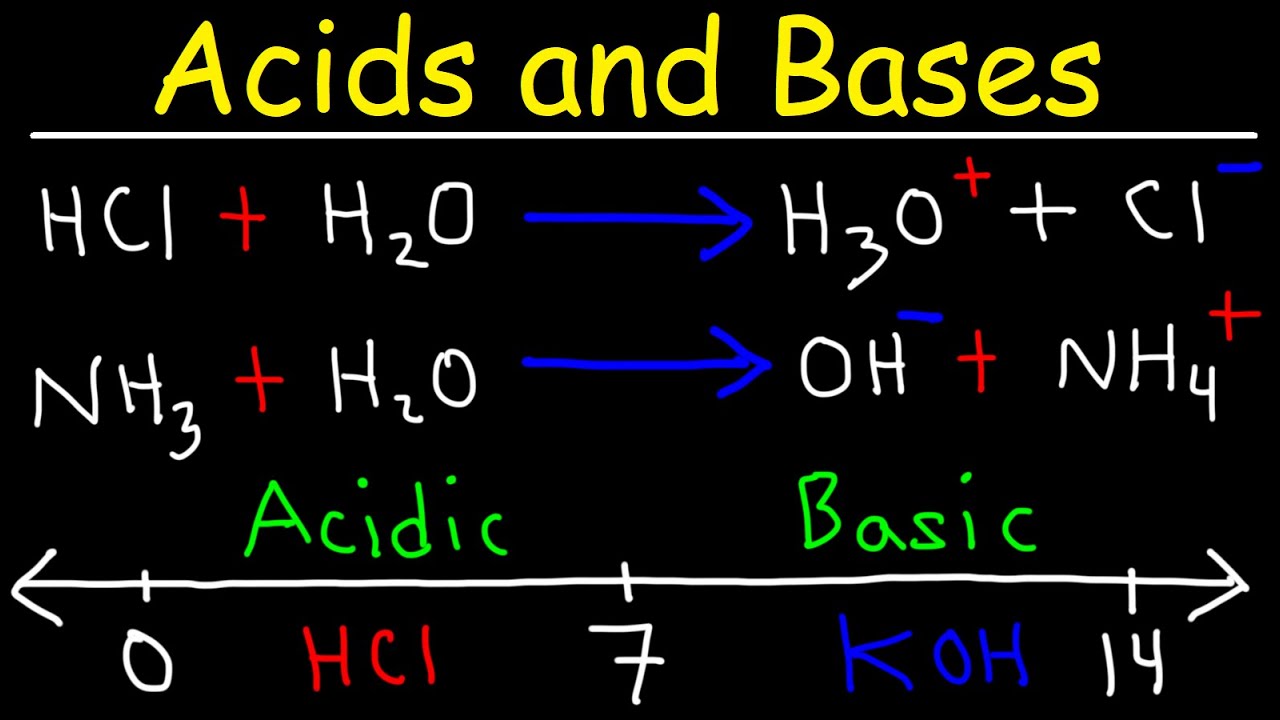
When HCl reacts with water, HCl donates a proton to water, making HCl the Brønsted-Lowry acid and water the Brønsted-Lowry base. HCl becomes the conjugate base (Cl-), and water becomes the conjugate acid (H3O+).
- The pH scale measures the acidity or basicity of a solution, typically ranging from 0 to 14.
- A pH less than 7 is acidic, pH equal to 7 is neutral, and pH greater than 7 is basic.
- pH is calculated as the negative logarithm of the hydronium ion (H3O+) concentration: pH = -log[H3O+].
- pOH is calculated as the negative logarithm of the hydroxide ion (OH-) concentration: pOH = -log[OH-].
- The relationship pH + pOH = 14 (at 25°C) allows conversion between pH and pOH.
Understanding the pH scale and how to calculate it is fundamental for quantifying the strength of acids and bases and predicting the conditions of chemical environments.
If a solution has a hydronium ion concentration of 1 x 10^-3 M, its pH is -log(1 x 10^-3) = 3, indicating an acidic solution.
- Strong acids and bases ionize completely in water, forming strong electrolytes.
- Weak acids and bases only partially ionize, forming weak electrolytes.
- Common strong acids include HCl, HBr, HI, HNO3, H2SO4, and HClO4.
- Strong bases are typically soluble metal hydroxides like NaOH and KOH.
- The strength of oxyacids increases with the number of oxygen atoms.
The degree of ionization determines how effectively a substance affects the pH of a solution and its ability to conduct electricity, impacting its reactivity and applications.
Hydrochloric acid (HCl) is a strong acid that completely dissociates into H+ and Cl- ions, while acetic acid (CH3COOH) is a weak acid that only partially dissociates.
- Reactions involving strong acids/bases use a single arrow (→) to show complete dissociation.
- Reactions involving weak acids/bases use a double arrow (⇌) to indicate a reversible equilibrium.
- The acid dissociation constant (Ka) quantifies the strength of a weak acid; a higher Ka means a stronger acid.
- The base dissociation constant (Kb) quantifies the strength of a weak base; a higher Kb means a stronger base.
- Water can act as both an acid and a base (amphoteric), undergoing autoionization (Kw = [H3O+][OH-]).
Understanding equilibrium allows us to predict the extent of acid-base reactions and calculate the concentrations of all species present, which is essential for controlling chemical processes.
The reaction of acetic acid with water (CH3COOH + H2O ⇌ H3O+ + CH3COO-) uses a double arrow because acetic acid is a weak acid and the reaction is reversible.
- Acids typically taste sour and turn blue litmus paper red.
- Bases typically taste bitter and feel slippery, turning red litmus paper blue.
- Strong acids have high Ka values and low pKa values; strong bases have high Kb values and low pKb values.
- There is an inverse relationship between acid strength and the strength of its conjugate base.
- Ka * Kb = Kw and pKa + pKb = 14 (at 25°C) relate acid and base strengths.
These relationships provide a framework for comparing the strengths of different acids and bases and predicting the properties of their conjugate pairs, aiding in chemical analysis and synthesis.
Hydrofluoric acid (HF) has a higher Ka than acetic acid (CH3COOH), making HF the stronger acid and its conjugate base, fluoride (F-), the weaker base compared to acetate (CH3COO-).
Key takeaways
- Acids and bases can be identified by their chemical formulas and defined by their behavior in donating/accepting protons or releasing ions.
- The pH scale quantifies acidity and basicity, with calculations based on ion concentrations.
- Strong acids and bases dissociate completely, while weak ones only partially dissociate, affecting solution conductivity and reactivity.
- Acid-base reactions often reach an equilibrium state, described by dissociation constants (Ka and Kb).
- Water is amphoteric and undergoes autoionization, with its equilibrium constant (Kw) linking H3O+ and OH- concentrations.
- There are inverse relationships between acid strength and conjugate base strength, and between Ka and pKa.
- Understanding these concepts is crucial for predicting and controlling chemical reactions in various fields.
Key terms
AcidBaseArrhenius DefinitionBrønsted-Lowry DefinitionLewis DefinitionProton DonorProton AcceptorConjugate AcidConjugate BasepHpOHHydronium IonHydroxide IonStrong AcidWeak AcidStrong BaseWeak BaseAmphotericKaKbKwpKapKbElectrolyte
Test your understanding
- How does the Brønsted-Lowry definition of an acid differ from the Arrhenius definition?
- What is the relationship between the pH of a solution and the concentration of hydronium ions?
- Why do strong acids form strong electrolytes, while weak acids form weak electrolytes?
- How can you determine if a substance is amphoteric based on its chemical structure or behavior?
- What is the relationship between the Ka of an acid and the Kb of its conjugate base?