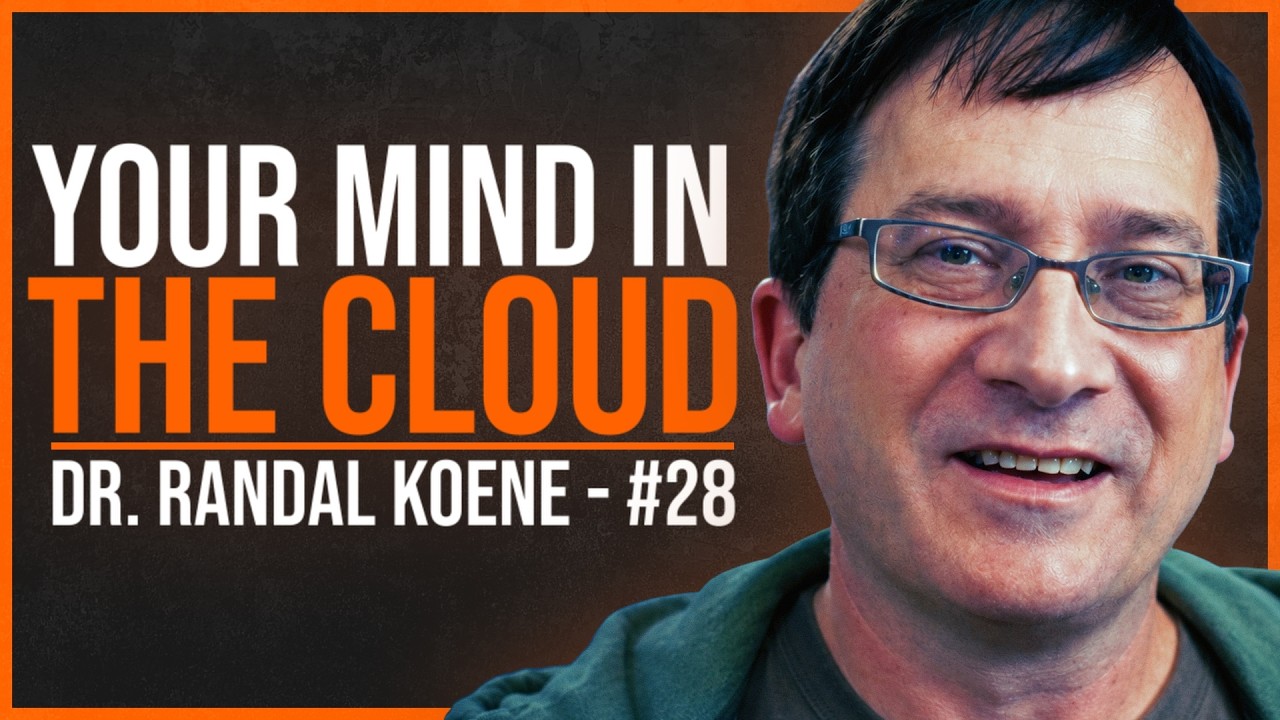
Can We Upload The Human Brain? - Dr. Randal Koene
Julius Moorman
Overview
This video explores the concept of whole brain emulation (WBE), a theoretical process of creating a digital replica of a human brain. Dr. Randal Koene discusses the scientific and philosophical underpinnings of WBE, drawing parallels to software and computational systems. He explains the current state of technology, the challenges in data collection and understanding neural complexity, and the potential future applications ranging from medical treatments to artificial intelligence. The discussion also touches upon the definition of consciousness, the role of AI in neuroscience, and the significant ethical considerations that arise with the possibility of creating conscious digital minds.
Save this permanently with flashcards, quizzes, and AI chat
Chapters
- Interest in whole brain emulation (WBE) began around age 13, stemming from the idea that identity is not tied to biological substrate.
- The concept solidified around 1996, leading to a PhD in computational neuroscience to explore modeling the brain.
- Early inspiration came from a particle physicist father, emphasizing substrate independence and abstraction levels in science.
- Science fiction, particularly Arthur C. Clarke's 'The City and the Stars,' also influenced the idea of digital consciousness.
- The brain is a neuronal network, distinct from traditional computers, where memory and processing are localized and distributed.
- Evidence for functional abstraction comes from lesion studies, showing specific cognitive deficits when brain parts are damaged.
- The brain's operation relies on electrical activity and molecular processes, with a functional divide between them.
- Evolutionary pressures favor predictable systems, suggesting the brain, like computers, has constraints and abstractions to ensure reliable communication between neural regions.
- The mind is defined as all the functions and capabilities of the brain, encompassing both conscious and subconscious processing.
- Consciousness is considered a part of the mind, generated by the brain, similar to emotions or cognitive processes, not a separate entity.
- The mind requires a vast amount of subconscious processing to create representations that are consciously available.
- The 'self' is a virtual representation, a process of generating a virtual reality of the world and oneself within it.
- Whole brain emulation aims to recreate the experience of a specific brain on a different platform, like software on hardware.
- The goal of an emulator can vary; for mind uploading, it must recreate internal experience, memories, drives, and consciousness.
- A successful emulation for mind uploading inherently requires consciousness to be present.
- Potential uses include testing drugs, creating neuroprosthetics, advancing neuroscience research, and developing AI.
- Data collection from living brains is improving but cannot yet record from every neuron simultaneously.
- Significant breakthroughs are in structural data collection using electron microscopy, allowing detailed mapping of neurons and synapses.
- The fruit fly brain is one of the few fully scanned, but understanding structure-function correlation is still a major hurdle.
- Evaluating the accuracy of an emulation is an unsolved problem due to the lack of a validated, working whole-brain emulation as ground truth.
- The primary bottleneck is scaling up data collection and processing from small brains (like fruit flies) to larger ones (like mice or humans).
- A major scientific challenge is the incomplete understanding of all cell dynamics, neurotransmitters, and inter-cell interactions.
- Translating structural data into functional models with accurate parameters and architecture remains a complex computational and scientific problem.
- While theoretical obstacles are not insurmountable, the scale of funding and collaborative effort required is immense.
- AI is an indispensable tool for neuroscientists, aiding in data analysis, literature review, and direct computational modeling.
- Machine learning and AI methods allow for new ways to describe brain functions without relying solely on traditional symbolic equations.
- The computational power required to *run* a final, validated brain emulation is projected to be relatively low (e.g., 20 watts, head-sized hardware).
- The significantly larger computational challenge lies in the *process of building* the emulation: iterating through models, estimating parameters, and validation.
- Consciousness requires conceptual representations, a model of the world and self, attention, and relationships between concepts.
- The 'phenomenological now' is a generated experience, not a direct perception of reality, and is always slightly delayed.
- A conscious entity, even an exact digital copy, raises profound ethical questions about rights and treatment.
- Current laws have not caught up with the ethical considerations of potential conscious digital entities or virtual animals.
Key takeaways
- Whole brain emulation is a scientific pursuit aiming to digitally replicate the functions and experiences of a biological brain, inspired by concepts of substrate independence.
- Despite significant progress in mapping brain structure, understanding the precise correlation between structure and function remains a major scientific challenge for WBE.
- The mind is viewed as the totality of brain functions, with consciousness being a generated process within that framework, not a separate entity.
- While the computational power to run a final brain emulation might be modest, the process of building and validating such an emulation requires immense computational resources and scientific effort.
- The creation of conscious digital entities raises complex ethical questions regarding rights, treatment, and the need for new legal and moral frameworks.
- Current technology is far from achieving human whole brain emulation, with significant hurdles in data acquisition, computational modeling, and validation.
- AI serves as a critical tool in analyzing neuroscience data and developing computational models, accelerating research in the field.
Key terms
Test your understanding
- What is the core principle of substrate independence as it relates to whole brain emulation?
- How does Dr. Koene define the mind, and how does consciousness fit into that definition?
- What are the main scientific and engineering bottlenecks preventing current whole brain emulation of complex brains?
- Why is evaluating the success of a brain emulation considered an unsolved problem?
- What ethical considerations arise from the potential creation of conscious digital entities, and how do current laws address them?