8:46
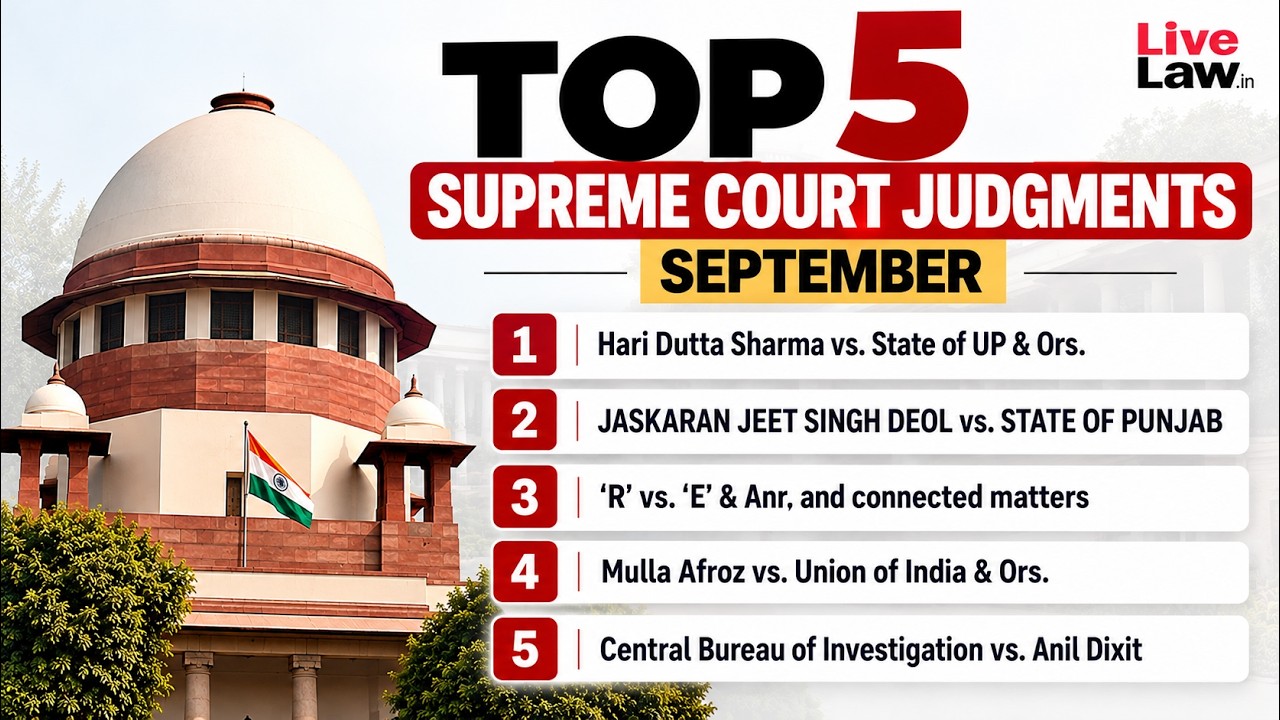
5 Supreme Court Judgments From September You Shouldn’t Miss
Live Law
Overview
This video summarizes five significant Supreme Court judgments from September, focusing on their implications for legal practitioners and the public. The cases cover a range of issues including vehicle repossession, rights of arrested individuals, allegations in matrimonial disputes, preventive detention, and access to documents during criminal trials. Each judgment highlights important legal safeguards and limitations on the exercise of power by financial institutions, law enforcement, and the state, emphasizing the need for adherence to constitutional and statutory provisions.
How was this?
Save this permanently with flashcards, quizzes, and AI chat
Chapters
- Finance companies cannot forcibly repossess vehicles without prior notice, even in cases of loan default.
- The Supreme Court ruled that such actions violate constitutional rights (Articles 14 and 21).
- RBI guidelines on fair practices must be actively enforced, not just exist on paper.
- The court ordered a refund, interest, and compensation for the truck owner whose vehicle was taken forcefully.
This judgment clarifies the legal boundaries for financial institutions when recovering assets, ensuring that borrowers are not subjected to arbitrary or forceful actions, and that regulatory guidelines are upheld.
A finance company forcibly took a truck owner's vehicle at night without notice, leading to a Supreme Court ruling against the company.
- Arrested individuals have a constitutional right (Article 22(1)) to be informed of the grounds of arrest in writing.
- Failure to provide written grounds renders the arrest and any subsequent remand illegal.
- Rearresting an individual requires providing written grounds and obtaining magistrate approval, justifying the necessity.
- The court can order departmental action against officers who violate these safeguards.
This ruling reinforces fundamental rights during arrest, ensuring transparency and preventing arbitrary detention by mandating clear communication of charges and judicial oversight for subsequent actions.
Police failed to provide written grounds for arrest, making the arrest and subsequent remand illegal, and requiring a specific procedure for any re-arrest.
- The Supreme Court addressed concerns about the misuse of Poxo allegations in matrimonial custody battles.
- Registration of an FIR under Poxo should not automatically lead to arrest in such disputes.
- Investigating officers must obtain an independent assessment from a child psychiatrist or psychologist before deciding on arrest.
- The court can quash an FIR if allegations are found unreliable after expert assessment and investigation.
This judgment balances the protection of children in genuine abuse cases with preventing the weaponization of Poxo allegations in divorce proceedings, ensuring a thorough and unbiased investigation before drastic measures like arrest.
In a custody dispute, an FIR alleging sexual assault was filed; the court, after expert assessment found the allegations unreliable, quashed the FIR and ordered the child's reintegration with the father.
- Preventive detention requires more than just the confessional statement of a co-accused made in police custody.
- Detaining authorities must consider surrounding circumstances and other relevant materials.
- The Supreme Court set aside a detention order based solely on a co-accused's confession.
- Preventive detention powers are subject to constitutional and statutory safeguards.
This judgment limits the state's broad powers of preventive detention, ensuring that such actions are based on substantial evidence beyond mere confessions, thereby protecting individual liberties.
An individual was detained under the National Security Act based only on a co-accused's confession, which the Supreme Court found insufficient grounds for detention.
- Accused persons are entitled to access documents necessary for preparing their defense.
- This right does not grant automatic access to copies of all documents not relied upon by the prosecution at the charge-framing stage.
- The court clarified that the accused can inspect and identify specific documents needed from the prosecution's material.
- The judgment distinguished the right to inspect from an unrestricted right to copies of entire unused investigation files.
This ruling clarifies the scope of an accused's right to discovery in criminal proceedings, ensuring a fair trial by allowing access to necessary defense materials while preventing fishing expeditions through all investigative documents.
An accused sought all documents collected during an investigation; the court allowed inspection of unrelied-upon material for the accused to identify specific documents needed for their defense, rather than providing blanket copies.
Key takeaways
- Financial institutions must adhere to fair practices and provide notice before repossessing assets.
- The right to know the grounds of arrest in writing is a fundamental safeguard against illegal detention.
- Allegations in matrimonial disputes, especially those involving Poxo, require careful, expert-driven investigation before arrest.
- Preventive detention must be based on comprehensive evidence, not solely on co-accused confessions.
- An accused's right to access documents is crucial for defense preparation but is not unlimited.
- Supreme Court judgments serve as vital checks on the exercise of power by various entities.
- Adherence to constitutional and statutory safeguards is paramount in all legal proceedings.
Key terms
Vehicle RepossessionLoan DefaultArticle 14Article 21RBI GuidelinesGrounds of ArrestArticle 22(1)Illegal ArrestPoxo AllegationsMatrimonial DisputeCustody DisputeFIRPreventive DetentionNational Security ActCo-accused ConfessionSection 91 CRPCCharge Framing StageUnrelied Upon Material
Test your understanding
- What are the constitutional rights violated when a finance company forcibly repossesses a vehicle without notice?
- Why is it crucial for the police to provide written grounds of arrest to an individual?
- How should allegations of sexual abuse made within a matrimonial custody dispute be investigated according to the Supreme Court?
- What type of evidence is insufficient on its own to justify preventive detention?
- What distinction did the Supreme Court draw regarding an accused's access to documents during a criminal trial?