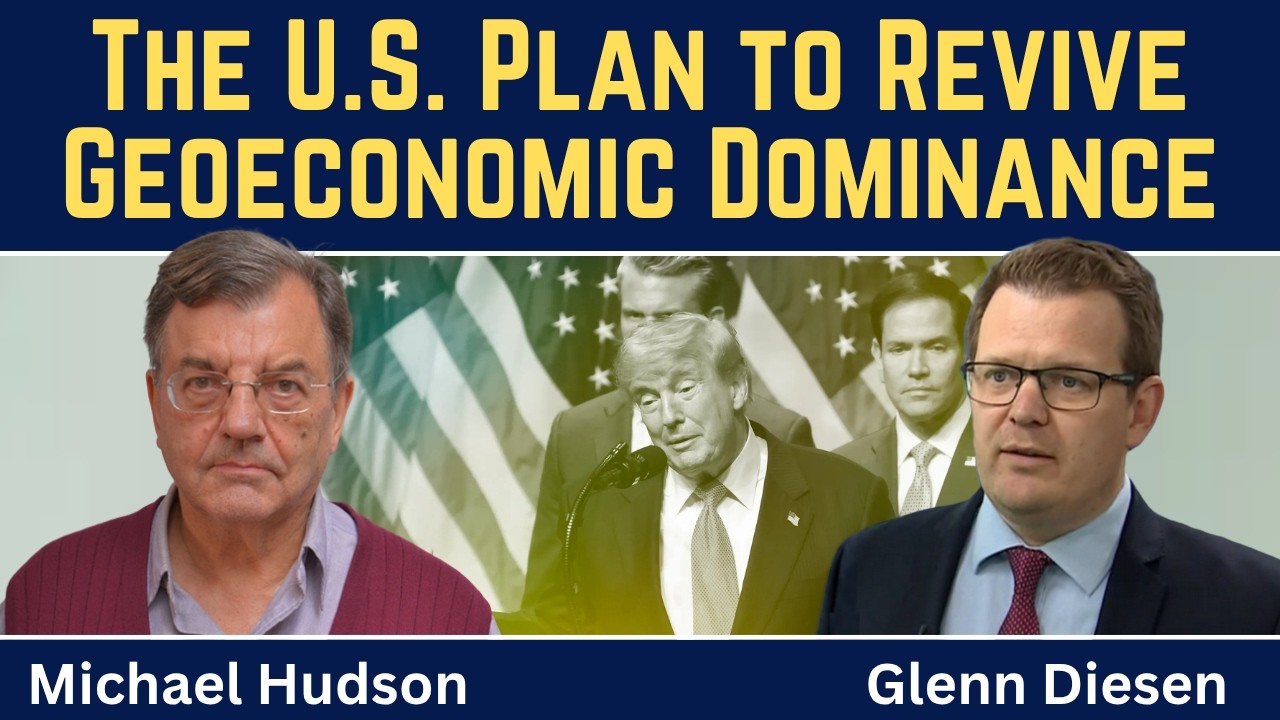
Michael Hudson: The U.S. Plan to Revive Geoeconomic Dominance
Glenn Diesen
Overview
This video discusses the United States' strategic shift from a globalization model centered around its financial markets and dollar to a geoeconomic strategy focused on establishing monopolies in key sectors like oil and information technology. The speaker, Michael Hudson, argues that this new strategy involves economic warfare and direct military action to weaken rivals, control global trade routes, and ensure that profits from these sectors are recycled back into the US economy. The discussion highlights the US plan to leverage its control over oil prices, technological infrastructure, and financial systems to maintain global dominance, even at the expense of its allies' economic interests. The video also touches on the potential for escalating conflicts, particularly with Russia and Iran, and the broader implications for the global economy, including potential food crises and political upheaval.
Save this permanently with flashcards, quizzes, and AI chat
Chapters
- The long-standing model of globalization, centered around US financial markets and the dollar, has become unsustainable due to massive debt.
- Economic warfare and direct military actions are now being used to dismantle this US-centric global order.
- These conflicts, such as those involving Iran, Venezuela, and Russia, are strategically aimed at strengthening the US dollar and US economic control.
- A long-term US plan aims to reverse the balance of payments drain caused by foreign military spending, which previously led to the US leaving the gold standard.
- The strategy involves stopping excessive military spending abroad and shifting towards establishing monopolies in key economic sectors.
- The US seeks to control the oil trade and information technology sectors to ensure its economic dominance.
- The US aims to control the global oil trade, preventing allies from dealing with alternative producers and benefiting from price increases.
- Simultaneously, the US seeks a monopoly in information technology, including AI and computerization, by controlling data centers and related infrastructure.
- This strategy involves leveraging conflicts, like those in Ukraine and the Middle East, to disrupt oil supplies and redirect energy resources and investments towards US-controlled sectors.
- The historical petrodollar agreement, where OPEC reinvested oil earnings in US markets, is being reconfigured.
- The US is exploring new ways to extract revenue, such as imposing tolls on international waterways like the Strait of Hormuz, though this faces legal challenges.
- There's a push for Arab OPEC countries to invest in US industries, particularly in information technology, in exchange for US protection and partnership.
- The US is offshoring its artificial intelligence and computerization efforts to countries like the Arab OPEC nations due to domestic limitations in electricity and water.
- This offshoring is framed as a partnership, where these nations provide energy for US investments in IT infrastructure.
- This strategy is challenged by geopolitical actors like Iran, which targets US IT investments in the region.
- Iran's strategy involves driving US military bases out of West Asia and severing the economic and financial ties between the US and regional monarchies.
- This economic symbiosis includes oil-exporting countries investing their surpluses in US stocks, bonds, and AI industries.
- Iran aims to prevent this linkage to free the region from US influence.
- The US prioritizes controlling international transportation corridors, including maritime routes, to enforce its economic strategy.
- This involves actions like disrupting pipelines (e.g., Nord Stream) and interfering with shipping routes (e.g., Baltic Sea, Indian Ocean).
- The US aims to subordinate allies like Europe and Japan, ensuring their dependence on US energy and transportation, even if it harms their economies.
- The US strategy relies on creating and exploiting 'choke points' in energy, technology, finance, and transportation to maintain global control.
- This involves imposing sanctions and ensuring rivals lack viable alternatives for independent economic activity.
- The success of this strategy depends on the US's ability to enforce a 'win-lose' trade dynamic and the continued subservience of its allies and regional powers.
- The sustainability of US dominance is questioned, given the potential for rivals to develop alternatives and allies to act in their own economic self-interest.
Key takeaways
- The US is actively pursuing a geoeconomic strategy to re-establish dominance by creating monopolies in critical sectors like oil and information technology.
- Economic warfare, including sanctions and disruption of trade routes, is a primary tool in this new US strategy.
- Control over global transportation and energy flows is essential for the US to enforce its economic agenda and ensure rivals and allies remain dependent.
- The US strategy aims to recycle profits from global trade and technology back into its own economy, often at the expense of its partners.
- Geopolitical conflicts, particularly with Russia and Iran, are central to the US plan to reshape the global economic order.
- The long-term success of the US strategy is uncertain, as rivals develop alternatives and allies may eventually prioritize their own economic interests.
- The current global situation risks significant economic disruption, including potential food and energy crises, due to escalating conflicts.
Key terms
Test your understanding
- What is the primary shift in US global economic strategy discussed in the video, and why has it occurred?
- How does the US aim to leverage control over oil and information technology to maintain its dominance?
- What role do geopolitical conflicts, such as those involving Iran and Russia, play in the US's geoeconomic plan?
- What are the key 'choke points' the US seeks to control, and how do they contribute to its strategy?
- What are the potential consequences for allies and rivals if the US successfully implements its new geoeconomic strategy?