31:24
1. Roadmap for backend from first principles
Sriniously
Overview
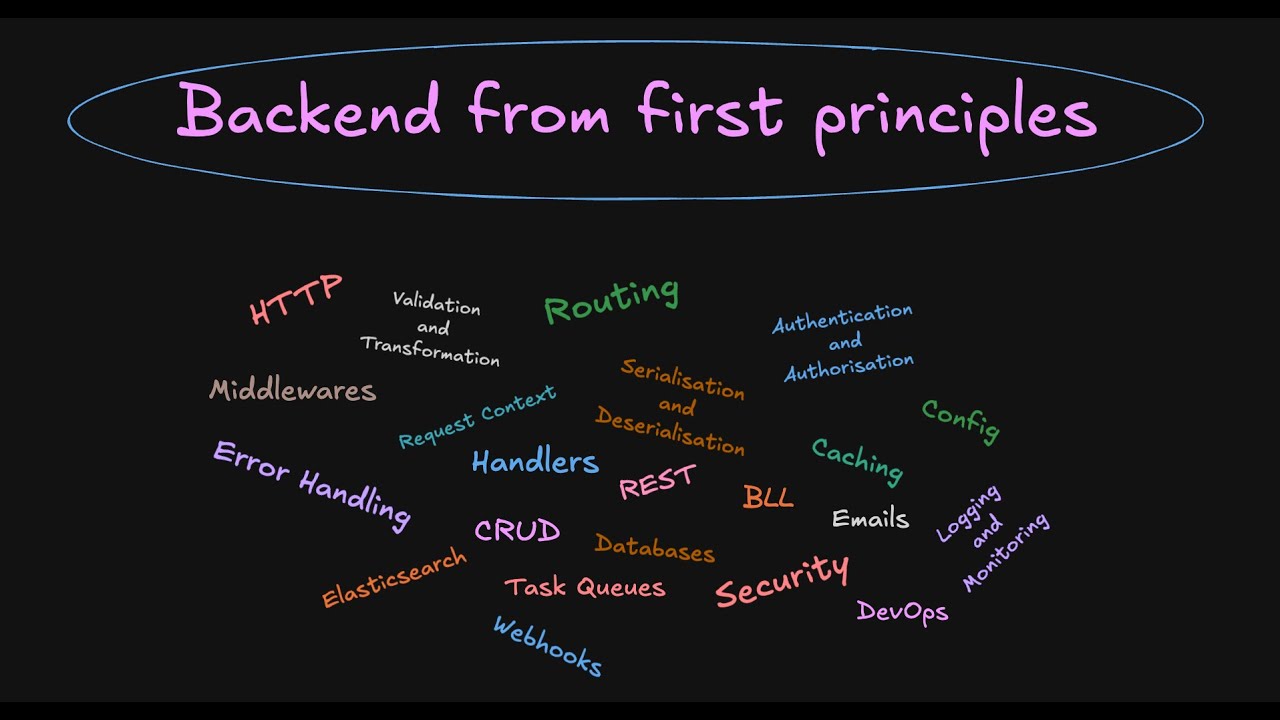
This video provides a comprehensive, first-principles roadmap for backend engineering, moving beyond simple API building to focus on creating reliable, scalable, and maintainable systems. It outlines a structured learning path, starting with fundamental concepts like HTTP protocols and request flows, and progressing through crucial areas such as routing, serialization, authentication, validation, middleware, databases, caching, and DevOps. The goal is to equip learners with a deep understanding of how backend systems function, enabling them to build robust and efficient applications regardless of specific languages or frameworks.
How was this?
Save this permanently with flashcards, quizzes, and AI chat
Chapters
- Backend engineering involves building reliable, scalable, fault-tolerant, and maintainable codebases and efficient systems.
- Learning backend development requires understanding foundational concepts rather than just specific languages or frameworks to ensure knowledge transferability.
- The journey begins with a high-level view of how requests flow from a browser through networks to a backend server and back.
- Understanding client-server communication and the role of protocols like HTTP is essential.
This foundational understanding provides the essential context for all subsequent backend concepts, enabling learners to grasp the 'why' behind various architectural decisions and technologies.
Visualizing a request traveling from a user's browser, through the internet, firewalls, and load balancers, to a remote AWS server and receiving a response.
- HTTP is the protocol that establishes communication between clients and servers, defining how messages are structured and exchanged.
- Key components include HTTP methods (GET, POST, PUT, DELETE), headers (request, response, general, security), and status codes (e.g., 200 OK, 404 Not Found).
- Understanding concepts like CORS, HTTP caching (ETags, Max-Age), persistent connections, and compression (gzip, deflate) is crucial for efficient communication.
- Security aspects like SSL/TLS and HTTPS are vital for protecting data in transit.
Mastering HTTP is fundamental as it's the language web clients and servers use to talk to each other, impacting performance, security, and functionality.
Explaining how different HTTP methods (like GET for retrieving data and POST for submitting data) have specific meanings and are used for different actions.
- Routing maps incoming URLs to specific server-side logic, utilizing components like path parameters and query parameters.
- Serialization and deserialization convert data between the server's native format and network-transferable formats (like JSON or Protocol Buffers).
- JSON is a widely used text-based format, while binary formats like Protocol Buffers offer performance advantages.
- Proper error handling, validation (syntactic, semantic, type), and transformation are critical for robust data processing.
These concepts ensure that data is correctly received, interpreted, and processed by the backend, forming the bridge between external requests and internal application logic.
Converting a string representation of an ID received in a URL parameter into an integer before using it to query a database.
- Authentication verifies the identity of a user or system, while authorization determines what actions they are permitted to perform.
- Techniques include session-based, token-based (JWT), OAuth, and API keys, alongside cryptographic methods like salting and hashing.
- Best practices involve securing against common attacks (CSRF, XSS, MITM), implementing least privilege, and using audit logging.
- Validation and sanitization are crucial security layers to prevent injection attacks and ensure data integrity.
Securing backend systems is paramount to protect sensitive data, maintain user trust, and prevent malicious activities.
Using JWT (JSON Web Tokens) to securely transmit user identity information between the client and server after initial login.
- Middleware functions execute in a sequence during the request lifecycle, handling tasks like logging, authentication, and request modification.
- Request context provides a temporary, request-scoped state to share data across different layers (e.g., user info, trace IDs).
- Handlers and controllers are responsible for executing the core logic of a request, often mapping CRUD operations to HTTP methods.
- Best practices include centralized error handling, consistent response formatting, and efficient route matching.
These components structure the request processing pipeline, enabling modularity, reusability, and efficient handling of cross-cutting concerns.
An authentication middleware checking if a user is logged in before allowing the request to proceed to the handler that fetches user-specific data.
- Understanding relational (SQL) and non-relational (NoSQL) databases, ACID vs. CAP theorem, and database design principles is essential.
- Caching (memory, browser, database) significantly improves performance by reducing data retrieval times.
- The business logic layer contains the core functionality of the application, distinct from presentation and data access layers.
- Design principles like Separation of Concerns and Single Responsibility guide the organization of business logic.
Efficient data management and well-structured business logic are the backbone of any scalable and performant backend application.
Using Redis as a cache to store frequently accessed query results, reducing the load on the primary database.
- Task queuing and scheduling handle background jobs, email sending, and offload heavy computations.
- Elasticsearch provides powerful search capabilities, log analytics, and full-text search.
- Logging, monitoring, and observability are crucial for understanding system health and debugging issues.
- DevOps concepts like CI/CD, Docker, Kubernetes, and infrastructure as code are vital for efficient deployment and scaling.
These advanced topics and practices enable building resilient, observable, and easily deployable backend systems capable of handling complex requirements and high loads.
Using a task queue to process image uploads in the background, allowing the user to continue interacting with the application without waiting.
Key takeaways
- Backend engineering is about building robust, scalable systems, not just APIs.
- A strong foundation in HTTP and network protocols is crucial for understanding system communication.
- Serialization and deserialization are key to handling data exchange between systems.
- Security must be a primary consideration throughout the development lifecycle, from authentication to input validation.
- Middleware and request context provide powerful patterns for structuring request processing and managing state.
- Effective caching strategies are essential for optimizing performance and reducing database load.
- Understanding databases, including relational and non-relational models, is fundamental for data persistence.
- DevOps practices and tools are critical for efficient deployment, scaling, and maintenance of backend services.
Key terms
HTTPRoutingSerializationDeserializationAuthenticationAuthorizationMiddlewareRequest ContextRelational DatabaseNoSQL DatabaseCachingTask QueueElasticsearchLoggingMonitoringObservabilityDevOpsCI/CDDockerKubernetes
Test your understanding
- What is the primary difference between authentication and authorization in backend systems?
- How does middleware contribute to the request processing pipeline in a backend application?
- Why is understanding HTTP methods, headers, and status codes essential for backend developers?
- Explain the purpose of serialization and deserialization in the context of backend communication.
- What are the key benefits of implementing caching strategies in a backend system?
- How do concepts like logging, monitoring, and observability help in maintaining backend systems?
- What is the role of a request context, and how does it facilitate data sharing across application layers?