AI-Generated Video Summary by NoteTube
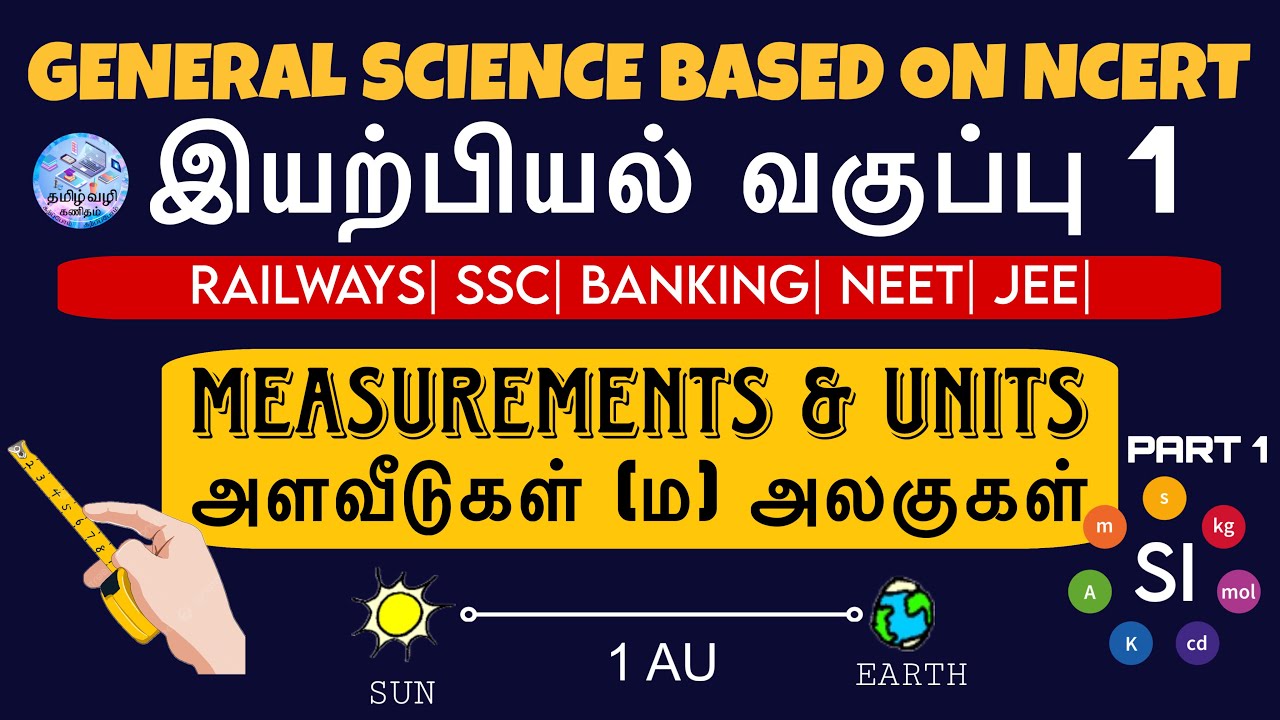
UNITS & MEASUREMENTS (அலகுகள் மற்றும் அளவீடுகள்) - PART 1| PHYSICS | NCERT SCIENCE IN TAMIL
TAMIL VAZHI KANIDHAM
Overview
This video introduces the fundamental concepts of units and measurements in physics, presented in Tamil. It begins by defining measurement as a comparison of an unknown quantity with a known standard. The video then explains that all physical quantities consist of a numerical value and a unit. It categorizes physical quantities into fundamental quantities (like length, mass, time) which are independent, and derived quantities (like velocity, force) which can be expressed in terms of fundamental quantities. Different systems of units, including CGS, MKS, and FPS, are discussed, leading to the introduction of the International System of Units (SI). The video also touches upon the definitions of some basic SI units like the meter and the second, highlighting their historical context and modern definitions.
Want AI Chat, Flashcards & Quizzes from this video?
Sign Up FreeChapters
- •Measurement is the comparison of an unknown quantity with a known, fixed standard.
- •Every physical quantity has a numerical value and a unit.
- •Physical quantities can be classified based on measurement.
- •Fundamental quantities do not depend on other physical quantities for their measurement.
- •Examples of fundamental quantities include length, mass, time, temperature, electric current, luminous intensity, and amount of substance.
- •Derived quantities can be derived from fundamental quantities.
- •Examples of derived quantities include velocity and force.
- •Introduction to different systems of units: CGS, MKS, and FPS.
- •CGS system: Centimeter, Gram, Second.
- •MKS system: Meter, Kilogram, Second.
- •FPS system: Foot, Pound, Second (British system).
- •The SI system is the modern version of the metric system.
- •It was established by the General Conference on Weights and Measures.
- •It includes seven fundamental units.
- •The SI unit for electric current is the Ampere (A).
- •Definition of the meter (m) based on the speed of light.
- •Definition of the second (s) based on atomic transitions (Cesium-133).
- •Mention of the triple point of water as a reference temperature.
Key Takeaways
- 1Measurement is a fundamental process in science, involving comparison to standards.
- 2Physical quantities are categorized into fundamental and derived types.
- 3Understanding different systems of units (CGS, MKS, FPS) is important.
- 4The SI system is the globally accepted standard for scientific measurements.
- 5The definitions of fundamental units are precise and based on physical constants or phenomena.
- 6The meter is defined based on the speed of light in a vacuum.
- 7The second is defined using the properties of Cesium-133 atoms.
- 8Accurate measurement relies on well-defined and universally accepted units.