13:12
Topic 1: Introduction to Financial Risk Management: 1.1 What is Financial Risk Management? (Part 2)
Professor Carol Alexander
Overview
This video explains the fundamental concepts of financial risk management, differentiating between general risk and financial risk. It defines financial risk as uncertainty in a portfolio's value at a specific future point (risk horizon), distinct from the investment horizon. The video categorizes major financial risks, including market, credit, liquidity, operational, and basis risk, providing examples and explanations for each. It also clarifies the difference between risk and investment horizons and how they apply to different financial assets and investor types.
How was this?
Save this permanently with flashcards, quizzes, and AI chat
Chapters
- Risk is the uncertainty in the future value of a random variable.
- Financial risk specifically refers to the uncertainty in a portfolio's value at a defined future point called the 'risk horizon'.
- A portfolio's value can fluctuate over time, and understanding this potential fluctuation is key to managing financial risk.
Understanding the core definition of financial risk is crucial for identifying and quantifying potential losses in financial investments.
The value of a share portfolio, initially £10,000, can fluctuate up or down over a period, creating uncertainty about its future value.
- The 'risk horizon' is the specific future time point at which portfolio value uncertainty is measured, often short (1-10 days for market risk) or longer (e.g., a year for credit risk).
- The 'investment horizon' is the period an investment is intended to be held, varying greatly by asset type (e.g., days for crypto, decades for bonds).
- Investment horizons also dictate how frequently asset managers report returns to investors, from monthly for hedge funds to annually for pension funds.
Distinguishing between these horizons helps in setting appropriate risk measurement periods and aligning investment strategies with investor expectations.
Hedge funds report returns monthly, reflecting a short investment horizon, while pension funds report annually, aligning with longer-term investment strategies.
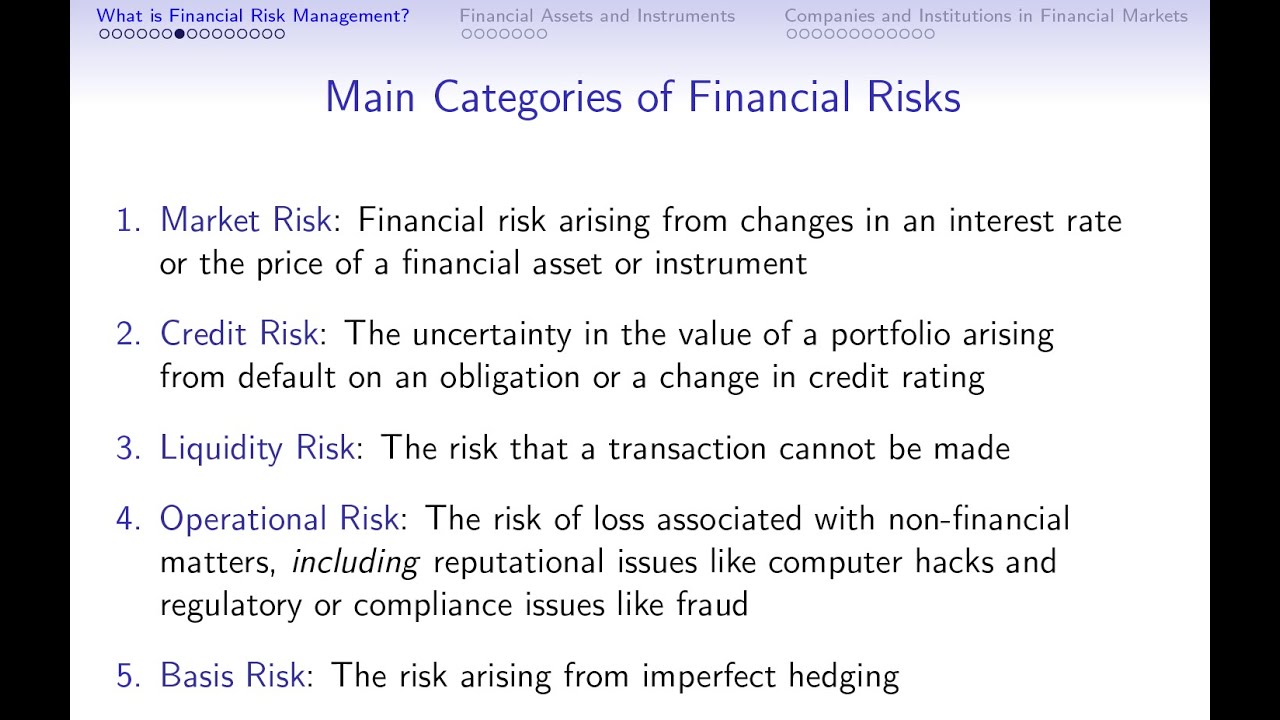
- Key financial risks include market risk (from changes in interest rates or asset prices), credit risk (from defaults or credit rating changes), and liquidity risk (inability to transact).
- Operational risk stems from non-financial issues like reputational damage or regulatory changes.
- Basis risk arises from imperfect hedging, leaving residual risk that cannot be entirely eliminated.
Categorizing risks allows for targeted management strategies and a clearer understanding of the diverse threats to financial stability.
Market risk can occur if interest rates change, affecting the value of bonds held in a portfolio.
- Liquidity risk is the danger that a transaction cannot be executed due to a lack of funds (funding liquidity risk) or insufficient market participants (trading liquidity risk).
- Funding liquidity risk occurs when a company cannot meet its financial obligations, such as repaying maturing loans.
- Trading liquidity risk arises when there are no buyers or sellers in the market, making it impossible to sell an asset quickly at a fair price.
Recognizing the different types of liquidity risk is essential for maintaining a company's ability to meet its financial commitments and trade assets efficiently.
Trading liquidity risk is illustrated when an obscure bond cannot be sold because there are no buyers listed on the electronic exchange's order book.
- Operational risk encompasses losses from non-financial events, broadly divided into high-impact, low-frequency events and lower-impact, everyday occurrences.
- High-impact risks include cybercrime, terrorism, and fraud, which are rare but can cause massive damage.
- Everyday operational risks involve issues like IT system failures or transaction processing errors, which are typically managed through budgeting.
Managing operational risks, especially the high-impact ones, is critical for business continuity and preventing catastrophic financial and reputational damage.
The Jaguar company experienced significant losses and operational disruption due to a cyberattack, highlighting the impact of high-impact operational risk.
Key takeaways
- Financial risk management involves understanding and quantifying uncertainty in portfolio values at specific future points.
- The distinction between risk horizon and investment horizon is critical for setting appropriate measurement periods and strategic goals.
- Financial risks are diverse, encompassing market fluctuations, credit defaults, liquidity constraints, operational failures, and hedging imperfections.
- Liquidity risk has two facets: the inability to fund obligations and the inability to trade assets due to market thinness.
- Operational risks range from rare, catastrophic events like cyberattacks to common, manageable issues like system downtime.
- Effective risk management requires a clear understanding of these categories to implement appropriate mitigation strategies.
Key terms
Financial RiskRisk HorizonInvestment HorizonRandom VariableStochastic VariableMarket RiskCredit RiskLiquidity RiskOperational RiskBasis RiskFunding Liquidity RiskTrading Liquidity Risk
Test your understanding
- How does the concept of a 'risk horizon' differ from an 'investment horizon' in financial risk management?
- What are the two primary sources of credit risk that can impact a portfolio's value?
- Explain the difference between funding liquidity risk and trading liquidity risk, providing an example for each.
- How are operational risks categorized, and what are the implications of these categories for management?
- Why is understanding basis risk important even when employing hedging strategies?