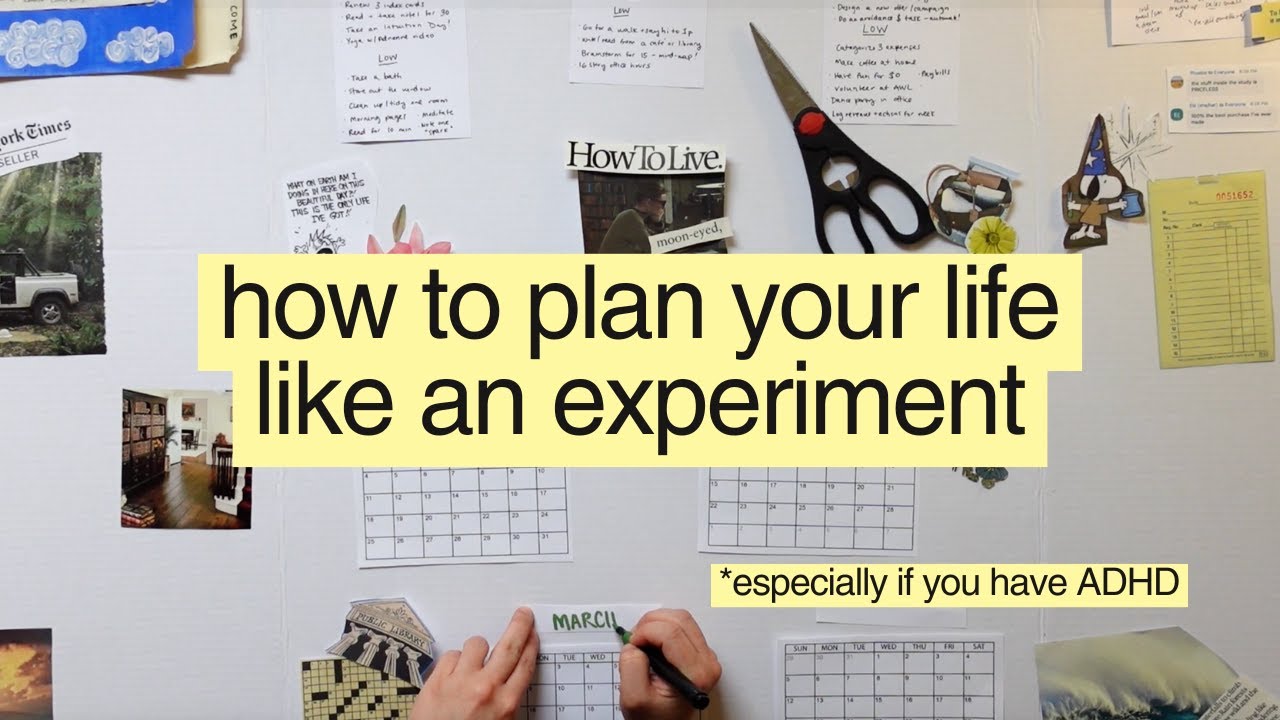
Why I plan my life on a science fair board (and you should, too!)
Lexi Merritt
Overview
This video introduces "Big Paper Planning Day," a quarterly life planning method that uses a science fair board to foster a self-compassionate, creative, and experimental approach to goal setting. The speaker, who has ADHD, explains how traditional productivity advice often fails neurodivergent individuals and presents this method as an accommodation. The process involves defining abstract goals rooted in values and desires, creating "action menus" for different energy levels, and focusing on the identity of being a goal-achiever rather than solely on concrete outcomes. This method emphasizes embracing novelty, learning from experiments, and maintaining control over actions rather than outcomes.
Save this permanently with flashcards, quizzes, and AI chat
Chapters
- Life planning can be creative and self-compassionate, moving away from rigid, daily routines.
- The "Big Paper Planning Day" uses a trifold science fair board as a visual tool for quarterly life planning.
- This method is particularly helpful for individuals with ADHD who may not thrive with conventional productivity advice.
- The process is inspired by design thinking, visual thinking, and the need for novelty.
- Traditional advice like 'just do it' often fails individuals with ADHD, who may require different strategies.
- Self-employment can be an accommodation for ADHD, but requires self-management skills.
- Novelty is a key motivator for individuals with ADHD, and planning quarterly injects this novelty regularly.
- Visual thinking and large-format planning (like on a big paper or board) are crucial for remembering and engaging with plans.
- The planning is focused on a three-month horizon, not long-term yearly or multi-year plans.
- Vision boarding or writing in the present tense about desired outcomes helps uncover underlying values.
- Values are explored, including core values and experimental ones like prioritizing beauty or discipline for the quarter.
- Goals are abstract, focusing on a 'desired state of being' rather than specific, measurable outcomes (SMART goals).
- Action menus provide concrete prompts for achieving abstract goals, with options for both high and low energy days.
- Any action taken that aligns with an abstract goal reinforces the desired identity, regardless of immediate results.
- This approach combats the demotivation of constantly feeling far from a distant, concrete goal.
- Abstract goals bring the desired future into the present context, making progress feel achievable.
- The ultimate benefit is strengthening the identity of being someone who achieves goals, countering past self-perceptions.
- Concrete targets are reframed as 'tiny experiments' or hypotheses for the three-month period.
- These experiments allow for flexibility within the month (e.g., varying gym visits) and acknowledge that results are not fully controllable.
- Focusing on controllable actions, rather than uncontrollable outcomes, fosters self-compassion and consistent effort.
Key takeaways
- Life planning can be an experimental, creative process, not a rigid set of rules.
- Visual tools like science fair boards can make abstract plans more tangible and memorable.
- Accommodations for neurodivergence, such as incorporating novelty and flexible action plans, are crucial for effective self-management.
- Abstract goals focused on desired states of being are more motivating and adaptable than traditional SMART goals.
- Action menus provide practical, energy-level-appropriate steps to move towards abstract goals.
- Building the identity of a goal-achiever through consistent, self-compassionate action is more important than hitting specific, often uncontrollable, outcomes.
- Framing quarterly targets as 'tiny experiments' allows for learning, adaptation, and grace.
Key terms
Test your understanding
- How does the 'Big Paper Planning Day' method differ from traditional, rigid planning systems, and why is this difference important for individuals with ADHD?
- What is the role of novelty in the 'Big Paper Planning Day' process, and how is it intentionally incorporated?
- Explain the concept of 'abstract goals' and how they are used in this planning method compared to traditional SMART goals.
- How do 'action menus' help bridge the gap between abstract goals and daily execution, especially considering varying energy levels?
- Why is focusing on the identity of 'being a goal-achiever' considered more impactful than solely focusing on achieving concrete targets?