16:03
A Coaches Guide to Plyometric Training
The Movement System
Overview
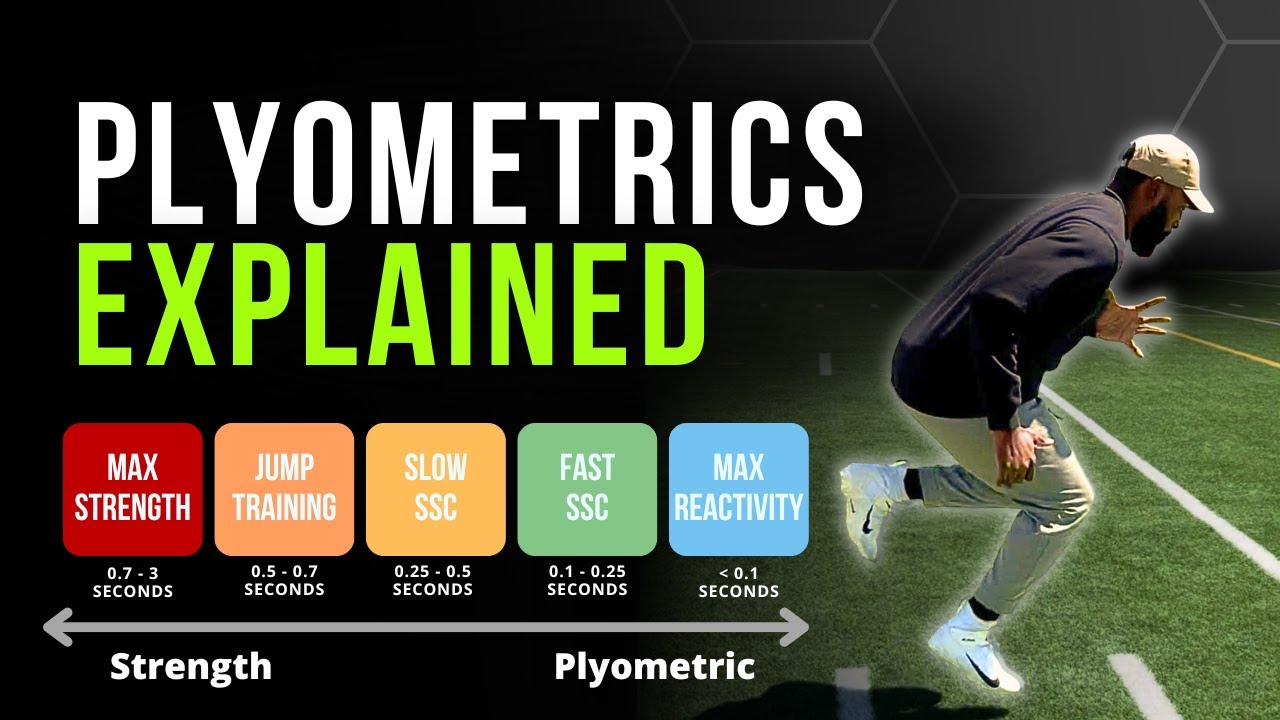
This video provides a comprehensive guide to plyometric training, explaining how different exercises fit along a spectrum based on ground contact time. It details the physiological principles behind each category, from max strength to max reactivity (sprinting), offering specific exercise examples, coaching cues, and expected adaptations. The core message is that understanding this spectrum allows coaches to tailor plyometric programs to specific athletic goals, whether it's building foundational strength, improving acceleration, enhancing change of direction, or maximizing sprint speed.
How was this?
Save this permanently with flashcards, quizzes, and AI chat
Chapters
- Max strength training (e.g., squats, deadlifts) involves long force production times (1-3 seconds) where elastic mechanisms are minimal.
- This type of training builds the muscle's capacity to produce force through voluntary contraction and neural drive, not by training tendons to store and release energy.
- Max strength is crucial because you cannot express force quickly if you don't have enough force to begin with; it sets the ceiling for all subsequent explosive training.
- Stronger athletes generally respond better and have a higher potential ceiling for plyometric training.
Establishing a strong foundation of maximal strength is essential because it directly limits how much explosive power and speed an athlete can ultimately develop.
Heavy squats, split squats, and trap bar deadlifts are examples of exercises that build maximal strength.
- Jump training exercises like box jumps and broad jumps have longer ground contact times (500-700ms) than true plyometrics.
- These movements are more muscularly dominant, focusing on quick muscle shortening rather than the rapid stretch-shortening cycle.
- Adaptations include improved rate of force development (RFD) and eccentric strength, but they don't significantly improve sprint times or max vertical jump.
- While useful for teaching coordination and intent, they can be redundant if already performing heavy strength training.
Understanding that basic jump training is distinct from plyometrics helps coaches avoid programming exercises that don't yield the desired explosive adaptations.
Box jumps, broad jumps, and loaded jumps fall into this category.
- This category involves ground contact times of 250-500ms and begins to utilize the stretch-shortening cycle (SSC) effectively.
- Exercises like depth jumps and single-leg hops can emphasize more active force production, which is beneficial for acceleration and change of direction.
- There's a risk of 'decoupling' the SSC with longer ground contacts (around 0.4-0.5s), leading to more muscle work and less elastic recoil.
- This type of training is beneficial for athletes needing to excel in acceleration and change of direction, making up 10-30% of some plyometric programs.
This phase of the spectrum is crucial for developing the explosive power needed for quick bursts of speed and agile movements, directly impacting performance in sports requiring rapid changes in direction.
Max effort bounding, single-leg hopping, and full depth jumps with slightly longer ground contact times.
- True plyometrics operate with very short ground contact times (100-250ms), keeping the SSC tightly coupled.
- This involves rapid eccentric loading followed by immediate elastic recoil with minimal amortization (muscle pause).
- Key adaptations include increased tendon stiffness, improved elastic energy storage and release, and enhanced pre-activation of muscles.
- Successful execution requires high intent, low fatigue, controlled volume, and specific cues to maintain short ground contact times and elasticity.
Mastering the fast SSC is vital for maximizing vertical jump height and sprint speed by training the nervous system and tendons to react instantaneously to ground impact.
Drop jumps, pogo hops, and hurdle hops with an emphasis on quick, reactive ground contact.
- Max reactivity involves the shortest ground contact times (<100ms), with sprinting being the prime example.
- At these speeds, voluntary force production is minimal; force is primarily generated by pre-activation, tendon stiffness, and a rapid stretch reflex.
- During sprinting, muscles act quasi-isometrically, with the Achilles tendon undergoing significant lengthening (5-10x more than muscle fascicles) to produce vertical force.
- Developing strong isometric contractions (e.g., ankle iso pushes) and consistent sprint training are key for this category.
Understanding the quasi-isometric nature of sprinting highlights the critical role of tendon elasticity and neural preparedness in achieving maximal speed.
Sprinting at maximal velocity, where the Achilles tendon is the primary elastic component.
- Plyometric training exists on a spectrum from max strength (long ground contact) to max reactivity (very short ground contact).
- Each zone targets specific adaptations: strength, RFD, acceleration, change of direction, or max velocity.
- The optimal program isn't one-size-fits-all; it depends on individual goals, athlete deficits, and desired adaptations.
- Understanding ground contact time is the key to selecting appropriate exercises and programming them effectively.
Recognizing plyometrics as a spectrum allows coaches to strategically select and program exercises to precisely target an athlete's specific performance needs and goals.
A football player might prioritize slow SSC and max reactivity, while a basketball player might focus more on fast SSC and slow SSC for jumping and change of direction.
Key takeaways
- Maximal strength is the non-negotiable foundation for all explosive power development.
- Basic jump training (e.g., box jumps) builds force but doesn't replicate the elastic benefits of true plyometrics.
- Ground contact time is the primary variable differentiating plyometric exercise categories and their adaptations.
- The slow stretch-shortening cycle is optimal for improving acceleration and change of direction.
- Fast stretch-shortening cycle exercises are crucial for enhancing reactive strength, tendon stiffness, and vertical jump/sprint speed.
- Sprinting relies heavily on tendon elasticity and pre-activation, with muscles acting quasi-isometrically.
- Effective plyometric programming requires tailoring exercise selection and intensity to specific athletic goals and individual needs.
Key terms
PlyometricsGround Contact TimeMax StrengthStretch-Shortening Cycle (SSC)Rate of Force Development (RFD)Elastic MechanismsTendon StiffnessPre-activationQuasi-isometricAmortization Phase
Test your understanding
- How does maximal strength training serve as the foundation for plyometric performance?
- What distinguishes 'jump training' exercises from true plyometrics in terms of ground contact time and adaptation?
- Why is understanding the 'decoupling' of the stretch-shortening cycle important when programming exercises like depth jumps?
- How does the physiological mechanism of sprinting differ from typical strength or jump exercises, particularly regarding muscle action and tendon involvement?
- What are the primary adaptations gained from training within the fast stretch-shortening cycle, and what conditions are necessary for optimal results?