32:35
AI Found Something Impossible in the Shroud of Turin — Scientists Are Terrified to Explain
Curious Explorer
Overview
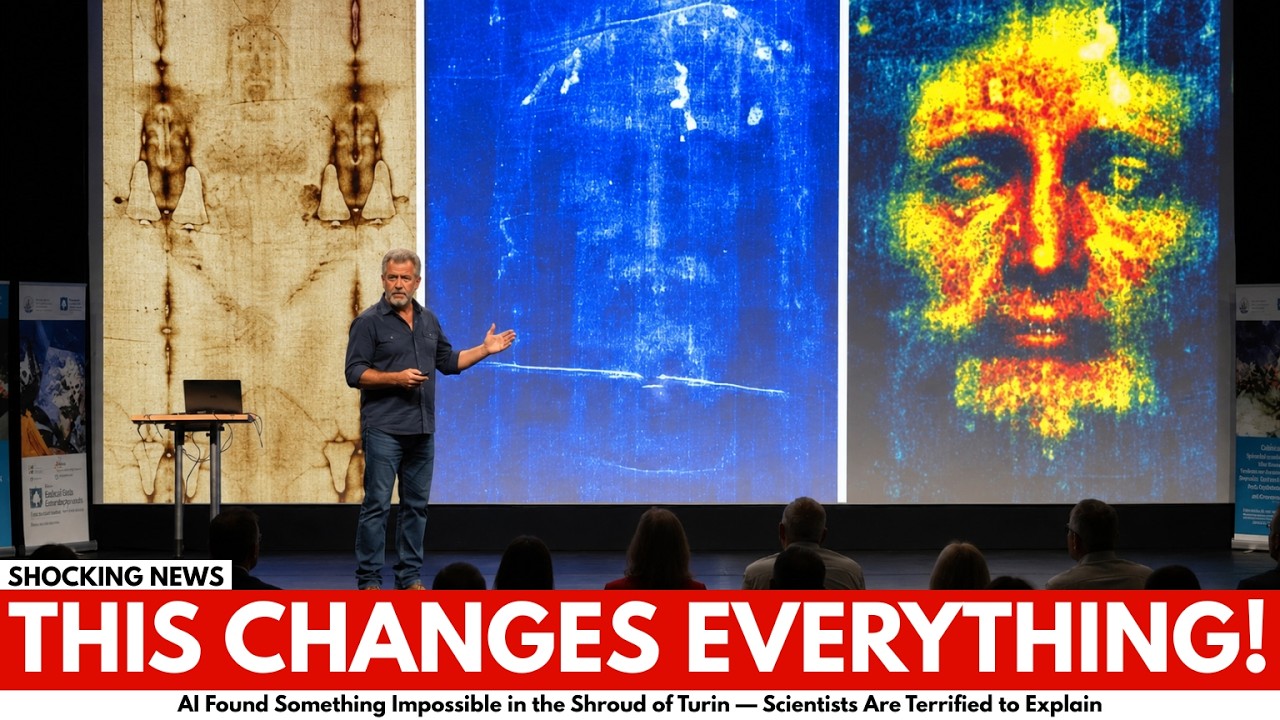
This video explores the use of artificial intelligence to analyze the Shroud of Turin, a relic believed by many to be the burial cloth of Jesus. The AI detected a complex, repeating mathematical pattern and 3D spatial data embedded in the linen, suggesting the image was not created by human hands or known natural processes. The findings challenge conventional explanations, pointing towards a high-energy event that defies current physics, and prompting new scientific hypotheses about the shroud's origin and the nature of the event it records.
How was this?
Save this permanently with flashcards, quizzes, and AI chat
Chapters
- An AI analyzed the Shroud of Turin's linen fibers, identifying a repeating, symmetrical pattern.
- This pattern is not a stain but a sequence of data, suggesting a non-traditional origin.
- The image is extremely superficial, existing only on the topmost microfibers, unlike paint or dye.
- AI analysis revealed the image intensity corresponds to the distance between the cloth and a body, creating a 3D map.
This chapter introduces the core AI discovery, shifting the focus from the shroud's age to the inexplicable nature of its image formation, which challenges existing scientific and historical understanding.
The AI found that image brightness precisely correlates with the distance of the linen from the body, acting as a perfect mathematical map of depth.
- The AI detected faint repeating symmetries and geometric ratios across the body's features.
- These ratios resemble tolerances found in precision optics, not freehand artistic consistency.
- The image's characteristics suggest it was not created by human hands, requiring a master of multiple advanced scientific fields.
- The AI indicates the image behaves more like a projection than a drawing.
This section highlights the advanced, almost impossible precision of the shroud's image, further undermining the medieval forgery theory and pointing towards a non-human or unknown natural process.
The spacing of the eyes and proportions of the hands on the shroud obey an underlying geometric framework that human artists could not replicate with such consistency.
- The image is microscopically sharp, implying the energy source moved in a perfectly straight line, defying the inverse square law.
- Contact scorch experiments show blurring when heat is transferred, a phenomenon absent in the shroud.
- The AI identified data silence in the background, indicating the imaging process was highly selective.
- The shroud appears to record a moment where the laws of physics, like heat transfer and light diffusion, were temporarily suspended.
This chapter delves into the physical properties of the image that contradict known physics, suggesting the event that created it was extraordinary and unlike anything reproducible by current technology.
Unlike a flashlight beam that spreads and blurs, the shroud image is razor-sharp at a microscopic level, suggesting the energy source was perfectly collimated (parallel).
- The shroud image functions as a photographic negative, revealing a detailed portrait only when viewed as a negative, centuries before photography.
- Early 3D imaging technology (VP-8 analyzer) revealed the shroud image contained undistorted topographical data of a human form.
- The AI refined these 3D findings, confirming a flawless anatomical relief consistent with a volumetric projection.
- The image is a precise, high-resolution topographic map encoded onto the linen.
These historical anomalies demonstrate that the shroud possesses characteristics of advanced imaging technology that were impossible in the eras it has been historically attributed to, further deepening the mystery.
When a NASA-used VP-8 analyzer processed the shroud image, it produced a perfect 3D relief map, unlike ordinary photos which distort due to light and shadow.
- AI enhancement revealed faint impressions of Roman coins (Pontius Pilate Lepta) over the eyes, potentially dating the shroud to 29-36 AD.
- The blood stains are identified as real human type AB blood, still reddish due to high bilirubin, suggesting extreme trauma.
- Crucially, the blood stains are on the cloth *before* the image formed, indicating the blood was present first.
- The wounds depicted (scourge marks, scalp punctures, wrist wound, rib wound) are anatomically precise and consistent with historical accounts of crucifixion.
The presence of specific ancient coins and anatomically accurate depictions of blood and wounds provide further chronological and forensic evidence that challenges the medieval forgery narrative.
AI analysis enhanced faint circular distortions over the eyes, matching the size and shape of Pontius Pilate Lepta coins, some showing an augur's staff.
- The 1988 radiocarbon dating suggested a medieval origin (1260-1390 AD), widely accepted as proof of a hoax.
- Subsequent analysis revealed the tested sample was from a corner with medieval repairs, including cotton and plant gum, not pure linen.
- Advanced tests (X-ray scattering, vibrational spectroscopy) on the main linen body indicate an age consistent with the 1st century AD.
- Pollen analysis identified plants exclusively from the Jerusalem/Dead Sea region, difficult to introduce to Europe naturally.
This chapter addresses and refutes the primary evidence used to declare the shroud a medieval fake, presenting newer, more reliable scientific methods that point to an ancient origin.
Chemist Raymond Rogers found the 1988 sample threads were coated with plant gum and interwoven with cotton, unlike the pure linen of the main shroud, suggesting it was a medieval repair patch.
- The Sudarium of Oviedo, a separate cloth believed to be a face cloth, has a documented history predating the medieval period.
- AI analysis showed a precise match between the bloodstains on the Sudarium and the Shroud of Turin.
- Over 70 distinct points of correspondence were found between the blood patterns on both cloths.
- If the Sudarium is ancient, the Shroud must also be ancient, as they bear the marks of the same individual.
The correlation with the Sudarium of Oviedo provides independent, external evidence that supports an ancient origin for the Shroud, further dismantling the medieval forgery theory.
When the Sudarium was digitally positioned over the Shroud's facial area, the geometry and distribution of bloodstains aligned perfectly.
- A hypothesis suggests neutron radiation from the body altered the carbon signature, explaining the anomalous dating.
- AI analysis of UV fluorescence patterns supports this neutron radiation hypothesis, showing variations consistent with radiation distribution.
- Replication experiments show neutron exposure increases linen's UV fluorescence and chlorine 36 content.
- The image formation is theorized to be a high-energy event, possibly vacuum ultraviolet radiation or corona discharge, that occurred without significant heat transfer.
This section explores the leading scientific hypotheses attempting to explain the shroud's image formation and anomalous dating, linking them to advanced physics and high-energy phenomena.
Thomas McAvoy used AI to analyze UV fluorescence patterns on the shroud, finding they matched computer simulations of neutron radiation distribution around a body.
- The body shows no signs of decomposition, suggesting it dematerialized or vanished before decay could begin.
- The image's orthographic nature (straight lines) suggests a controlled event, not an explosion.
- Theories include mass-to-energy conversion (Einstein's E=mc²) or a body passing through a higher spatial dimension.
- The shroud's unique properties simultaneously recorded spatial data, blood, and evidence of a high-energy event without decomposition.
These speculative yet data-supported theories push the boundaries of known physics, suggesting the shroud may be evidence of a singular event that transcends current scientific comprehension.
The 'collapsed state theory' proposes the body's mass was converted directly into energy, releasing radiation that formed the image without heat or decomposition.
Key takeaways
- AI analysis has revealed complex, data-like patterns and 3D spatial information embedded in the Shroud of Turin, challenging traditional explanations.
- The superficial nature and precise geometric ratios of the image suggest it was not created by human hands or known natural processes.
- The shroud's image formation defies conventional physics, particularly regarding heat transfer, light diffusion, and the lack of decomposition.
- Anomalies in radiocarbon dating have been largely explained by the presence of medieval repairs in the tested sample, with other tests supporting a 1st-century origin.
- Corroborating evidence from the Sudarium of Oviedo strongly suggests the Shroud is ancient and depicts the same individual.
- Leading scientific hypotheses involve high-energy events like neutron radiation or vacuum ultraviolet radiation, potentially linked to a dematerialization event.
- The AI's findings compel scientists to view the Shroud not just as a relic, but as a 'crime scene' or a record of a physical event that current physics cannot fully explain.
Key terms
Shroud of TurinArtificial Intelligence (AI)Neural NetworksPrincipal Component Analysis (PCA)3D Spatial DataSuperficial ImageRadiocarbon DatingMedieval RepairVacuum Ultraviolet RadiationNeutron RadiationDematerializationSudarium of Oviedo
Test your understanding
- How did the AI's analysis of the Shroud of Turin's image differ from previous interpretations, and what specific data did it uncover?
- Why do the geometric precision and superficial nature of the image suggest it could not have been created by human hands?
- What physical laws does the formation of the image on the Shroud of Turin appear to defy, and what alternative explanations are being considered?
- How did the 1988 radiocarbon dating results become controversial, and what scientific methods have since provided evidence for an earlier date?
- What is the significance of the correlation between the Shroud of Turin and the Sudarium of Oviedo in understanding the Shroud's origin?