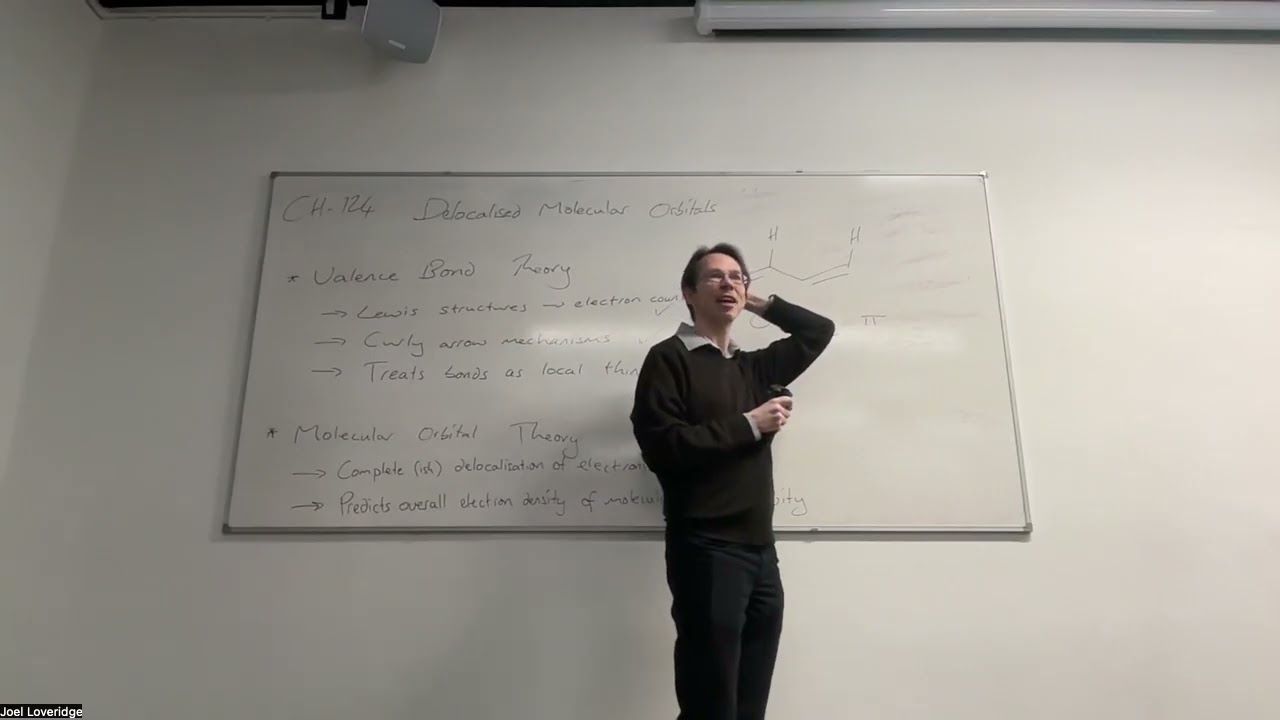
20260210 CH124 JL Delocalised MOs
Department of Chemistry Swansea University
Overview
This video explains how to draw molecular orbitals (MOs) for delocalized pi systems, contrasting Molecular Orbital Theory with Valence Bond Theory. While Valence Bond Theory (Lewis structures, curly arrows) is simpler and useful for electron counting and reaction mechanisms, MO theory is more accurate as it describes electrons as delocalized across the entire molecule. The video focuses on a simplified MO approach, applying it to sigma electrons using Valence Bond Theory and only to pi electrons using MO theory. It details a step-by-step process for constructing MO diagrams, including determining the number of atomic and molecular orbitals, placing nodes symmetrically, and assigning bonding/antibonding character, ultimately showing how to fill these orbitals with electrons and identify the HOMO and LUMO for predicting chemical reactivity.
Save this permanently with flashcards, quizzes, and AI chat
Chapters
- Valence Bond (VB) theory, used for Lewis structures and reaction mechanisms, treats electrons as localized in specific bonds.
- Molecular Orbital (MO) theory is more accurate, describing electrons as delocalized across the entire molecule.
- VB theory is simpler and useful for electron counting and drawing mechanisms, making it popular despite its inaccuracies.
- MO theory accurately predicts electron density but is more complex.
- This video uses a simplified MO approach, treating sigma electrons with VB theory and only pi electrons with MO theory.
- Determine the number of atomic orbitals needed: one per atom in the pi system.
- The number of atomic orbitals equals the number of molecular orbitals that will be formed.
- Number the molecular orbitals from lowest energy (1) to highest energy.
- Calculate the number of nodes in each MO by subtracting one from its orbital number (e.g., orbital 2 has 1 node).
- Place nodes symmetrically along the molecular framework, often using dummy bonds to help visualize spacing.
- Draw p orbitals on each atom involved in the pi system.
- When moving between adjacent atoms, flip the sign (phase) of the p orbital if a node has been crossed.
- Nodes represent points where the probability of finding an electron is zero; nothing is drawn at a node.
- The lowest energy MO (orbital 1) has all p orbitals in phase (no nodes).
- The highest energy MO (orbital N) has all p orbitals out of phase (N-1 nodes).
- Analyze adjacent atom pairs to determine if their p orbitals are in phase (bonding) or out of phase (antibonding).
- A bonding interaction occurs when adjacent orbitals have the same phase, contributing to stability.
- An antibonding interaction occurs when adjacent orbitals have opposite phases, destabilizing the molecule.
- The overall character of an MO (bonding, non-bonding, or antibonding) is determined by the net number of bonding vs. antibonding interactions.
- Lower energy MOs have more bonding interactions, while higher energy MOs have more antibonding interactions.
- Fill the molecular orbitals with pi electrons starting from the lowest energy level, following the Pauli exclusion principle (max two electrons per orbital).
- The Highest Occupied Molecular Orbital (HOMO) is the highest energy orbital containing electrons.
- The Lowest Unoccupied Molecular Orbital (LUMO) is the lowest energy orbital that does not contain electrons.
- Nucleophiles react using their HOMO, as they donate electrons from their highest energy occupied orbital.
- Electrophiles react using their LUMO, as they accept electrons into their lowest energy available orbital.
- A five-atom pi system requires five atomic orbitals, forming five molecular orbitals.
- Nodes are placed symmetrically: 0 for MO1, 1 for MO2 (midpoint), 2 for MO3 (1/3 and 2/3), 3 for MO4 (1/4, 1/2, 3/4), and 4 for MO5 (1/5, 2/5, 3/5, 4/5).
- When drawing MOs, remember that nodes mean nothing is drawn at that atom's position.
- The bonding/antibonding character is determined by adjacent atom interactions, considering nodes.
- Six pi electrons (e.g., from two double bonds and a lone pair) fill the first three MOs, making the third MO the HOMO and the fourth MO the LUMO.
Key takeaways
- Molecular Orbital theory provides a more accurate description of electron delocalization than Valence Bond theory.
- The number of molecular orbitals formed equals the number of atomic orbitals combined.
- Nodes in molecular orbitals represent regions of zero electron density and dictate phase changes between adjacent atoms.
- Bonding interactions stabilize a molecule, while antibonding interactions destabilize it.
- The relative energy of molecular orbitals determines their stability, with lower energy orbitals being more bonding.
- The HOMO and LUMO are the key orbitals for understanding a molecule's chemical reactivity.
- Nucleophiles react via their HOMO, and electrophiles react via their LUMO.
Key terms
Test your understanding
- How does Molecular Orbital Theory differ from Valence Bond Theory in its description of electrons?
- What is the relationship between the number of atomic orbitals and the number of molecular orbitals formed?
- How does the presence of a node affect the drawing and phase of molecular orbitals?
- What is the significance of bonding versus antibonding interactions in molecular orbitals?
- Why are the HOMO and LUMO considered the most important orbitals for predicting chemical reactivity?