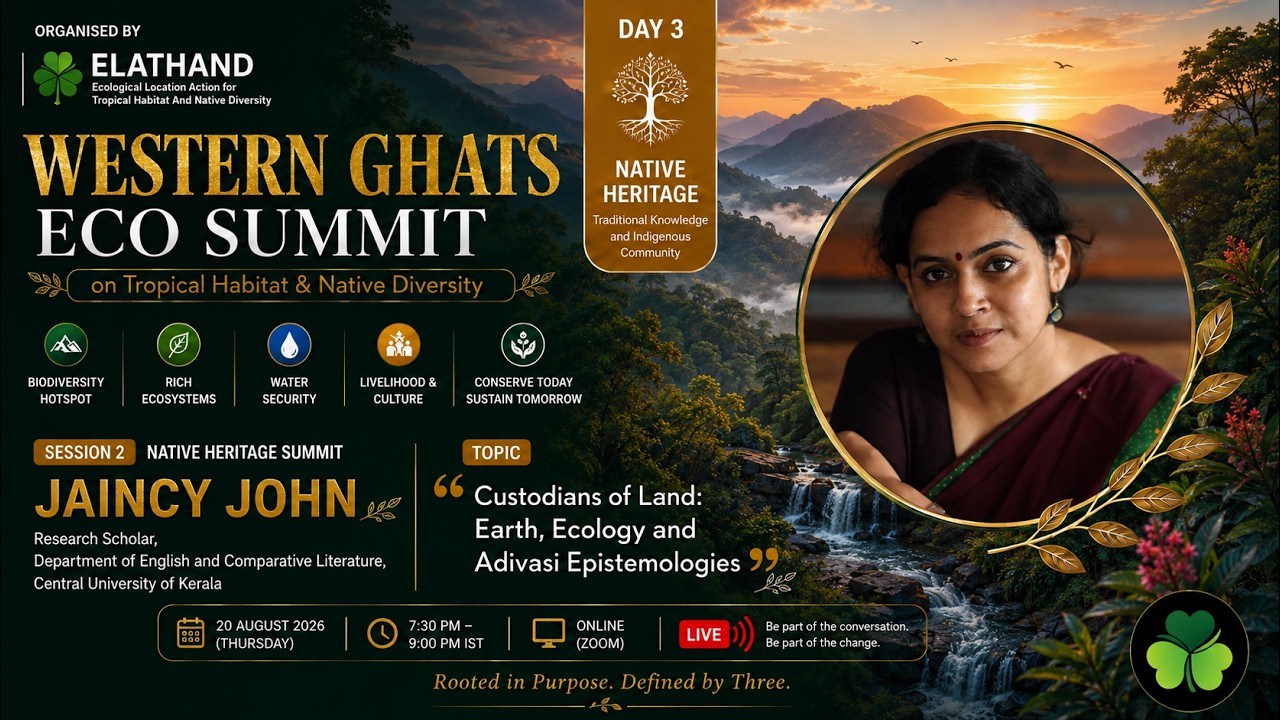
Ms. Jaincy John | | ELATHAND
Elathand TV
Overview
This video explores the concept of 'Custodians of Land: Earth, Ecology, and Adivasi Epistemologies,' challenging Western scientific and colonial frameworks for understanding land and ecology. The speaker, drawing from a humanities and literature background and identifying with the Malayali community, contrasts Western epistemology with indigenous knowledge systems. The presentation highlights how Western perspectives have historically objectified and territorialized land, while indigenous epistemologies emphasize relational, place-based, and embodied knowledge. It calls for a critical examination of how knowledge is constructed, translated, and represented, advocating for a more equitable and accountable approach to understanding and engaging with indigenous wisdom.
Save this permanently with flashcards, quizzes, and AI chat
Chapters
- Indigenous communities hold agency over their knowledge, which is often overlooked by dominant Western frameworks.
- The speaker, from a literature background and indigenous community, aims to share her perspective on indigenous knowledge systems.
- Understanding knowledge requires questioning who frames it, who validates it, and the underlying power structures.
- The presentation will explore indigenous epistemologies as 'custodians of land' from an epistemological viewpoint.
- Biblical imagery presents Earth as a divine creation, with humans given a place within it.
- Scientific modernity views Earth as an object to be observed, studied, and measured.
- Colonial modernity transforms Earth into a territory to be surveyed, mapped, and owned, altering its fundamental meaning.
- Contemporary Earth system thinking recognizes the planet as a complex system affected by human actions, emphasizing shared responsibility for climate change.
- Initially, land was seen as common ground in biblical thought.
- Labor transformed land into private property, with uncultivated land deemed 'waste'.
- Colonial modernity turned land into territory, used for governance, surveys, and mapping.
- Land is increasingly viewed as a resource for revenue and industrial products, as seen in colonial forestry practices.
- Early natural history focused on classification and naming of organisms.
- Ecology initially studied the spatial and environmental relationships of organisms.
- Later developments introduced the concept of ecosystems and interdependence.
- Modern ecology views the planet as a complex system of interacting spheres (biosphere, atmosphere, etc.).
- Indigenous knowledge is situated, sacred, grounded, and inseparable from lived experience and the land.
- Indigenous epistemologies are relational, emphasizing interconnectedness between humans, plants, animals, and the environment.
- Knowledge is often embodied and collectively held, passed down through generations via practice.
- Unlike Western models, indigenous knowledge systems do not operate on principles of domination but on mutual relationship and respect.
- Western research methodologies often carry colonial biases and fail to produce equitable knowledge.
- Indigenous knowledge is not merely data but a practice deeply embedded in culture, place, and relationships.
- Research involving indigenous communities must be accountable, respecting privacy, dignity, and rights.
- The concept of 'custodianship' itself can be problematic, as indigenous relationships with land are often more akin to kinship ('children of the soil') than ownership or guardianship.
Key takeaways
- Dominant Western frameworks for understanding land and ecology often objectify and territorialize, overlooking indigenous perspectives.
- The concept of 'Earth' has evolved from divine creation to a scientific object, a colonial territory, and finally a complex planetary system.
- Western views have transformed 'land' from common ground to private property and then to a resource for exploitation.
- Indigenous knowledge is deeply relational, place-based, embodied, and collective, emphasizing interconnectedness rather than domination.
- Research involving indigenous communities requires accountability, respect for their rights, and an understanding of their unique ways of knowing.
- Indigenous relationships with the land are often characterized by kinship and belonging, not ownership or simple custodianship.
- Challenging the authority and biases within Western knowledge production is crucial for a more equitable understanding of ecological wisdom.
Key terms
Test your understanding
- How has the Western understanding of 'Earth' evolved over time, and what are the implications of these shifts?
- In what ways does the Western concept of 'land' differ from indigenous perspectives on land?
- What are the core characteristics of indigenous epistemologies, and how do they contrast with Western scientific approaches?
- Why is it important to critically examine the origins and representation of knowledge, especially concerning indigenous wisdom?
- What ethical considerations must researchers address when engaging with indigenous knowledge systems?