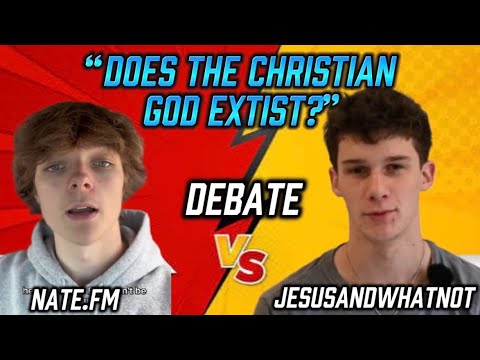
(HEATED DEBATE) “Does the Christian God Exist?” Nate.FM vs JesusandWhatnot
Jesus and Whatnot
Overview
This video presents a debate on the existence of the Christian God, featuring Noah (JesusandWhatnot) arguing for its existence and Nate (Nate.FM) arguing against it. Noah employs a metaphysical argument based on Aristotelian and Thomistic philosophy, defining terms like potency, actuality, contingency, and parts to construct a cosmological argument for an uncaused, pure actuality as God. Nate challenges the argument's leap from a first cause to the specific Christian God, questioning the historical reliability of the Bible and the coherence of Christian doctrines, particularly focusing on alleged contradictions and the problem of evil. The debate delves into the nature of evidence, the interpretation of scripture, and the criteria for distinguishing between natural and supernatural explanations.
Save this permanently with flashcards, quizzes, and AI chat
Chapters
- Potency refers to the possibility of a thing being different than it is (e.g., wood's potential to burn).
- Actuality is the realization of potency (e.g., wood burning).
- Contingency describes existence dependent on an external cause, unlike self-existent beings.
- Parts are components that together form a whole, implying incompleteness and potential change.
- Premise 1: Anything with parts possesses potency (e.g., a composite object can be rearranged or changed).
- Premise 2: Anything with both actuality and potency requires an external cause.
- Premise 3: The material universe has parts and thus possesses both actuality and potency.
- Conclusion: Therefore, the universe requires an external cause, which must be pure actuality, without parts or potency, leading to the attributes of God.
- The external cause cannot be material, as it would then be part of the material universe.
- The external cause cannot have potency, as that would require its own external cause.
- This being is pure actuality (actus purus), lacking any potential for change or imperfection.
- This being possesses attributes like perfection, goodness, eternity, omnipotence, omniscience, and omnipresence due to its nature as pure actuality.
- Nate acknowledges the argument's structure but questions the leap from a first cause to the Christian God, noting similar arguments are used by other religions.
- He challenges Noah to provide evidence that distinguishes the Christian God from deities in Islam or Judaism.
- Nate proposes shifting the debate from abstract metaphysics to concrete evidence for the Christian narrative, specifically the resurrection and miracles.
- He argues that the existence of God should be supported by actual evidence, not just philosophical deduction.
- Noah addresses anticipated arguments about natural and moral evil, using the story of Lazarus to illustrate God permitting tragedy for a greater purpose.
- Moral evil is explained as God permitting it for redemption (mercy) or justice.
- Punishments and harsh commands in the Bible are justified by divine command theory and as means of sanctification or justice.
- Noah emphasizes that interpreting the Bible requires a holistic view, acknowledging divine command theory and avoiding isolated verses.
- Nate questions the historical reliability of the Gospels, citing late authorship, anonymous texts, and reliance on oral traditions that vary.
- He argues that early dating and creedal statements prove belief, not historical fact.
- Nate highlights alleged contradictions in the Gospels, such as differing genealogies, resurrection accounts, and birth narratives.
- He asserts that there is no independent, corroborating evidence for key Christian events like the resurrection.
- Noah presents the stigmata of Padre Pio as a scientifically studied miracle, challenging Nate's claim that no miracles can be scientifically verified.
- Nate argues that even if true, one miracle doesn't prove the resurrection or the Christian God, and questions how to differentiate supernatural from natural explanations.
- The debate touches on objective morality, with Nate questioning Noah's standard for judging God as evil and Noah asserting that God's actions violate the Bible's own moral framework.
- Nate struggles to articulate an objective moral standard, suggesting that morality might not be fixed or objective.
- Nate presses Noah on biblical contradictions (e.g., numbers in Samuel/Chronicles, Gospel accounts) and questions how to distinguish literal from metaphorical passages.
- Noah defends his interpretation by referencing Thomistic and Augustinian thought, stating that these figures clarify apparent contradictions and that numbers can be metaphorical.
- Nate argues that this flexibility in interpretation undermines the Bible's claim to be a literal, historically accurate account.
- The discussion highlights the challenge of harmonizing scripture when literal readings lead to inconsistencies or inconvenient truths.
Key takeaways
- Metaphysical arguments for God's existence, like the cosmological argument, rely on defining concepts like potency and actuality to infer a necessary, uncaused being.
- The leap from a philosophical 'first cause' to the specific God of Christianity requires additional evidence beyond logical deduction.
- Historical reliability of religious texts, particularly the Gospels, is a critical battleground for debates about the existence of specific deities.
- Alleged contradictions within scripture and the problem of evil are significant challenges for theistic arguments.
- The nature of evidence and the criteria for distinguishing natural from supernatural explanations are central to evaluating claims about miracles and divine intervention.
- Interpreting religious texts involves complex hermeneutical challenges, with the distinction between literal and metaphorical readings being a key point of contention.
- Objective morality is a difficult concept to establish, and its absence or ambiguity can complicate arguments about the nature and actions of God.
Key terms
Test your understanding
- How does the concept of 'potency' and 'actuality' function in Noah's cosmological argument for God's existence?
- What are Nate's primary objections to Noah's metaphysical argument, and what kind of evidence does he believe is needed instead?
- How does Noah attempt to reconcile the existence of evil and suffering with the attributes of a benevolent and omnipotent God?
- What specific types of contradictions does Nate identify in the Gospels, and how does Noah respond to these claims?
- What is the significance of the Padre Pio stigmata example in the debate, and what are the differing views on its evidential value?