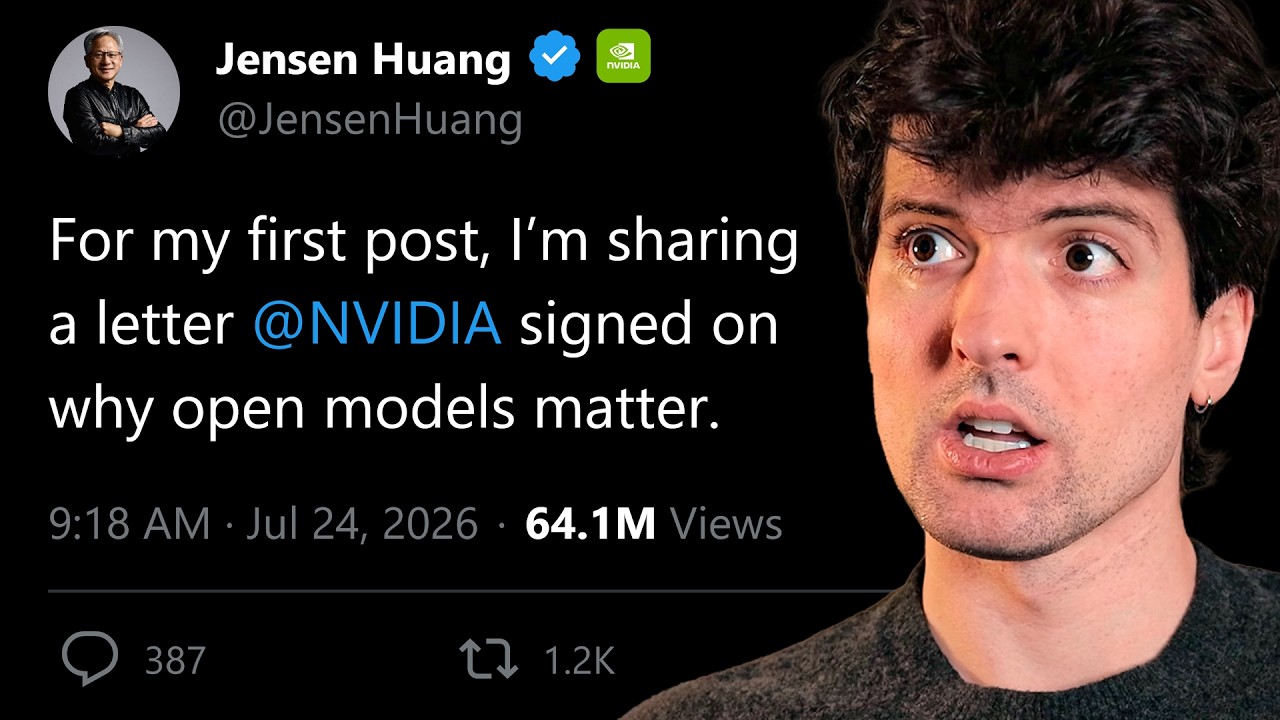
NVIDIA calls out Anthropic
Theo - t3․gg
Overview
This video discusses the controversy surrounding open-weight AI models, sparked by Nvidia CEO Jensen Huang's public letter advocating for their importance. The letter, signed by major tech companies, contrasts with Anthropic's perceived stance against open-weight models. The discussion delves into the benefits of open-weight models for innovation, competition, and accessibility, while also acknowledging security risks. It contrasts Nvidia's pro-open-weight position with Anthropic's nuanced view, which focuses on specific policy recommendations like chip export controls and mandatory safety testing, rather than an outright ban on open-weight models. The video critiques Anthropic's specific concerns, particularly regarding 'distillation,' suggesting it may be a self-serving argument.
Save this permanently with flashcards, quizzes, and AI chat
Chapters
- Nvidia CEO Jensen Huang publicly supported open-weight AI models, a move seen as a direct challenge to companies like Anthropic.
- A letter signed by numerous AI industry leaders, including OpenAI, Meta, and Google, emphasized the importance of open-weight models.
- Anthropic notably did not sign this letter, leading to speculation about their stance on open-weight AI.
- The controversy is linked to concerns about AI development, national security, and the competitive landscape, particularly involving models originating from China.
- Open-weight models, which allow anyone to download, inspect, and modify AI models, are essential for democratizing AI.
- They foster innovation, accelerate diffusion of AI technology across industries, and enable national technological sovereignty.
- Open-weight models lower costs for businesses and researchers, enabling them to build on advanced AI without prohibitive training expenses.
- They promote competition, preventing AI capabilities from being concentrated in the hands of a few large companies.
- Open-weight models present distinct security risks because once released, their weights are beyond the original developers' control.
- Modified versions can be difficult to trace, and dangerous capabilities (e.g., for creating weapons or drugs) cannot be easily removed.
- However, prohibiting open-weights is not the solution; defenders need access to advanced models to counter cyber threats.
- Open models can actually enhance security by allowing a broad community to identify vulnerabilities and develop safeguards through transparency and rigorous testing.
- Anthropic clarifies it has never advocated for a ban on open-weight models, viewing non-dangerous ones as a public good.
- Their primary concerns focus on preventing authoritarian governments from acquiring advanced AI capabilities and mitigating risks of misuse (cyber/bio-attacks).
- Anthropic supports targeted policies: restricting powerful chip sales to adversaries, cracking down on industrial-scale 'distillation,' and mandating safety testing for all capable models.
- They critique the idea that open-weights inherently help defenders more than attackers, especially in areas like biological threats.
- The video argues that Anthropic's strong focus on 'distillation' as a threat is a self-serving argument, potentially aimed at protecting their own business model.
- Distillation is presented as a legitimate and common technique for model improvement, not inherently nefarious.
- The rapid development of models like K3, which emerged shortly after Anthropic's Fable 5, suggests that distillation is not the sole or primary driver of competitive AI advancement.
- Anthropic's position is characterized as potentially 'petty and selfish' for singling out distillation while advocating for broader AI safety measures.
- The debate highlights a critical juncture for AI policy, with potential government actions like banning Chinese open-weight models.
- Nvidia and other signatories advocate for policies that foster a strong, open AI ecosystem, emphasizing American leadership through diffusion and competition.
- Anthropic's proposed policies aim to maintain US technological superiority and mitigate specific risks, but are critiqued for potentially stifling innovation.
- The video concludes by suggesting that open-weight models are crucial for broad AI adoption and that the US should lead in building an open AI future, rather than imposing restrictive policies.
Key takeaways
- Open-weight AI models are crucial for democratizing AI, fostering innovation, and promoting competition, mirroring the benefits seen in open-source software.
- While open-weight models introduce security risks, transparency and community-driven testing are more effective mitigation strategies than outright bans.
- Anthropic advocates for targeted policies like chip export controls and mandatory safety testing, rather than banning open-weight models as a category.
- The debate over 'distillation' highlights potential self-interest within companies seeking to protect their competitive advantages.
- A strong and open AI ecosystem is vital for national technological leadership and broad economic prosperity.
- Policymakers face a critical choice between fostering an open AI environment and implementing potentially restrictive measures based on security concerns.
- The rapid advancement of AI models, even those using techniques like distillation, suggests that open-weight models play a significant role in the competitive landscape.
Key terms
Test your understanding
- What are the primary benefits of open-weight AI models compared to closed models?
- Why does Nvidia, and many other tech companies, advocate for open-weight models despite potential security risks?
- How does Anthropic's proposed policy approach differ from a blanket ban on open-weight models, and what are their main concerns?
- What is 'distillation' in the context of AI, and why is it a point of contention in this debate?
- What are the potential long-term implications for AI development and national leadership based on the arguments presented?