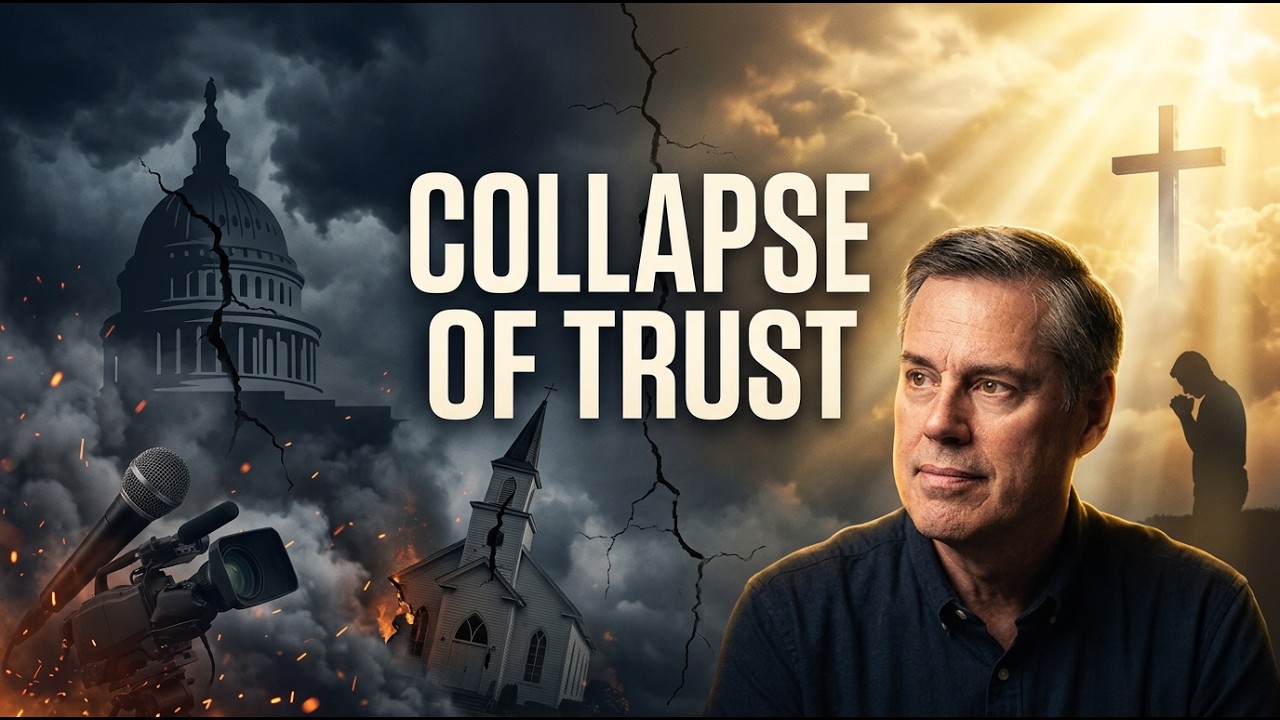
The Collapse of Trust | How to Rebuild What's Broken (E092)
Come And Reason Ministries
Overview
This video explores the pervasive collapse of trust in modern institutions, including government, media, education, and even churches and families. It delves into the foundational elements of healthy trust, distinguishing between superficial confidence and deep-seated reliance built on love, maturity, and wisdom. The discussion contrasts the principles of a government 'for the people' with Marxist ideologies that prioritize the state, explaining how deviations from these principles erode public confidence. The video also examines the psychological and cultural consequences of declining trust, such as increased fear and polarization, and differentiates between healthy discernment and cynical distrust. Finally, it posits that this erosion is part of a larger spiritual dynamic, allowing individuals to seek ultimate trust in a reliable source.
Save this permanently with flashcards, quizzes, and AI chat
Chapters
- Trust in major institutions like government, media, and education has reached a historic low.
- This erosion extends to traditional institutions such as churches and families.
- Historical context shows a decline in patriotism and confidence in these institutions compared to previous decades.
- Specific examples, like athletes kneeling during the national anthem, illustrate the shift in societal norms and trust.
- Healthy trust is built, not declared, and requires more than just a claim of trustworthiness.
- The core elements of trust are reliability, having the other's best interests at heart, and demonstrable love.
- Three essential components for deep trust are: 1) self-sacrificial love, 2) maturity and capability, and 3) wisdom.
- These principles apply to trusting individuals, such as a spouse or God, and are demonstrated by God's character.
- A healthy government is oriented 'for the people,' prioritizing individual development and liberty, as exemplified by the US Constitution's principles.
- Conversely, Marxist or communist ideologies view people as commodities for the state, leading to a loss of trust when government serves itself rather than its citizens.
- Erosion of trust occurs when governments restrict liberties, engage in indoctrination, or enrich elites at the expense of the masses.
- Repeated deception and the hiding of problems, rather than honest mistakes, are key drivers of institutional distrust.
- When trust erodes, fear increases, leading to societal polarization and the formation of 'tribes' or factions.
- Individuals and groups seek safety by reinforcing their worldviews, often viewing those with differing beliefs as threats.
- This fear-driven dynamic replaces tolerance with hostility and undermines the ability to coexist peacefully.
- Discernment, rooted in love for truth and evidence, is contrasted with cynicism, which is an unhealthy, fear-based position that rejects truth to maintain a false sense of security.
- The human heart hardens when truth is rejected and selfishness is embraced, but softens through repentance and embracing truth in love.
- Trust is a fundamental human capacity, but misplaced trust (in idols, false saviors, or flawed systems) stems from a desire to mitigate fear and find security.
- True, unshakable trust is only possible in the Creator God, whose character is self-sacrificial, mature, and wise.
- Salvation and transformation come not from external actions or mechanical adherence to rules, but from a freely chosen trust in God, leading to a 'new heart and right spirit' empowered by love and trust, not fear.
- Much of modern media functions as a propaganda machine, using facts to spin narratives and advance agendas rather than reporting objectively.
- This manipulation, designed to incite emotional responses, further erodes trust in information sources.
- Christians are called to recognize that earthly kingdoms are not God's kingdom and to place their ultimate citizenship and trust in heaven.
- Misplaced faith is often placed in external mechanisms (sacraments, rituals, legalistic interpretations) rather than in the person of Jesus Christ and His character.
Key takeaways
- Healthy trust is built on a foundation of demonstrable love, maturity, and wisdom, not mere claims.
- The erosion of trust in institutions is often linked to a shift from principles of 'government for the people' to ideologies that prioritize the state.
- Fear is a primary driver of societal polarization and distrust; overcoming it requires a shift towards love and truth.
- Cynicism is a defense mechanism rooted in fear and insecurity, actively rejecting truth to maintain a false sense of safety.
- Genuine transformation and lasting peace come from freely choosing to place trust in a trustworthy, unshakable source, like the Creator God.
- Our choices about where to place our trust profoundly shape our neurobiology, character, and spiritual state.
- The media often uses facts to manipulate emotions and advance agendas, contributing significantly to the collapse of public trust.
- True faith is placed in the person of God and His character, not in external religious mechanisms or rituals.
Key terms
Test your understanding
- What are the three essential elements required for building deep, healthy trust?
- How does the speaker differentiate between a government 'for the people' and ideologies that prioritize the state, and why does this distinction matter for public trust?
- What are the psychological consequences of widespread distrust, and how does this lead to societal polarization?
- How does the video distinguish between healthy discernment and cynical distrust, and what motivates each?
- According to the video, why is placing trust in the Creator God considered the only path to unshakable peace and transformation?