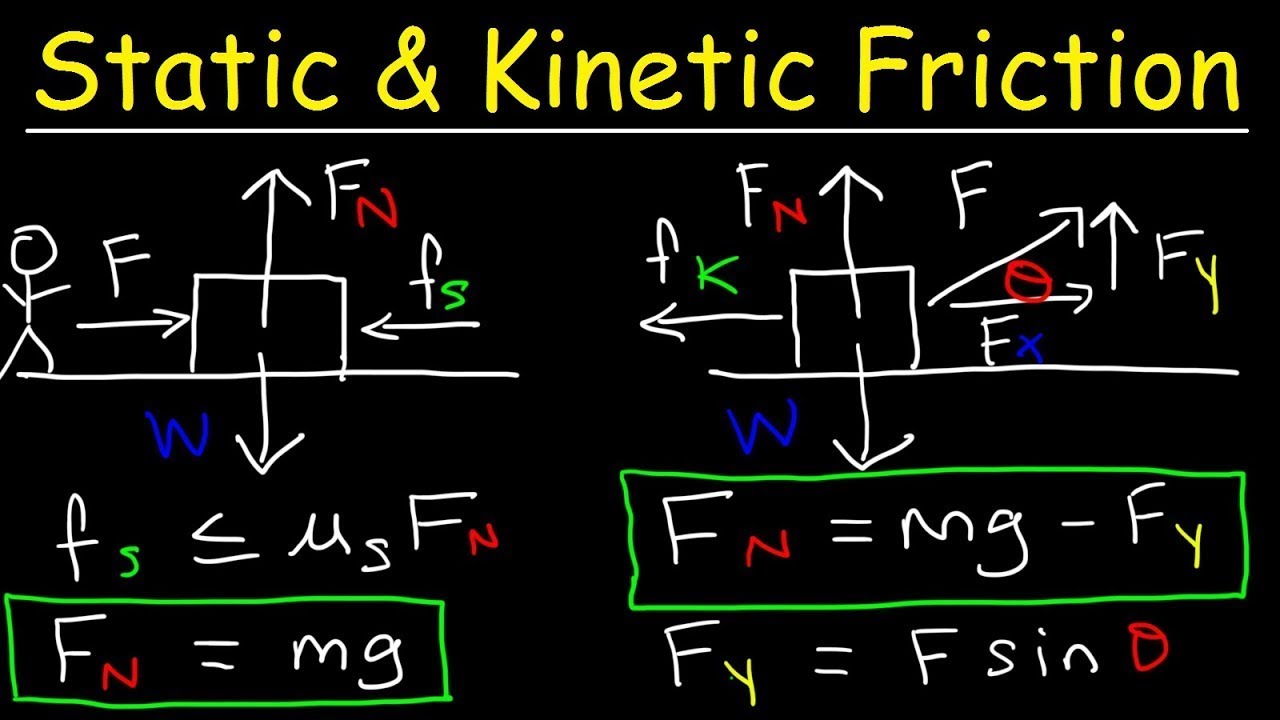
Static Friction and Kinetic Friction Physics Problems With Free Body Diagrams
The Organic Chemistry Tutor
Overview
This video explains the concepts of static and kinetic friction, detailing how they oppose motion and the conditions under which each applies. It covers the formulas for calculating these forces, emphasizing that static friction has a maximum value while kinetic friction is constant when an object is sliding. The video demonstrates these principles through several example problems, including calculating friction forces, determining the minimum force to initiate sliding, and finding acceleration when friction is present. A key focus is on how the normal force can change based on applied forces, affecting friction calculations, especially when forces are applied at an angle.
Save this permanently with flashcards, quizzes, and AI chat
Chapters
- Static friction prevents an object from moving when a force is applied.
- Kinetic friction opposes the motion of an object that is already sliding.
- Static friction is represented by an inequality (Fs <= μs * N) indicating a range of possible values.
- Kinetic friction is represented by an equation (Fk = μk * N), indicating a constant value when sliding occurs.
- The coefficient of static friction (μs) is generally greater than the coefficient of kinetic friction (μk).
- The normal force (N) is the force exerted by a surface perpendicular to that surface.
- On a horizontal surface with no other vertical forces, the normal force equals the object's weight (N = mg).
- The maximum static friction is calculated as Fs_max = μs * N.
- The kinetic friction is calculated as Fk = μk * N.
- Static friction adjusts its value to match the applied force up to its maximum limit.
- To make an object begin to slide, the applied force must exceed the maximum static friction.
- The minimum force required to start sliding is equal to the maximum static friction.
- Once sliding begins, static friction is replaced by kinetic friction.
- The net force determines the acceleration of the object (F_net = ma).
- The coefficient of static friction (μs) can be found if the maximum static friction and normal force are known.
- The coefficient of kinetic friction (μk) can be found if the kinetic friction force and normal force are known, or by using the net force and acceleration.
- When calculating acceleration, the net force is the applied force minus kinetic friction.
- The relationship μs > μk generally holds true.
- When a force is applied at an angle, its components (horizontal and vertical) must be considered.
- The horizontal component of the applied force contributes to overcoming friction.
- The vertical component of the applied force can alter the normal force.
- If the vertical component pulls upward, it reduces the normal force, thus reducing friction.
- If the vertical component pushes downward, it increases the normal force, thus increasing friction.
Key takeaways
- Static friction is a variable force that matches the applied force up to a maximum, preventing motion.
- Kinetic friction is a constant force that opposes motion once an object is sliding.
- The maximum static friction is always greater than or equal to kinetic friction for the same surfaces.
- The normal force is critical for calculating friction and can be affected by other applied forces.
- Forces applied at an angle must be resolved into components to correctly analyze their effect on motion and friction.
- Understanding friction is key to analyzing the dynamics of objects in contact with surfaces.
Key terms
Test your understanding
- What is the fundamental difference between static and kinetic friction, and when does each type apply?
- How does the normal force influence the magnitude of both static and kinetic friction?
- Explain why static friction can have a range of values, while kinetic friction typically has a single value when an object is sliding.
- How would applying a force at an upward angle to a box affect the normal force and the resulting friction compared to applying the same force horizontally?
- What is the minimum condition required for an object to begin sliding, and how is this related to the coefficients of friction?