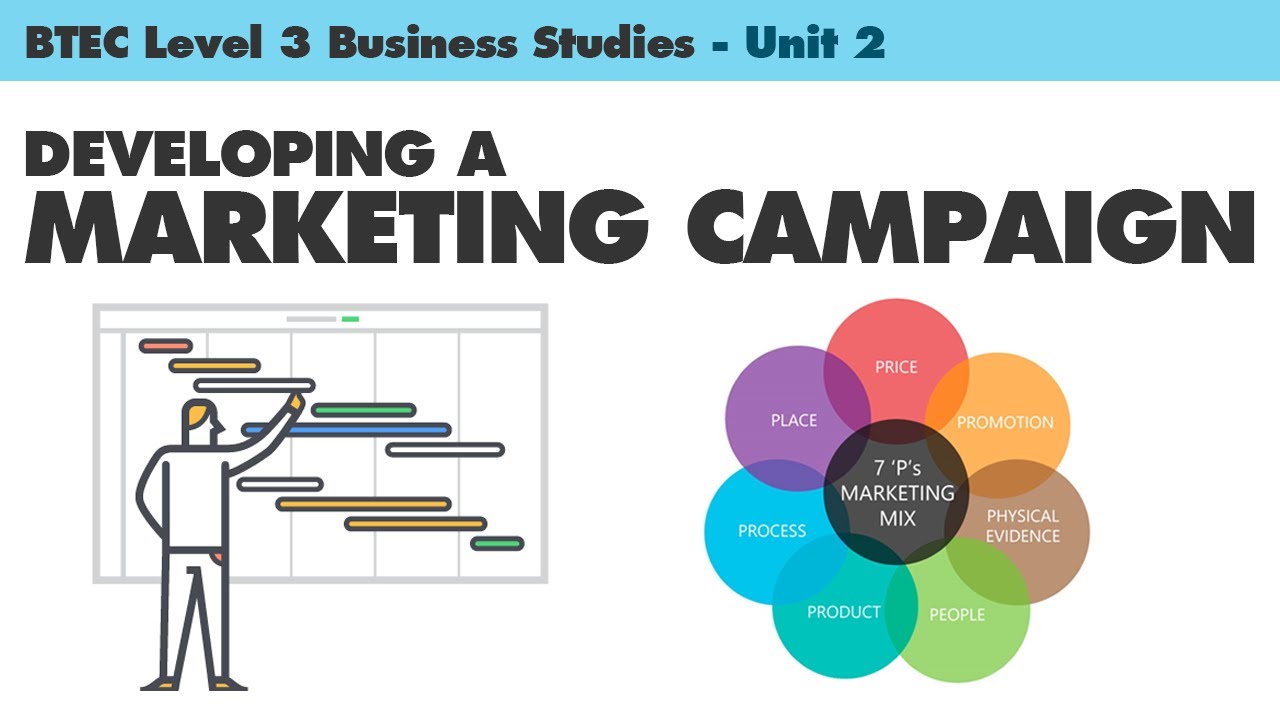
BTEC Level 3 Business Studies / Unit 2: Developing a Marketing Campaign
Synnipoe
Overview
This video outlines the structure and requirements for BTEC Level 3 Business Studies Unit 2, focusing on developing a marketing campaign. It details a two-stage assessment: a six-hour research period followed by a three-hour exam. The exam involves two activities: a rationale based on research and a comprehensive marketing plan. The rationale requires analyzing market information, setting SMART marketing objectives, and conducting PEST and SWOT analyses. The marketing plan involves identifying a target market, detailing the marketing mix (product, price, place, promotion), allocating a budget, and creating a timeline. The video emphasizes the importance of using research effectively, analyzing data, and justifying all marketing decisions with clear, logical reasoning.
Save this permanently with flashcards, quizzes, and AI chat
Chapters
- The assessment has two stages: a 6-hour research phase and a 3-hour exam.
- The exam requires completing two activities: a rationale and a marketing plan.
- During the research phase, collect data on market size, trends, customer needs, competitors, and PEST factors.
- Research should consist of facts, quotes, and statistics, and must be printed for the exam.
- Analysis and evaluation are not permitted in the research notes; only factual data collection is allowed.
- The rationale involves discussing collected market information, defining SMART marketing objectives, and conducting PEST and SWOT analyses.
- Analyze market information using frameworks like the 5 Cs (Company, Customers, Competitors, Climate, Channels) focusing on relevance to the case study.
- Define three SMART marketing objectives (Specific, Measurable, Achievable, Relevant, Time-bound) that are marketing-focused, not financial.
- Conduct a PEST analysis to identify significant political, economic, social, and technological factors influencing the market.
- Perform a SWOT analysis to identify the business's internal Strengths and Weaknesses, and external Opportunities and Threats, using existing research and case study information.
- The justification section synthesizes findings from market information, PEST, and SWOT analyses to form initial marketing ideas.
- Discuss key strengths and opportunities and how they can influence marketing activities.
- Consider potential challenges and threats to the business's marketing efforts.
- The justification should reflect on all previous work to form balanced conclusions and tie together the analysis.
- Focus on high-quality analysis of relevant information rather than simply presenting a large volume of data.
- The marketing plan requires identifying the target market and justifying the choice.
- Detail the marketing mix (Product, Price, Place, Promotion) and potentially the extended marketing mix (Process, People, Physical Evidence).
- Develop a realistic budget allocation for promotional activities based on research and case study information.
- Create a timeline for implementing the marketing campaign, considering seasonality and budget constraints.
- All decisions within the marketing plan must be justified and linked back to research and the case study.
- Clearly outline the product or service features and its unique selling proposition (USP).
- Select and justify a pricing strategy (e.g., penetration, skimming, psychological) based on competitor analysis and product value.
- Define distribution channels (Place) considering where customers can purchase and access the product, and competitor strategies.
- Decisions for Price and Place should be realistic and supported by research and the case study.
- Consider both online and physical distribution options as appropriate for the product and target market.
- Promotion is a key element, involving the selection of appropriate promotional methods (traditional and digital).
- Develop a clear marketing message that reflects the desired brand image and resonates with the target audience.
- Justify the choice of promotional methods based on budget, target market, and effectiveness, considering competitor activities.
- Allocate the given budget realistically across chosen promotional activities, detailing associated costs.
- The promotional message should be consistently communicated through chosen methods using appropriate language, imagery, and slogans.
- Review the entire submission for structure, presentation, and logical flow.
- Ensure clear headings are used to organize different sections of the work.
- Check for any spelling or grammatical errors, as these can impact marks.
- Ensure all decisions and justifications are clearly linked back to the research and case study information.
- The final output should be neat, organized, and professional in appearance.
Key takeaways
- Effective marketing campaign development requires a structured approach, starting with thorough research and culminating in a detailed, justified plan.
- The distinction between research (data collection) and analysis (interpretation) is critical for exam success.
- SMART objectives provide clear, measurable targets that guide marketing strategy.
- Situational analysis tools like PEST and SWOT are essential for understanding the business environment and informing decisions.
- The marketing mix (4 Ps or 7 Ps) must be strategically chosen and justified based on research, target market, and business objectives.
- Budget allocation and a realistic timeline are crucial for the practical implementation of a marketing plan.
- Justification is key: every decision made in the marketing plan must be explained and supported by evidence from research or the case study.
Key terms
Test your understanding
- What are the two main activities required in the BTEC Unit 2 marketing campaign assessment, and what is the primary purpose of each?
- How does the research phase differ from the analysis required in Activity 1, and why is this distinction important?
- Explain the SMART criteria and provide an example of a marketing objective that meets these criteria for a hypothetical business.
- How can PEST and SWOT analyses be used to inform the development of a marketing plan?
- What are the core components of the marketing mix, and how should decisions regarding each component be justified in the marketing plan?