8:31
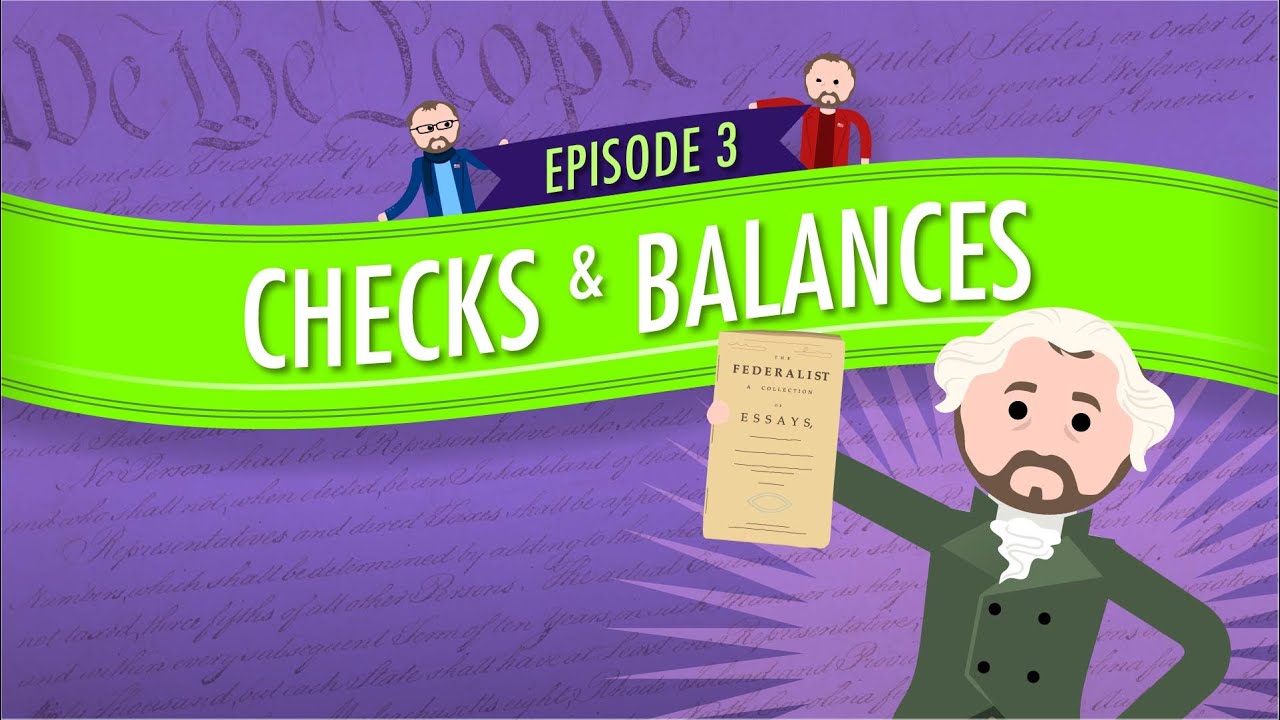
Separation of Powers and Checks and Balances: Crash Course Government and Politics #3
CrashCourse
Overview
This video explains the core principles of separation of powers and checks and balances in the U.S. government. It details how the government is divided into three branches—legislative, executive, and judicial—each with distinct roles. The video then elaborates on how each branch has specific powers to limit or influence the others, preventing any single branch from becoming too dominant. This system is designed to protect citizens' rights by making government overreach more difficult, as articulated by James Madison in Federalist 51.
How was this?
Save this permanently with flashcards, quizzes, and AI chat
Chapters
- Separation of powers divides the national government into three distinct branches: legislative, executive, and judicial.
- The legislative branch, outlined in Article I, is primarily responsible for making laws.
- The executive branch, led by the President and detailed in Article II, is responsible for executing or carrying out laws.
- The judicial branch, described in Article III, is tasked with interpreting laws.
Understanding the distinct roles of each branch is fundamental to grasping how the U.S. government is structured and how laws are created, implemented, and interpreted.
The legislative branch makes laws, the executive branch enforces them, and the judicial branch explains what they mean.
- The legislative branch (Congress) has the most detailed constitutional outline and the most checks on other branches.
- Congress can impeach and remove the President and judges.
- The Senate confirms presidential appointments of judges and officials (advice and consent).
- Congress can override a presidential veto with a two-thirds vote in both houses.
- Congress controls funding for executive programs and can refuse to pass desired laws.
This highlights how the branch closest to the people, Congress, is designed to hold significant power to prevent potential abuses by the executive and judicial branches.
The House can impeach the President, and the Senate can remove him from office with a two-thirds vote.
- The executive branch, headed by the President, executes laws.
- The President can veto laws passed by Congress.
- The President nominates Supreme Court justices and other federal judges, shaping the judiciary.
- The President can grant pardons, nullifying court judgments.
- The executive branch's interpretation of how to carry out laws can sometimes conflict with legislative intent.
The executive branch's ability to veto legislation and shape the judiciary provides crucial counterbalances to the legislative and judicial powers.
The President vetoing a bill passed by Congress, preventing it from becoming law unless overridden.
- The judicial branch (the Courts) interprets laws.
- The judiciary's primary check is judicial review: declaring laws and executive actions unconstitutional.
- The Chief Justice presides over presidential impeachment trials in the Senate.
- The courts issue warrants and can shape legal proceedings.
- The judiciary is often considered the weakest branch due to its reliance on the other branches for enforcement.
Although often seen as the weakest, the judiciary's power to declare actions unconstitutional is a profound check on both the legislative and executive branches.
The Supreme Court ruling a law passed by Congress to be unconstitutional.
- The Framers feared a tyrannical central government, drawing from experiences with British rule.
- Separation of powers and checks and balances make it harder for the government to infringe on citizens' rights.
- James Madison, in Federalist 51, argued that these systems are necessary to control government abuses.
- These mechanisms rely on giving each branch the means and motives to resist encroachment by others.
- The system acknowledges a realistic, and perhaps cynical, view of human nature and the potential for power to corrupt.
Understanding the 'why' behind these structures reveals that they are deliberate safeguards designed to protect liberty by preventing the concentration of power.
Federalist 51's argument that necessary constitutional means and personal motives allow each branch to resist the others' encroachments.
Key takeaways
- The U.S. government is divided into three co-equal branches: legislative (makes laws), executive (enforces laws), and judicial (interprets laws).
- Separation of powers prevents any single entity from accumulating too much authority.
- Checks and balances allow each branch to limit the powers of the other two, creating a system of mutual restraint.
- The legislative branch holds significant power to check both the executive and judicial branches through impeachment, confirmation, and legislative action.
- The executive branch checks the legislature via veto power and influences the judiciary through appointments.
- The judicial branch's most significant check is judicial review, the power to deem laws and actions unconstitutional.
- The ultimate purpose of these structures is to prevent tyranny and protect individual rights, reflecting a cautious view of human nature.
- James Madison emphasized that these checks are essential safeguards against the abuse of governmental power.
Key terms
Separation of PowersChecks and BalancesLegislative BranchExecutive BranchJudicial BranchImpeachmentVetoAdvice and ConsentJudicial ReviewFederalist 51
Test your understanding
- What are the three branches of the U.S. government and what is the primary function of each?
- How does the legislative branch check the power of the executive branch?
- What is judicial review and how does it allow the judiciary to check the other branches?
- Why did the Framers of the Constitution establish a system of checks and balances?
- Explain how the executive branch can influence the composition and decisions of the judicial branch.