4:50
Porter's Generic Strategies
after the bell
Overview
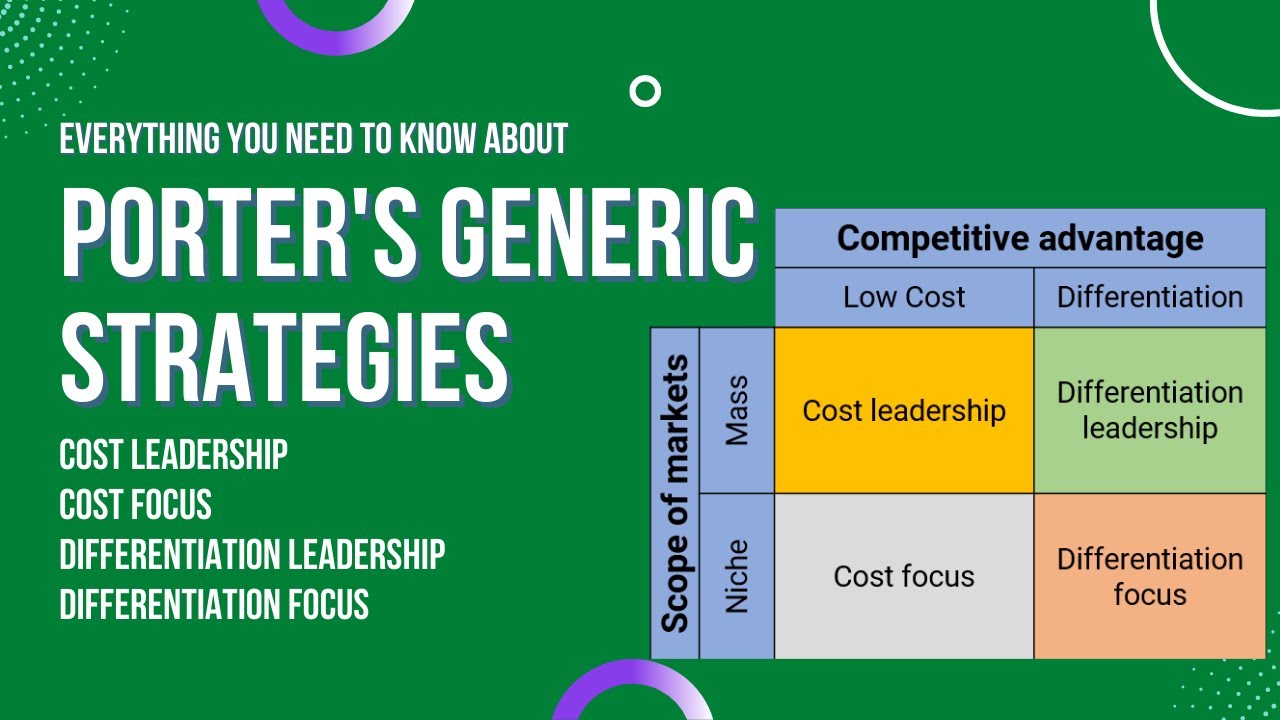
This video explains Michael Porter's Generic Strategies, a framework for achieving competitive advantage. Businesses can gain an edge by either focusing on low cost or by differentiating their products or services. Each of these broad approaches can be applied to either a broad mass market or a narrow market niche, resulting in four potential strategic positions: cost leadership, cost focus, differentiation leadership, and differentiation focus. The video elaborates on how each strategy works and the key elements required for success.
How was this?
Save this permanently with flashcards, quizzes, and AI chat
Chapters
- Porter's Generic Strategies are a framework for businesses to achieve a competitive advantage over rivals.
- The two primary ways to gain this advantage are by offering low costs or by differentiating products/services.
- These strategies can be applied to either a broad market or a specific market niche.
Understanding these strategies helps businesses identify the most effective ways to position themselves in the market and outperform competitors.
- A low-cost strategy aims to keep expenses as low as possible to offer customers lower prices.
- This can lead to a competitive advantage by attracting price-sensitive customers or widening profit margins.
- Cost leadership targets the mass market using economies of scale and high capacity utilization to reduce per-unit costs.
- Cost focus targets a niche market, potentially by offering a more basic product and saving on R&D compared to larger competitors.
This approach is crucial for businesses that compete primarily on price, as it outlines methods to maintain profitability while offering the lowest prices.
A large supermarket chain using economies of scale to negotiate bulk discounts and high-volume sales to offer everyday low prices on a wide range of goods.
- A differentiation strategy focuses on adding value by offering unique products or services that stand out from competitors.
- This uniqueness can be achieved through high quality, superior customer service, or a strong unique selling proposition.
- Differentiation allows businesses to charge premium prices.
- Differentiation focus targets a niche market by catering to specific customer needs, making it easier to stand out.
- Differentiation leadership targets the mass market, requiring strong branding and marketing to justify higher prices.
This strategy is vital for businesses that want to avoid direct price competition by offering something unique and valuable that customers are willing to pay more for.
A luxury car manufacturer that differentiates itself through superior engineering, premium materials, advanced technology, and exclusive brand image, allowing it to command high prices.
Key takeaways
- Competitive advantage can be achieved through either being the lowest cost provider or by offering unique value.
- The scope of the target market (mass vs. niche) significantly influences how a low-cost or differentiation strategy is implemented.
- Cost leadership relies on operational efficiency, economies of scale, and high capacity utilization.
- Differentiation strategies require a clear unique selling proposition, often supported by strong branding and marketing.
- Choosing the right generic strategy is fundamental to a business's long-term success and market positioning.
- Businesses must carefully consider their resources and market conditions when deciding between cost leadership and differentiation.
Key terms
Porter's Generic StrategiesCompetitive AdvantageLow Cost StrategyDifferentiation StrategyCost LeadershipCost FocusDifferentiation LeadershipDifferentiation FocusEconomies of ScaleUnique Selling Proposition (USP)
Test your understanding
- What are the two fundamental approaches to achieving a competitive advantage according to Porter's Generic Strategies?
- How do economies of scale contribute to a cost leadership strategy?
- Why might a differentiation focus strategy be easier to implement than a differentiation leadership strategy?
- What are the key elements required for a successful differentiation leadership strategy in a mass market?
- How does the choice of target market (mass vs. niche) affect the implementation of low-cost strategies?