2:25
Le Chatelier's Principle - Iron (III) Thiocyanate
Chemistry and Biochemistry Demo lab at OSU
Overview
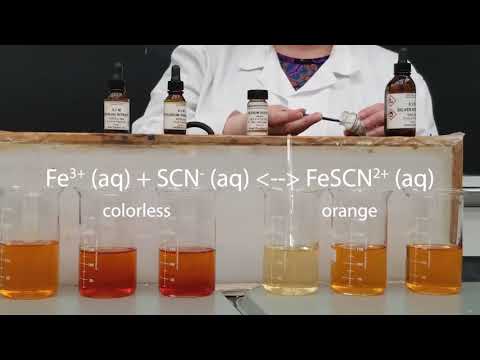
This video demonstrates Le Chatelier's Principle using the reaction between iron (III) ions and thiocyanate ions, which produces a colored complex. By adding various substances that affect the concentrations of reactants or products, the video visually shows how the equilibrium shifts to counteract the disturbance, resulting in observable color changes. It illustrates how changes in concentration, reduction, complex formation, and precipitation influence the equilibrium position.
How was this?
Save this permanently with flashcards, quizzes, and AI chat
Chapters
- The reaction involves iron (III) ions (Fe3+) and thiocyanate ions (SCN-) forming a colored iron thiocyanate complex.
- This reaction establishes an equilibrium between reactants and products.
- A reference beaker shows the initial color of the iron thiocyanate complex at equilibrium.
Understanding the initial state of the system is crucial before observing how changes perturb the equilibrium.
A beaker containing the colored iron thiocyanate complex serves as the baseline for observing color changes.
- Adding more of a reactant (Fe3+ or SCN-) will shift the equilibrium to the right, favoring product formation.
- This shift results in a more intense color, indicating a higher concentration of the iron thiocyanate complex.
- Le Chatelier's Principle predicts that the system will try to consume the added reactant, thus shifting towards products.
This demonstrates the fundamental principle that increasing reactant concentration drives the reaction forward to re-establish equilibrium.
Adding iron (III) nitrate or potassium thiocyanate to the reference beaker causes the solution to become more orange.
- Adding sodium sulfite reduces Fe3+ to Fe2+, effectively removing Fe3+ from the equilibrium.
- The removal of a reactant causes the equilibrium to shift to the left, favoring the reactants.
- This shift results in a decrease in the color intensity of the iron thiocyanate complex.
This illustrates how altering the chemical form of a reactant can disrupt equilibrium and cause a shift towards the reactants.
Adding sodium sulfite to the colored solution causes the orange color to fade because Fe3+ is converted to Fe2+.
- Adding sodium fluoride introduces fluoride ions which form a stable complex with Fe3+.
- This complex formation effectively removes Fe3+ ions from the solution, acting similarly to reducing the reactant concentration.
- The equilibrium shifts to the left to compensate for the loss of Fe3+, leading to a paler color.
This shows that forming stable complexes with reactants can also disrupt equilibrium by lowering reactant concentration.
Adding sodium fluoride to the colored solution causes the orange color to diminish as Fe3+ is sequestered into a new complex.
- Adding silver nitrate causes silver ions (Ag+) to react with thiocyanate ions (SCN-) to form a solid precipitate (AgSCN).
- This removes thiocyanate ions (SCN-) from the solution, reducing the concentration of a reactant.
- The equilibrium shifts to the left to replenish the removed SCN-, causing a loss of the colored product and cloudiness.
This demonstrates how removing a reactant by forming an insoluble precipitate drives the equilibrium backward.
Adding silver nitrate to the colored solution causes the orange color to disappear and the solution to become cloudy due to the formation of AgSCN precipitate.
Key takeaways
- Le Chatelier's Principle states that a system at equilibrium will shift to counteract any disturbance.
- Adding reactants shifts equilibrium towards products, increasing product concentration and intensity of color.
- Removing reactants (by reduction or complexation) shifts equilibrium towards reactants, decreasing product concentration and color intensity.
- Removing a reactant by precipitation also shifts equilibrium towards reactants, leading to product loss.
- The color intensity of the iron thiocyanate complex is a direct visual indicator of the equilibrium's position.
Key terms
Le Chatelier's PrincipleEquilibriumIron (III) ion (Fe3+)Thiocyanate ion (SCN-)Iron thiocyanate complexReactantProductPrecipitateComplex ion
Test your understanding
- How does adding more iron (III) ions affect the color of the iron thiocyanate solution according to Le Chatelier's Principle?
- Why does the addition of sodium sulfite cause the orange color to fade?
- What happens to the equilibrium position when fluoride ions are added, and why?
- Explain how the formation of a silver thiocyanate precipitate influences the original equilibrium.
- What is the relationship between the concentration of the iron thiocyanate complex and the observed color intensity?