21:05
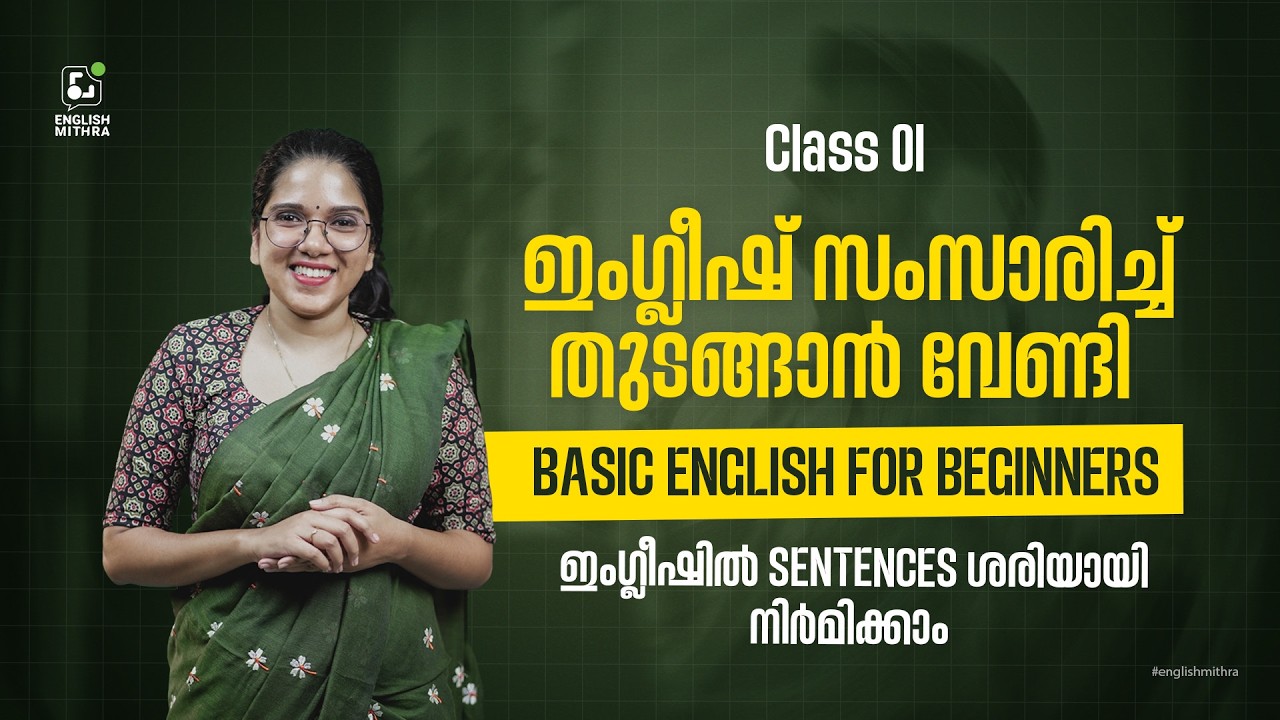
ഇംഗ്ലീഷ് പഠിച്ചു തുടങ്ങാൻ വേണ്ടി- Day 01| Basic Spoken English for Beginners |👉 ഈസി ആയി പഠിക്കൂ ...
English Mithra
Overview
This video introduces the fundamental concept of sentence construction in English for beginners who know some words but struggle to form sentences. It emphasizes the difference between Malayalam and English sentence structure, explaining that direct translation often leads to errors. The core lesson focuses on the Subject-Verb-Object (SVO) order in English, contrasting it with the Malayalam structure. Practical examples are provided to illustrate how to correctly arrange words to form basic English sentences, encouraging learners to practice and build confidence.
How was this?
Save this permanently with flashcards, quizzes, and AI chat
Chapters
- This video is for individuals who know English words but lack the ability to form sentences.
- The goal is to teach how to construct simple sentences using known vocabulary.
- It's part of a free, sequential playlist designed for beginners to learn basic spoken English.
- Learners are encouraged to take notes and practice sentence creation independently.
Understanding the purpose and structure of sentences is the foundational step to speaking and communicating effectively in English.
The speaker explains that this video is specifically for those who know words but don't know how to make sentences.
- Directly translating Malayalam sentences into English often results in incorrect grammar and meaning.
- Malayalam sentence structure typically follows Subject-Object-Verb (SOV).
- English sentence structure primarily follows Subject-Verb-Object (SVO).
- The difference in word order is a major reason for common English speaking errors.
Recognizing the structural differences between the two languages is crucial to avoid common mistakes and build grammatically correct English sentences.
The sentence 'I read books' is explained: in Malayalam, it might be structured as 'I books read', but in English, the verb 'read' comes after the subject 'I' and before the object 'books'.
- The Subject is the person or thing performing the action or being talked about.
- The Verb represents the action being performed.
- The Object is the person or thing that receives the action of the verb.
- Every English sentence must have a Subject and a Verb, but an Object is not always necessary.
Identifying these core components and their order (SVO) is essential for constructing any grammatically sound English sentence.
In 'He goes to the office daily,' 'He' is the subject, 'goes' is the verb, and 'the office' is the object/place where the action is directed.
- Example 1: 'We drive cars' (Subject: We, Verb: drive, Object: cars).
- Example 2: 'They watch movies' (Subject: They, Verb: watch, Object: movies).
- Example 3: 'I talk to him every day' (Subject: I, Verb: talk, Object: him, Time: every day). Time is placed at the end for beginners.
- Example 4: 'I go to school' (Subject: I, Verb: go, Place: school). Places are also placed after the verb.
Applying the SVO structure to real-life examples helps solidify understanding and build practical sentence-making skills.
The sentence 'We drive cars' is broken down: 'We' (Subject) + 'drive' (Verb) + 'cars' (Object).
- Learn step-by-step; do not try to grasp everything at once.
- Dedicate time to study one class per day to ensure comprehension.
- Consistent practice and proper learning methods are key to mastering English.
- Don't be discouraged by grammar rules; focus on understanding sentence structure first.
- Ask questions in the comments or via Instagram if you have doubts.
Adopting a structured and patient learning approach prevents overwhelm and ensures long-term retention and confidence in speaking English.
The speaker advises beginners to study one class per day to allow the information to 'sink in' rather than trying to learn everything at once.
Key takeaways
- English sentence structure follows Subject-Verb-Object (SVO), which differs significantly from Malayalam's Subject-Object-Verb (SOV).
- Direct translation from Malayalam to English often leads to grammatical errors.
- The Subject is who or what performs the action; the Verb is the action itself; the Object receives the action.
- While a Subject and Verb are mandatory in English sentences, an Object is not always required.
- Understanding the roles of Subject, Verb, and Object is fundamental to forming correct English sentences.
- Placing time and place elements after the verb generally leads to correct sentence construction for beginners.
- Consistent, step-by-step learning and practice are more effective than trying to learn everything at once.
Key terms
Sentence StructureSubjectVerbObjectSVO OrderSOV OrderTranslationBeginner EnglishPractice
Test your understanding
- What is the primary difference in sentence structure between English and Malayalam?
- How do you identify the Subject, Verb, and Object in an English sentence?
- Why is direct translation from Malayalam to English often problematic for sentence formation?
- What is the recommended approach for beginners to learn English sentence construction effectively?
- Explain the role of the verb in an English sentence and provide an example.