12:26
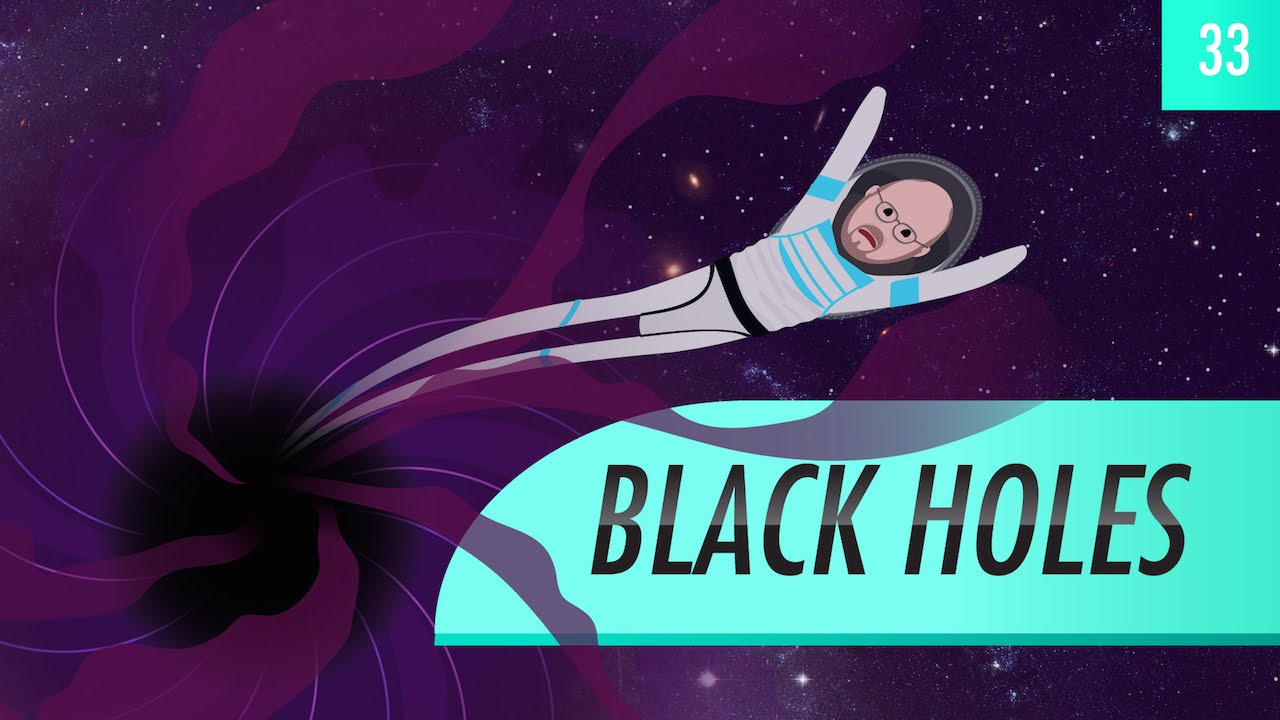
Black Holes: Crash Course Astronomy #33
CrashCourse
Overview
This video explains the formation, properties, and phenomena associated with black holes, the ultimate end-state for massive stars. It clarifies common misconceptions, such as black holes acting as cosmic vacuum cleaners, and details the extreme effects of their gravity, including spaghettification and time dilation. The discussion also touches upon the existence of stellar-mass and supermassive black holes and their profound impact on the structure of the universe, while acknowledging the ongoing scientific inquiry into their complex nature.
How was this?
Save this permanently with flashcards, quizzes, and AI chat
Chapters
- Stars with cores less than 1.4 solar masses become white dwarfs, and those between 1.4 and 2.8 solar masses become neutron stars, whose matter resists further collapse.
- If a stellar core's mass exceeds approximately 2.8 times the Sun's mass, its gravity overcomes neutron resistance, leading to unstoppable collapse.
- This collapse continues until the object's escape velocity reaches the speed of light, at which point it becomes a black hole.
- The boundary where the escape velocity equals the speed of light is called the event horizon; nothing, not even light, can escape from within this boundary.
Understanding the conditions under which black holes form is crucial for comprehending the life cycle of massive stars and the extreme physics governing the universe.
A star's core collapsing past the point where neutron resistance can halt it, leading to a black hole.
- The Sun cannot become a black hole; only stars with initial masses around 20 times the Sun's mass can produce the necessary core mass (over 2.8 solar masses).
- Black holes are not cosmic vacuum cleaners; their intense gravitational pull is significant only at very close distances.
- If the Sun were replaced by a black hole of the same mass, Earth's orbit would remain unchanged because the gravitational influence at that distance depends only on mass, not size.
Clarifying these misconceptions helps learners develop an accurate mental model of black holes, distinguishing scientific understanding from science fiction portrayals.
The Earth would continue to orbit the Sun even if it were replaced by a black hole of equal mass, as long as the orbit remained at the same distance.
- Stellar-mass black holes form from the collapse of massive stars and typically range from 3 to a dozen solar masses.
- Supermassive black holes reside at the centers of galaxies, with masses millions to billions of times that of the Sun, and may play a role in galaxy formation.
- Falling into a stellar-mass black hole causes 'spaghettification' due to extreme tidal forces, stretching an object vertically and compressing it horizontally.
- Supermassive black holes have less severe tidal forces across an object due to their larger size, meaning one might fall in relatively intact.
Recognizing the different scales and extreme physical effects associated with black holes highlights the diverse and powerful phenomena in the cosmos.
A star getting too close to a black hole and being torn apart by tidal forces, resulting in a bright flare of energy.
- According to Einstein's theory, gravity is the warping of spacetime caused by mass and energy.
- Massive objects warp spacetime, and this warping affects the passage of time; time passes more slowly in stronger gravitational fields.
- Near a black hole's event horizon, time slows dramatically from an outside observer's perspective, appearing to stop at the horizon itself.
- An observer falling into a black hole would perceive the universe's entire future history flash before them as they cross the event horizon, while experiencing extreme blueshifted radiation.
This chapter connects black holes to fundamental concepts in physics, illustrating how extreme gravity distorts the very fabric of space and time.
Clocks on Earth tick slightly slower than clocks in orbit due to Earth's gravity, an effect amplified immensely near a black hole's event horizon.
Key takeaways
- Black holes form from the remnants of massive stars when gravity overwhelms all other forces, leading to a complete collapse.
- The event horizon is the defining boundary of a black hole, marking the point of no return where the escape velocity equals the speed of light.
- Black holes are not 'cosmic vacuum cleaners'; their gravitational influence is only overwhelmingly strong very close to their event horizon.
- Tidal forces near black holes can be so extreme that they stretch objects into long, thin strands, a process known as spaghettification.
- The intense gravity of black holes warps spacetime, causing time to slow down significantly for observers near the event horizon.
- Supermassive black holes at galactic centers are vastly larger than stellar-mass black holes and may influence galaxy evolution.
- Our understanding of black holes is still evolving, with ongoing research exploring quantum effects and the nature of the event horizon.
Key terms
Black HoleEvent HorizonEscape VelocityNeutron StarWhite DwarfSpaghettificationSpacetimeTidal ForcesStellar-mass Black HoleSupermassive Black Hole
Test your understanding
- What conditions must a star's core meet to form a black hole instead of a neutron star or white dwarf?
- How does the concept of escape velocity relate to the formation and properties of a black hole?
- Why are black holes not considered cosmic vacuum cleaners, and where is their gravitational pull most potent?
- What is spaghettification, and why does it occur when falling into a stellar-mass black hole?
- How does the presence of a black hole affect the passage of time according to Einstein's theory of relativity?