AI-Generated Video Summary by NoteTube
Downstream Processing
Vidya-mitra
Overview
This video details the critical process of downstream processing in industrial fermentation, focusing on the recovery and purification of products after fermentation. It outlines the six key steps: solid-liquid separation, cell disruption, extraction, concentration, purification, and drying. Various techniques within each step are explained, including filtration, centrifugation, mechanical and non-mechanical cell disruption methods, liquid-liquid extraction, evaporation, membrane filtration, ion exchange, absorption, crystallization, and chromatography. The importance of choosing appropriate methods based on product characteristics, required purity, and cost-effectiveness is emphasized. The video concludes by highlighting downstream processing's vital role in determining the final product's quality and economic viability in fermentation technology.
This summary expires in 30 days. Save it permanently with flashcards, quizzes & AI chat.
Chapters
- •Downstream processing (DSP) follows upstream processing in industrial fermentation.
- •Its primary objective is efficient, reproducible, and safe product recovery to specifications.
- •DSP aims for maximum yield at minimum cost.
- •The module will cover recovery of extracellular products using separation techniques.
- •DSP involves product extraction and purification after formation.
- •Steps depend on product nature, required purity, and if it's intracellular or extracellular.
- •The six main steps are: solid-liquid separation, cell disruption, extraction, concentration, purification, and drying.
- •A diagram illustrates the overall upstream and downstream process flow.
- •This step separates cells from the fermentation broth.
- •Methods include filtration, centrifugation, sedimentation, flocculation, and gravity settling.
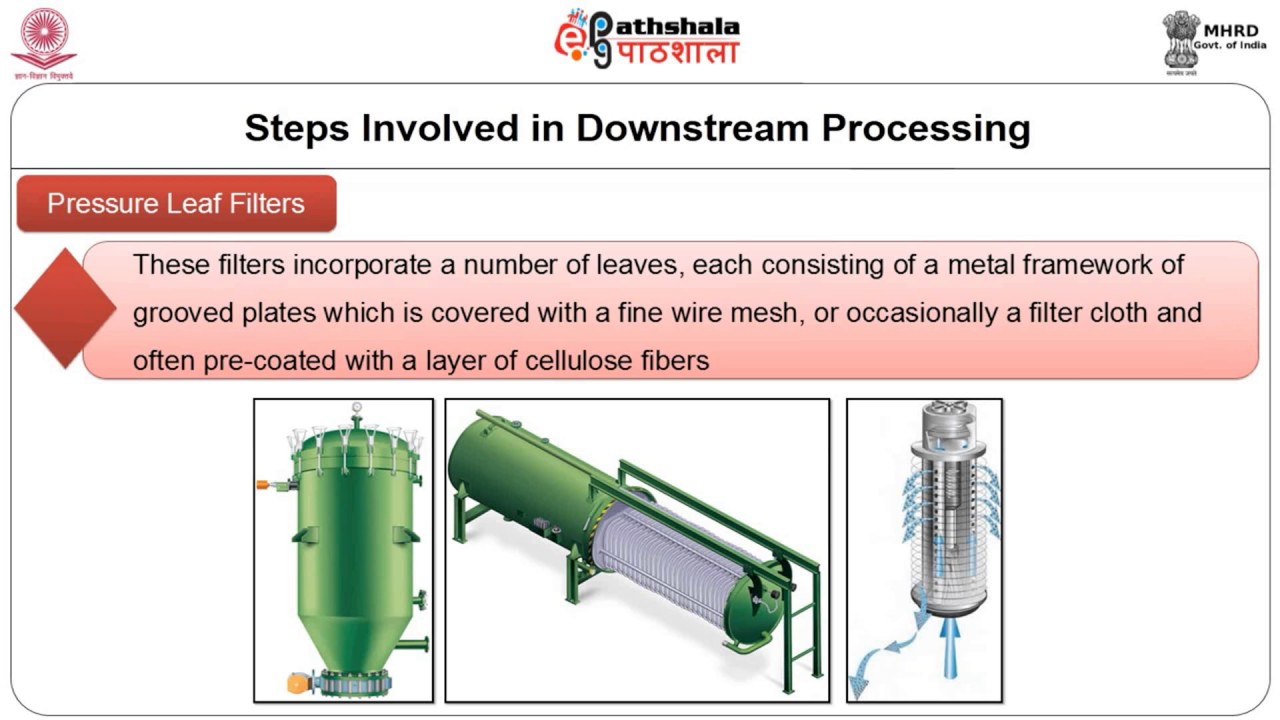
- •Filtration uses a porous medium to retain particles; filter aids like diatomaceous earth are often used.
- •Centrifugation uses density differences to separate solids from liquids.
- •Flocculation aggregates small cells, and flotation uses gas bubbles to raise cells to the surface.
- •Disrupting microbial cells is necessary for intracellular products.
- •Methods are categorized as mechanical and non-mechanical.
- •Mechanical methods include liquid shear (high-pressure homogenizers), solid shear, bead milling, freezing/thawing, and ultrasonication.
- •Non-mechanical methods include autolysis, osmotic shock, heat shock, and chemical treatments (solvents, detergents, enzymes).
- •Extraction recovers compounds into a solvent phase, often involving separation and concentration.
- •Liquid-liquid extraction uses immiscible liquids for differential solubility.
- •Whole broth extraction reduces steps but can be less effective with cells present.
- •Aqueous multiphase extraction separates enzymes from cells using phase-forming polymers.
- •Concentration methods include evaporation, membrane filtration (microfiltration, ultrafiltration, reverse osmosis), ion exchange, and absorption.
- •Purification aims for a highly pure final product, removing impurities from the concentrated fraction.
- •Crystallization is used for low molecular weight compounds like antibiotics and organic acids.
- •Chromatographic methods are essential for separating similar molecules, especially macromolecules like enzymes.
- •Various chromatography types exist: adsorption, ion exchange, gel filtration, affinity, hydrophobic, and covalent.
- •Drying makes the product suitable for handling and storage, minimizing heat damage.
- •Common drying methods are vacuum drying, spray drying, and freeze-drying (lyophilization).
- •Freeze-drying is the most gentle method, suitable for sensitive products like vaccines and enzymes.
- •Downstream processing is crucial for product quality and economic viability.
- •The choice of techniques depends on product characteristics, sensitivity, and cost.
Key Takeaways
- 1Downstream processing is a multi-step process essential for isolating and purifying products from fermentation broths.
- 2The six core stages are solid-liquid separation, cell disruption, extraction, concentration, purification, and drying.
- 3Filtration and centrifugation are primary methods for initial solid-liquid separation.
- 4Cell disruption techniques range from mechanical methods like homogenization to non-mechanical approaches like osmotic shock.
- 5Extraction and concentration steps often employ liquid-liquid extraction, evaporation, and various membrane filtration techniques.
- 6Purification relies heavily on crystallization and diverse chromatographic methods (adsorption, ion exchange, affinity, etc.) to achieve high purity.
- 7Drying methods like spray drying and freeze-drying are critical for product stability and storage, with freeze-drying being the gentlest.
- 8The selection of downstream processing strategies must consider the specific product's properties, required purity level, and overall economic feasibility.