6:51
Properties of Water
Amoeba Sisters
Overview
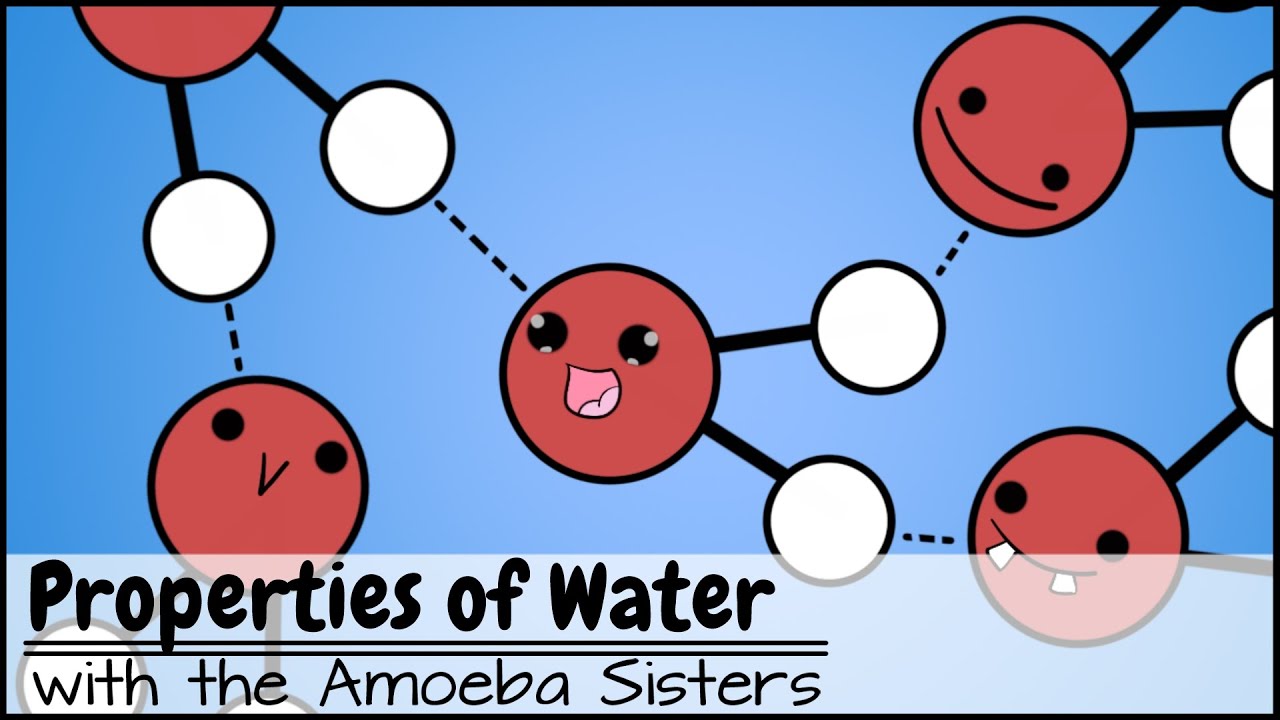
This video explores the unique chemical and physical properties of water that make it essential for life. It explains how water's polarity, resulting from its V-shape and electronegative oxygen atom, leads to hydrogen bonding between molecules. These hydrogen bonds are the foundation for water's remarkable characteristics, including cohesion, adhesion, its ability to act as a versatile solvent, its unusual freezing behavior where ice floats, its high specific heat, and its role in evaporative cooling. The video emphasizes how these properties collectively support biological processes and aquatic ecosystems.
How was this?
Save this permanently with flashcards, quizzes, and AI chat
Chapters
- Water is a polar molecule due to its V-shape and the unequal sharing of electrons with a highly electronegative oxygen atom.
- The oxygen atom gains a partial negative charge, while the hydrogen atoms gain partial positive charges.
- This polarity allows water molecules to form hydrogen bonds with each other.
Understanding water's polarity is fundamental because it directly explains the basis for all of water's other unique and life-sustaining properties.
The oxygen atom pulls electrons closer, making it slightly negative, and the hydrogen atoms slightly positive, enabling attraction to other water molecules.
- Cohesion is the attraction between water molecules themselves, driven by hydrogen bonds.
- Adhesion is the attraction between water molecules and other surfaces, like the walls of plant xylem.
- These properties enable water to move upwards against gravity in plants (transpiration pull) and allow insects to walk on water.
Cohesion and adhesion are critical for transporting water within plants to great heights and for enabling certain organisms to utilize the water's surface.
Water molecules 'sticking' to the xylem walls (adhesion) and pulling each other up like a chain as they evaporate from leaves (cohesion).
- Cohesion among water molecules creates a strong 'skin' on the water's surface, known as surface tension.
- This surface tension is significant enough to support small organisms.
- Many insects and some larger animals can walk or skate on the water's surface due to this property.
Surface tension, a direct consequence of cohesion, allows a variety of small creatures to inhabit the water's surface, expanding ecological niches.
Water striders are able to walk on the surface of a pond without sinking because of water's high surface tension.
- Water's polarity makes it an excellent solvent, particularly for other polar molecules and ionic compounds.
- Many biological and chemical processes within organisms rely on water to dissolve necessary substances.
- This solvent property is vital for functions like kidney filtration and maintaining body fluids.
Water's ability to dissolve a wide range of substances is essential for the chemical reactions and transport systems that sustain life within organisms.
The role of water in the kidneys for filtering waste products from the blood.
- Unlike most substances, water expands and becomes less dense when it freezes.
- This is because hydrogen bonds form a stable, crystalline lattice structure in ice, holding molecules farther apart than in liquid water.
- Floating ice acts as an insulator, protecting aquatic life below from freezing solid.
The fact that ice floats is crucial for the survival of aquatic ecosystems, preventing entire bodies of water from freezing solid and allowing life to persist through cold seasons.
A frozen pond with a layer of ice on top, while fish continue to swim in the liquid water beneath.
- Water has a high specific heat, meaning it requires a large amount of energy to change its temperature.
- This property helps stabilize temperatures in aquatic environments and on Earth's surface.
- Water can absorb significant heat without drastic temperature increases, and release heat slowly as it cools.
Water's high specific heat moderates temperature fluctuations, creating stable environments essential for the survival and function of organisms, especially in aquatic habitats.
Even on a very hot summer day, the water in a lake or ocean remains significantly cooler than the air temperature.
- Evaporation is the process where water molecules with high kinetic energy turn into gas, taking heat energy with them.
- This process effectively cools surfaces, such as skin or plant leaves.
- Both animals (sweating) and plants use evaporative cooling to regulate their temperature and prevent overheating.
Evaporative cooling is a vital mechanism for organisms to dissipate excess heat, preventing cellular damage and maintaining optimal physiological conditions.
Animals sweating on a hot day, where the evaporation of sweat cools their skin.
Key takeaways
- Water's polarity is the root cause of its unique properties, enabling life as we know it.
- Hydrogen bonds between water molecules are responsible for cohesion, adhesion, and surface tension.
- Cohesion and adhesion are essential for water transport in plants and for enabling organisms to utilize water's surface.
- Water's ability to dissolve many substances makes it a critical medium for biological processes.
- The unique property of ice floating protects aquatic life by insulating water bodies from freezing solid.
- Water's high specific heat stabilizes temperatures, creating habitable environments.
- Evaporative cooling is a key mechanism for temperature regulation in both plants and animals.
Key terms
Polar moleculeElectronegativeHydrogen bondCohesionAdhesionSurface tensionSolventSpecific heatEvaporative cooling
Test your understanding
- What makes a water molecule polar, and how does this polarity influence its interactions with other water molecules?
- How do cohesion and adhesion work together to facilitate water transport in tall plants?
- Why is water's property of ice floating so crucial for aquatic life during winter?
- Explain how water's high specific heat contributes to temperature stability in aquatic environments.
- What is evaporative cooling, and how do organisms utilize this property of water for thermoregulation?