23:37
InCubed Industry Day - 16 June 2026
UK Space Agency
Overview
This video introduces the InCubed Industry Day, a UK-led initiative in partnership with ESA, focused on commercializing innovative Earth observation (EO) technologies. With over £7 million available, the program seeks proposals for novel, market-ready solutions, emphasizing tangible deliverables within 18 months. It supports both upstream (e.g., satellite technology) and downstream (e.g., data analytics, services) applications, aiming to bridge the gap from early-stage R&D to commercial viability. The call encourages international collaboration and highlights the shift in the EO market from raw data to actionable intelligence.
How was this?
Save this permanently with flashcards, quizzes, and AI chat
Chapters
- The InCubed program, now in its fourth iteration, is specifically focused on commercialization, distinct from earlier R&D calls.
- Over £7 million is available for innovative proposals with a clear commercial angle, aiming for market readiness.
- Deliverables are expected within an 18-month timeframe to showcase outcomes and support future funding reviews.
- The initiative encourages collaboration with other ESA member states to broaden its scope and impact.
This chapter sets the stage by clarifying the program's commercialization objective and the urgency for market-ready outcomes, which is crucial for understanding the application criteria and expected results.
The speaker mentions that this call is not for early-stage R&D, unlike a future national call for early-stage technology R&D planned for later in the summer.
- The Earth Observation market has shifted from selling raw images ('pixels') to providing decision-ready intelligence and insights.
- The upstream satellite market is experiencing growth, with forecasts predicting a significant increase in market value by 2034.
- A substantial majority of future satellites are expected to be part of constellations, with defense missions driving a large portion of this market value.
Understanding these market shifts is vital for applicants to align their proposals with current industry demands and future growth areas in Earth observation.
The forecast for the upstream market value by 2034 is $182.6 billion, with 82% of satellites expected to be in constellations.
- InCubed supports companies throughout the Earth Observation (EO) company lifecycle, targeting Technology Readiness Levels (TRLs) from 3 to 7 or 8.
- It complements other ESA programs like Future EO (for earlier stages) and the Business Applications (BASS) program (for later stages).
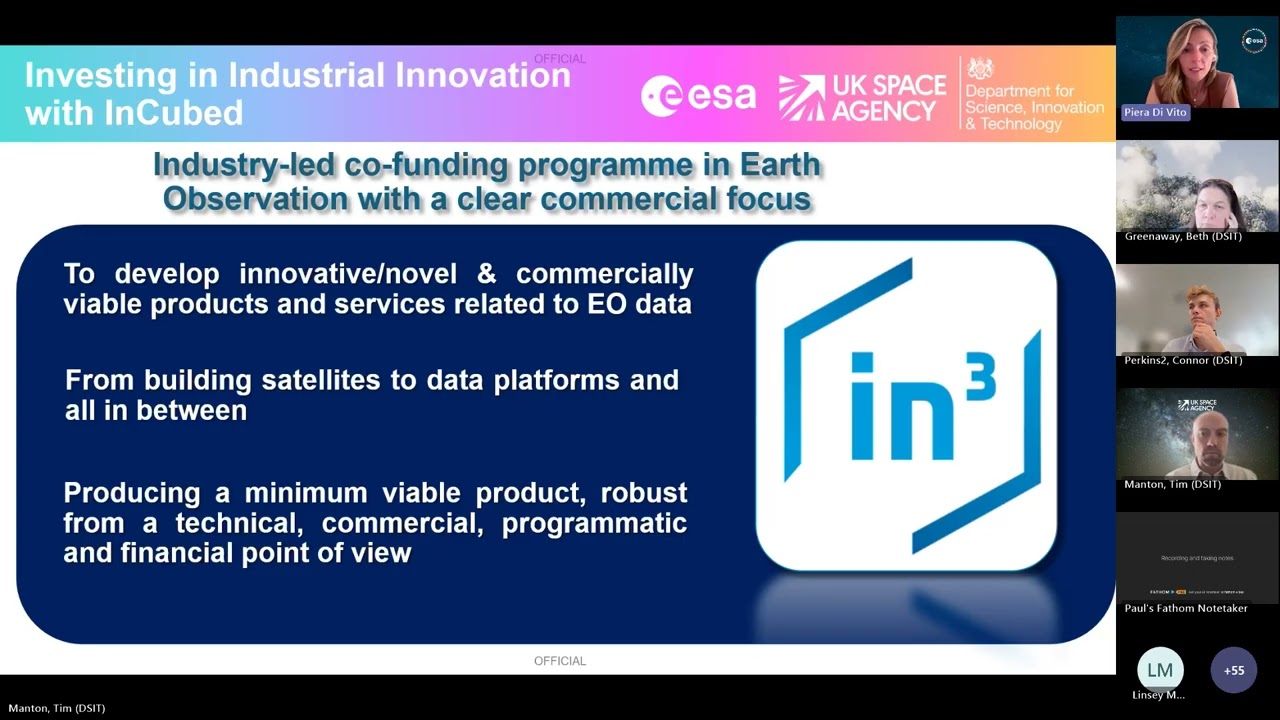
- The core focus of InCubed is to foster innovative and commercially viable EO products and services, supporting both upstream and downstream activities.
- Key criteria for InCubed projects are innovation, commercial viability, and a strong link to Earth observation.
This chapter clarifies InCubed's specific niche within ESA's broader support structure, helping applicants understand where their project fits and what level of maturity is expected.
InCubed targets activities starting from TRL 3 and aiming for TRL 7 up to 8, distinguishing it from earlier stage programs like Future EO and later stage programs like BASS.
- InCubed is a co-funded program with a significant fund size, expecting private co-funding from applicant companies.
- Project sizes can range widely, from €250,000 to €25 million.
- The program has a strong track record, with supported companies generating revenue, reaching investment break-even, and raising substantial private investment.
- InCubed has supported the development of numerous satellites, with several already launched or under development.
These details provide insight into the program's financial structure, scale, and demonstrated success, offering potential applicants confidence and context for their proposals.
Over 50% of companies supported by InCubed are generating revenues, and collectively, supported companies have raised approximately €1 billion in private funding.
- Applicants can apply for 'derisking' (to assess technical/commercial feasibility) or 'product development' (for projects with solid plans).
- Customer validation is a critical component, requiring active involvement from representative customers to define requirements and provide feedback against agreed KPIs.
- A letter of support from an interested customer is mandatory at the proposal part two stage.
- International consortia are welcome, provided non-UK partners are from eligible InCubed member states and receive national support.
Understanding the application stages, the crucial role of customer validation, and the requirements for international collaboration is essential for preparing a successful proposal.
A letter of support from a representative customer is mandatory for proposal part two, demonstrating market interest and validating the product's relevance.
- The current UK call is open until August 21st, with funding ranging from £300,000 to £4 million per project, totaling up to £7.23 million.
- The UK assessment criteria are largely harmonized with ESA's, with an additional focus on UK value chain and competitiveness.
- Projects must demonstrate a credible path to commercialization within 18 months, remaining agnostic across the EO value chain (upstream, midstream, downstream).
- Strong monitoring and evaluation are required, focusing on impact, commercial traction, and progress towards real-world deployment beyond the project lifecycle.
This chapter provides crucial logistical details for UK applicants, including deadlines, funding specifics, and unique assessment criteria, ensuring proposals meet the call's requirements.
The call is deliberately framed around commercialization, not a specific technical theme, to encourage applications across the entire Earth observation value chain.
- Key information, including the call document, can be found on gov.uk and the ESA InCubed portal.
- The application process involves submitting an initial idea via the Orbit portal, followed by proposal part one and part two.
- Dedicated trilateral sessions are available for applicants to discuss specific queries with ESA and UKSA representatives.
- Early engagement with national agencies is recommended, especially for international consortia, to navigate the application process.
This chapter guides applicants on where to find necessary information and how to seek clarification, ensuring they can effectively navigate the application process.
Applicants can schedule 15-minute Teams conversations or in-person meetings on June 23rd to discuss specific application queries with ESA and UKSA.
Key takeaways
- The InCubed program prioritizes commercial viability and market readiness over early-stage research.
- Successful proposals must demonstrate a clear path to generating revenue and achieving tangible outcomes within an 18-month timeframe.
- The Earth Observation market is evolving towards providing actionable intelligence and decision support, rather than just raw data.
- Customer involvement and validation are critical throughout the application and project development process.
- International collaboration is encouraged, but non-UK partners must secure support from their respective national agencies.
- Applicants should leverage the harmonized assessment criteria between ESA and the UKSA while also addressing specific UK competitiveness requirements.
- Projects need to show a plan for sustained market adoption and impact beyond the initial funding period.
Key terms
InCubedESA (European Space Agency)UK Space Agency (UKSA)Earth Observation (EO)CommercializationTechnology Readiness Level (TRL)UpstreamDownstreamDecision-ready intelligenceConstellation eraCo-fundingKey Performance Indicators (KPIs)Customer validation
Test your understanding
- What is the primary objective of the InCubed program as highlighted in this industry day?
- How has the Earth Observation market evolved, and how does this influence the types of proposals sought by InCubed?
- What is the significance of customer validation in the InCubed application and project development process?
- What are the key differences and similarities between the ESA and UKSA assessment criteria for this call?
- How can international companies participate in this UK-focused InCubed call, and what are the requirements for their involvement?