Module 2 Part 1
Michelle Nathan
Overview
This video introduces the fundamental properties of water, emphasizing its unique structure and how it influences its behavior and importance in marine biology. It explains the covalent and dipole nature of water molecules, leading to properties like its unusual density curve where ice is less dense than liquid water. The video also touches upon water's exceptional solvent capabilities due to its polarity and briefly explains different types of chemical bonds (covalent, ionic, hydrogen), highlighting hydrogen bonds as crucial for water's unique characteristics. Finally, it discusses the states of water and its natural triple point, where solid, liquid, and gas phases coexist.
Save this permanently with flashcards, quizzes, and AI chat
Chapters
- Water is essential for all life on Earth and its evolution.
- A water molecule consists of one oxygen atom and two hydrogen atoms joined by covalent bonds, where electrons are shared.
- Due to the angle between hydrogen atoms, water is a dipole molecule, with a negative charge on the oxygen side and positive charges on the hydrogen sides.
- Unlike most substances, water is most dense at 4 degrees Celsius.
- As water cools below 4°C, its molecules spread out, becoming less dense.
- Ice (solid water) is less dense than liquid water, causing it to float.
- This property prevents entire bodies of water from freezing solid, allowing aquatic life to survive beneath the ice.
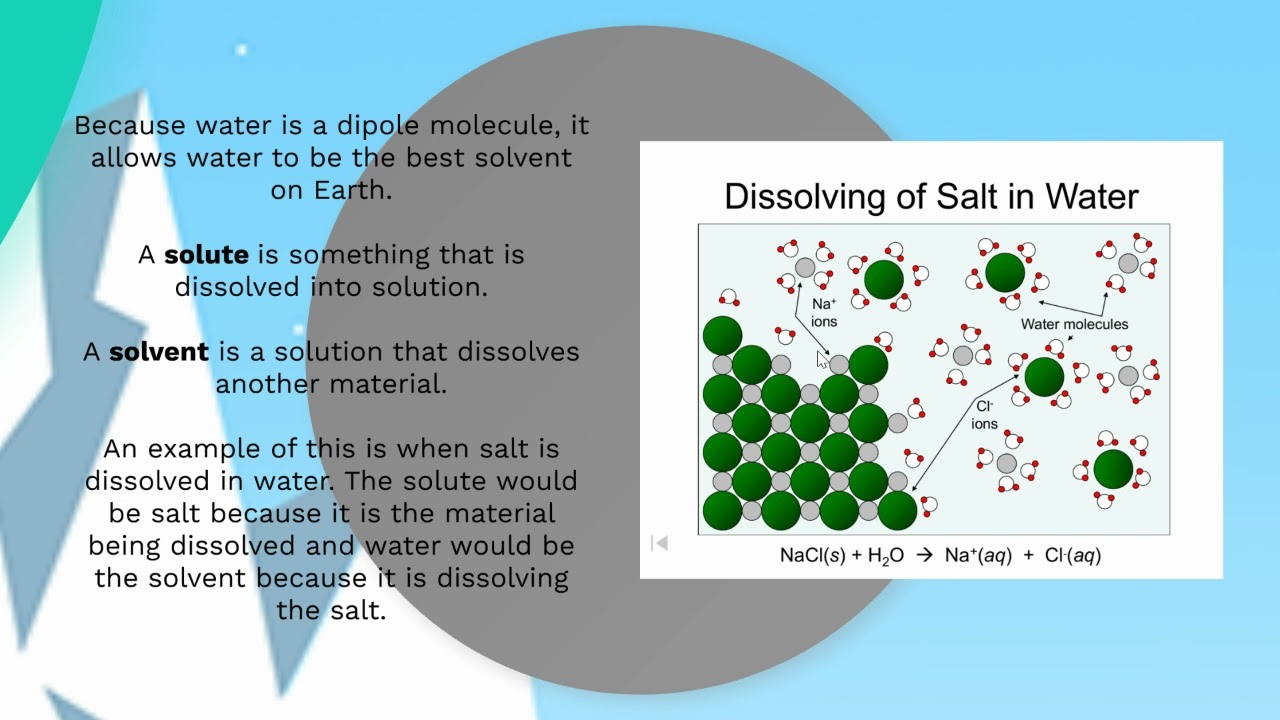
- Water's polarity makes it an excellent solvent, capable of dissolving many substances.
- A solvent is the substance that dissolves another (the solute); water is the solvent, and salt is an example of a solute.
- Water can dissolve ionic substances by surrounding their positive and negative ions.
- Covalent bonds involve the sharing of electrons between atoms, as seen in water molecules.
- Ionic bonds involve the transfer of electrons, creating charged ions that attract each other (e.g., sodium chloride).
- Hydrogen bonds are weak attractions between the positive end of one molecule (like hydrogen in water) and the negative end of another (like oxygen in water).
- Hydrogen bonds are responsible for many of water's unique properties, such as surface tension and thermal stability.
- Water exists in three states: solid (ice), liquid, and gas (water vapor), each with different molecular arrangements and entropy.
- Water is unique because its triple point, where all three phases coexist, occurs under natural temperatures and pressures.
- This natural triple point can be observed in polar regions where ice, liquid ocean water, and water vapor are present simultaneously.
- The normal boiling point is 100°C and freezing point is 0°C at one atmosphere of pressure.
Key takeaways
- Water's molecular structure, with its polar covalent bonds and resulting dipole moment, is the foundation for all its unique properties.
- The density anomaly of water, where ice floats, is a critical factor for the survival of aquatic life in cold climates.
- Water's exceptional ability to dissolve substances is due to its polarity, making it essential for biological transport and chemical reactions.
- Hydrogen bonds, though weak individually, collectively create strong forces that give water properties like surface tension and high heat capacity.
- The existence of a natural triple point for water demonstrates its unique behavior compared to other substances and its presence in multiple states simultaneously on Earth.
- Understanding water's physical and chemical properties is fundamental to comprehending marine biology and the organisms that inhabit it.
Key terms
Test your understanding
- How does the covalent bonding and resulting dipole nature of a water molecule influence its interactions with other molecules?
- Why is water's density anomaly, where ice floats, so important for marine ecosystems?
- What makes water such an effective solvent, and what are the implications for biological processes?
- Compare and contrast covalent, ionic, and hydrogen bonds, explaining the role of hydrogen bonds in water's unique properties.
- What is the significance of water's natural triple point, and where might one observe it?