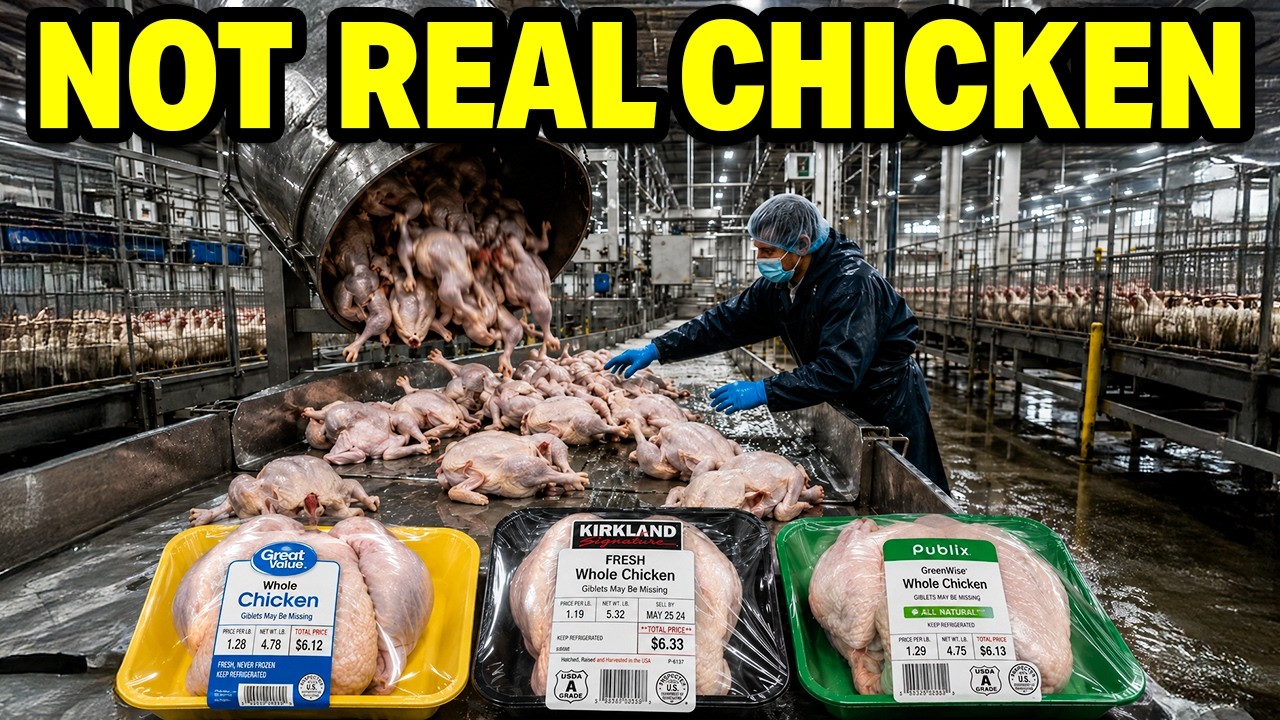
We Tested Chicken From Costco, Walmart, Loblaws, Sobeys & 8 More Canadian Stores | Most Failed
Broken Canada
Overview
This video investigates the composition of chicken sold in major Canadian grocery stores, revealing that most chicken breasts are enhanced with water and sodium phosphate, a practice that increases weight and cost for consumers without improving quality. The investigation details a testing methodology including cook loss, sodium content, and visual inspection for issues like woody breast syndrome. It ranks stores based on their chicken quality, highlighting Whole Foods and Farm Boy as top performers due to their air-chilled and minimally processed products, while cautioning against discount brands that heavily rely on enhancement. The summary emphasizes the importance of reading ingredient labels to make informed purchasing decisions in a market optimized for processors rather than consumers.
Save this permanently with flashcards, quizzes, and AI chat
Chapters
- Historically, chicken was sourced locally and processed regionally, with clear knowledge of its origin.
- Today, a few large corporations (Maple Leaf Foods, Sofina Foods, Olymel) dominate Canadian chicken processing.
- Industrial-scale processing prioritizes cost reduction, often leading to practices that compromise quality.
- The practice of 'enhanced processing' involves injecting raw chicken with water and sodium phosphate.
- Enhanced processing injects solutions (water, sodium phosphate, carrageenan) into chicken to increase weight.
- Chicken is sold by weight, so adding water inflates the price consumers pay for a product that is not pure chicken.
- A 12% water solution means consumers pay for roughly $1.40 of water per kilogram of chicken at $12/kg.
- Disclosure of enhancement is often in small print on the back of packaging, making it easily overlooked.
- The test evaluated six specific metrics, not just taste.
- Cook loss percentage measures how much weight is lost during cooking (normal is 20-25%, enhanced is 35-45%).
- Sodium content per 100g indicates added solutions (natural is 65-75mg, higher suggests enhancement).
- Other tests included visual inspection for 'woody breast syndrome,' smell, purge test (liquid leakage), and label analysis.
- Discount banners like Food Basics and FreshCo performed poorly, with high cook loss and sodium levels.
- Major retailers like Walmart, No Frills, Sobeys, and Metro showed varying degrees of enhancement, with some transparency improvements in higher-tier brands.
- Premium private labels (e.g., Loblaws' President's Choice) generally performed better than their store's discount offerings.
- T&T Supermarket, Costco, Farm Boy, and Whole Foods demonstrated significantly less enhancement and better quality.
- Woody breast syndrome is a quality issue caused by rapid muscle growth in broiler chickens, resulting in a tough, fibrous texture.
- This condition is not a safety hazard and often passes standard inspections, affecting 5-30% of commercial chicken.
- Air chilling cools chicken carcasses using cold air, preventing water absorption, unlike water chilling which adds 4-8% weight.
- Air chilling is more expensive and typically used by premium processors, resulting in a denser, higher-quality product.
- Terms like 'Enhanced,' 'Marinated,' and 'Seasoned' often indicate added water and solutions.
- 'Air-chilled' is a genuine quality indicator, signifying no added processing water.
- The ingredient list is the most reliable indicator: 'Chicken' as the sole ingredient means unenhanced.
- Consumers should check for significant liquid (purge) in the package as a sign of high cook loss.
- Prioritize stores like Farm Boy, Costco, Whole Foods, and T&T for better quality chicken.
- When buying from mainstream banners (Loblaws, Sobeys, Metro), opt for their highest-tier private label products.
- Always flip the package and read the ingredient list; if it's just 'chicken,' it's likely unenhanced.
- Assess the purge in the tray; minimal liquid suggests less added solution and better quality.
Key takeaways
- Most chicken sold in Canadian grocery stores is 'enhanced' with water and sodium phosphate, increasing its weight and cost to consumers.
- The practice of enhancement is often disclosed in small print on packaging, making it difficult for consumers to be fully aware.
- Cook loss percentage and sodium content are key indicators of whether chicken has been enhanced.
- Woody breast syndrome is a quality defect resulting from rapid chicken growth, which affects texture but is not a food safety issue.
- Air-chilled chicken is a premium product that has not absorbed water during processing, unlike water-chilled chicken.
- Consumers must actively read ingredient labels, looking for 'chicken' as the sole ingredient, to identify unenhanced products.
- Stores like Whole Foods, Farm Boy, Costco, and T&T generally offer higher quality, less enhanced chicken compared to discount brands.
Key terms
Test your understanding
- What is 'enhanced processing' and why is it used in chicken production?
- How does the cook loss percentage differ between enhanced and unenhanced chicken breasts, and what does this signify for the consumer?
- What is woody breast syndrome, and why is it a quality concern despite not being a food safety issue?
- How can consumers differentiate between air-chilled and water-chilled chicken based on packaging and processing methods?
- What is the most reliable way to identify unenhanced chicken when shopping, and what specific information should consumers look for on the packaging?