AI-Generated Video Summary by NoteTube
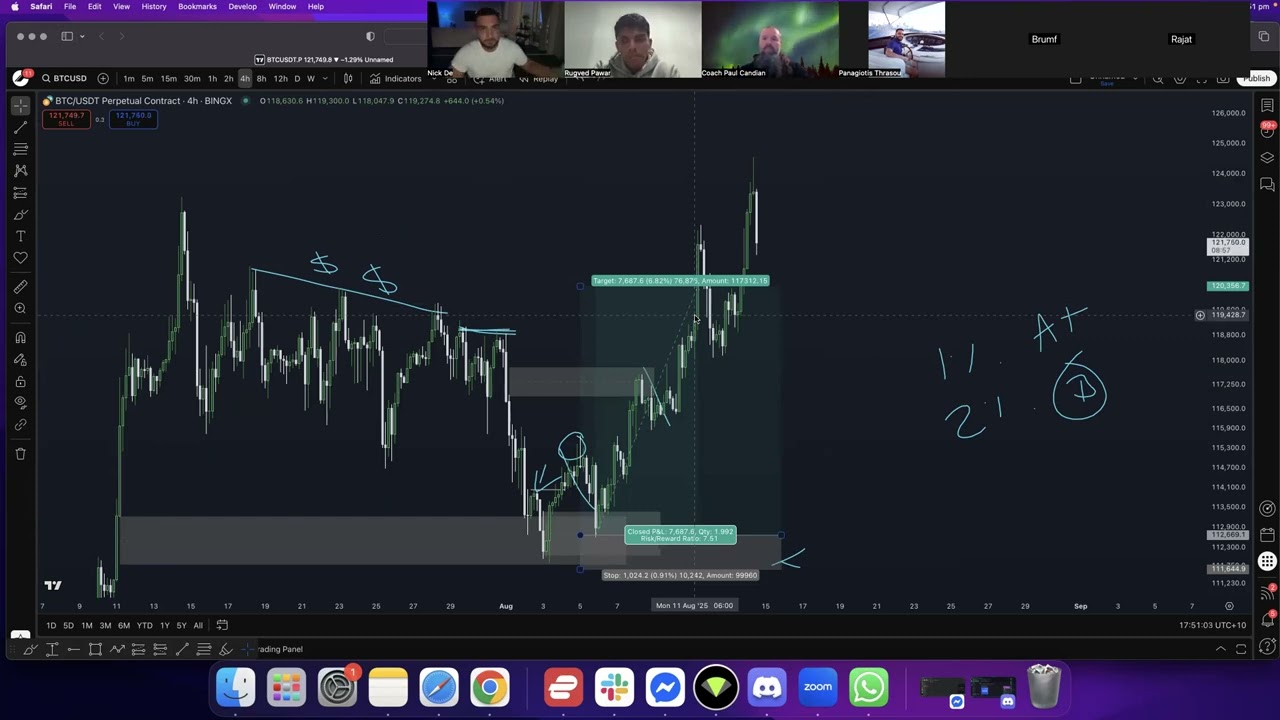
YouTube Video pwF4l4Vd7Js
Overview
This video focuses on building confidence in executing trades by emphasizing the importance of accumulating evidence to support a trade setup, rather than relying on prediction. The speaker uses an analogy of building a case for a jury to explain how traders should gather supporting evidence for both long and short positions, ultimately choosing the direction with the strongest case. Key concepts discussed include differentiating between A+ and B+ setups based on the volume of evidence, managing risk effectively, especially within prop firm challenges, and understanding market dynamics in bull markets. The session also delves into specific trading strategies like sweep and reclaim, the significance of trading liquidity, and adapting trading strategies to current market conditions, using Ethereum vs. Bitcoin as an example. The importance of intuition, continuous learning, and perseverance in trading is also highlighted.
Want AI Chat, Flashcards & Quizzes from this video?
Sign Up FreeChapters
- •Traders often feel like 'deer in headlights' when executing trades despite having the knowledge.
- •The core idea is to build evidence for a trade setup, similar to presenting a case to a jury.
- •Gather evidence for both long and short positions; the direction with more evidence is the one to take.
- •The goal is not to predict the market but to build enough confidence to take calculated risks.
- •A+ setups have abundant evidence, making them high-probability trades.
- •B+ setups have less evidence, indicating lower probability and requiring smaller risk.
- •Lack of internal liquidity or clear reasons for price movement can make a setup less convincing.
- •Market structure, liquidity sweeps, and premium/discount levels are key factors in assessing setup quality.
- •Profitable prop firm trading requires taking calculated higher risks on high-conviction trades.
- •Consistently risking very small amounts (e.g., 0.25%) can hinder progress in prop firm challenges.
- •Understanding the prop firm's business model (eval fees) helps in devising strategies to beat it.
- •Taking larger risks on A+ setups can accelerate passing challenges and lead to significant payouts.
- •In bull markets, focus on trading pullbacks and avoid shorting strong upward momentum.
- •Smaller time frames (hourly, 15-minute) are crucial for identifying intraday opportunities.
- •Even at all-time highs, pullbacks on smaller time frames can offer discounted entry points.
- •Don't predict reversals; trade the prevailing trend until clear signs of reversal appear.
- •Sweep and reclaim setups are most reliable when they occur to the left of the current price leg.
- •Internal structure sweeps are less reliable than external sweeps (liquidity to the left).
- •Confirming entries on lower time frames (5-minute, 15-minute) after a higher time frame sweep improves entry precision.
- •A double sweep (external followed by internal) offers the strongest confirmation.
- •Trading strategies must adapt to different market conditions (e.g., ranging vs. trending).
- •Comparing asset strength (e.g., ETH/BTC ratio) helps decide which asset to trade.
- •Trading the stronger asset generally leads to faster and more profitable moves.
- •This analysis helps traders focus their time and marking levels on the most promising assets.
- •Trading intuition develops over time through experience, allowing for confident decision-making.
- •Taking profit quickly, especially for beginners, builds confidence and minimizes risk.
- •Recognizing when to take partial profits or exit a trade based on market data is crucial.
- •Greed can lead to poor exit decisions; discipline and adherence to a plan are vital.
- •Structure and trading opportunities exist on all time frames, even if not immediately apparent on higher ones.
- •Higher time frame candle wicks often represent smaller time frame structure.
- •Focus on 15-minute and 5-minute time frames for detailed analysis, but always identify higher time frame context first.
- •Liquidity is paramount: identify where it's building and use triggers like sweeps for entries.
Key Takeaways
- 1Build a strong case with evidence for trades rather than relying on predictions.
- 2Differentiate between high-probability (A+) and lower-probability (B+) setups to manage risk effectively.
- 3Strategic risk-taking on high-conviction trades is essential for success, especially in prop firm challenges.
- 4In bull markets, prioritize trading pullbacks in the direction of the trend.
- 5Understand and utilize sweep and reclaim patterns, paying close attention to liquidity to the left of price.
- 6Compare asset strengths (e.g., ETH vs. BTC) to trade the most promising opportunities.
- 7Develop trading intuition and discipline, particularly around taking profits and managing exits.
- 8Structure and trading opportunities exist on all time frames; learn to identify them by zooming in and out.