9:39
What Assets Hold Their Value In a Currency Reset, and Why.
Lock Stock Finance
Overview
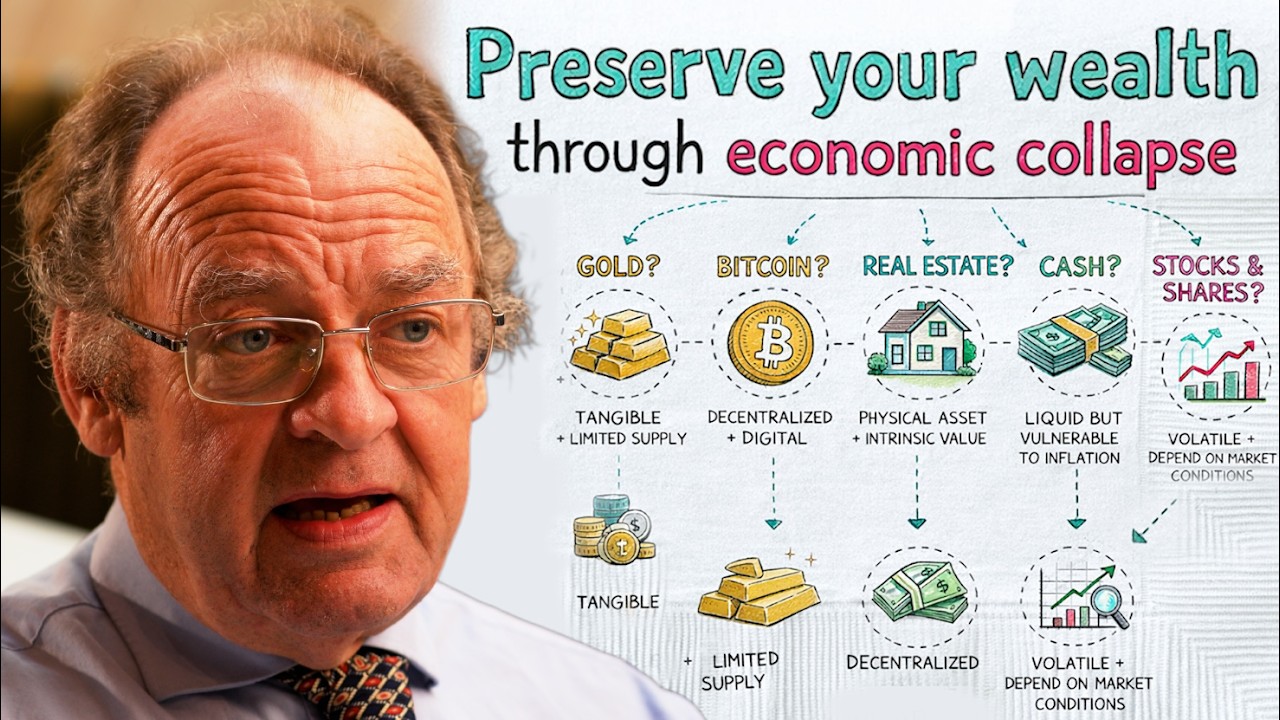
This video explains the concept of a currency reset, a rare and disruptive event occurring roughly every 75-100 years due to unsustainable debt and inequality. It highlights historical precedents and discusses which assets are likely to retain or increase their value during such a crisis. The video contrasts traditional assets like gold and real estate with newer ones like Bitcoin, and analyzes the risks associated with cash, stocks, and large savings accounts in a potential future financial upheaval.
How was this?
Save this permanently with flashcards, quizzes, and AI chat
Chapters
- Currency resets are major, infrequent (75-100 year cycles) financial system collapses driven by unmanageable debt and inequality.
- Historically, these events have led to crises like the Great Depression and World Wars.
- While disruptive, some wealthy families have preserved and even grown fortunes during these periods by converting wealth into resilient assets.
- The goal is to understand how to protect and grow wealth during such a seismic financial shift.
Recognizing the historical patterns and potential impact of a currency reset is crucial for proactive financial planning and wealth preservation.
The hyperinflation crisis in Germany in 1923, where people carried cash in wheelbarrows and burned money for warmth, illustrates the extreme devaluation of currency during a reset.
- Gold has seen significant price increases as central banks and investors seek a safe haven against volatile currencies.
- Physical gold's value is intrinsic and independent of banks or government policies, making it difficult to devalue or control.
- Unlike currencies, gold cannot be easily inflated by printing more money, as new gold creation is a difficult and expensive process.
- It's important to distinguish between physical gold (coins, bars) and 'paper gold' (contracts, digital records), as the latter carries risks of not being fully backed by real assets.
Understanding gold's historical role and unique properties as a physical asset provides a foundational strategy for wealth preservation during financial instability.
The rarity of gold, with all the world's supply fitting into a 23-meter cube, explains its inherent value and why it's sought after.
- Bitcoin offers characteristics like self-custody, easy transfer, and fungibility, potentially making it resilient during a currency reset.
- However, Bitcoin is a very new asset class, lacking historical data on its performance during major global crises.
- Concerns exist about Bitcoin being a speculative bubble, similar to historical events like Tulip Mania, where prices detached from intrinsic value.
- While resistant to direct government manipulation, Bitcoin faces regulatory uncertainty as governments develop their approach to digital currencies.
Evaluating Bitcoin requires balancing its innovative technological features against its unproven track record and speculative risks in extreme economic conditions.
Tulip Mania in the 1600s, where rare tulip bulbs became incredibly valuable before the market crashed, serves as a cautionary tale for new, hype-driven asset classes like Bitcoin.
- Central Bank Digital Currencies (CBDCs) are poised to make physical cash obsolete, rendering it an unreliable asset.
- Stocks and shares are deeply embedded within the existing financial system and priced in legacy currencies, making them vulnerable to systemic reshaping.
- Large savings, pensions, and investment accounts held within the system are at risk of being devalued or 'confiscated' through mechanisms like Universal Basic Income (UBI) funding.
- The system dictates the conversion and use of wealth held as legacy assets, potentially leading to a feeling of asset seizure for those with significant savings.
Understanding the systemic risks associated with cash, stocks, and traditional savings is critical for recognizing why rebalancing assets is necessary before a currency reset.
The concept of Universal Basic Income (UBI) is presented as a potential future mechanism where governments might taper or write down large legacy claims (like substantial pensions or savings) to fund regular payments to all citizens.
- Real estate offers utility as shelter and is difficult to move, giving it intrinsic value.
- However, it is tied to the financial system and is easily taxable, making it less independent than gold or Bitcoin.
- More rural and self-sufficient properties offer greater resilience against civil unrest, pollution, or crime.
- Its value is influenced by the broader financial system, though its fundamental utility as a place to live or work provides a baseline.
Real estate's position as a tangible asset with utility, yet still connected to the financial system, means its resilience is conditional and benefits from self-sufficiency.
A rural, self-sufficient property is more resilient than an urban apartment during a currency reset because it is less exposed to potential civil volatility like rioting or increased crime.
Key takeaways
- Currency resets are cyclical, historically disruptive events driven by debt and inequality, necessitating proactive financial preparation.
- Physical gold offers a time-tested hedge against currency devaluation due to its intrinsic value and independence from financial systems.
- Bitcoin presents a novel digital alternative, but its long-term resilience during major crises remains unproven due to its newness and speculative nature.
- Cash is likely to become obsolete with the rise of CBDCs, and traditional investments like stocks are vulnerable to systemic changes.
- Wealth held within the existing financial system, especially large savings and pensions, faces significant risks of devaluation or redirection.
- Real estate retains intrinsic value as shelter, with rural and self-sufficient properties offering greater protection.
- Rebalancing assets away from legacy financial systems towards more independent stores of value is a key strategy for navigating a currency reset.
Key terms
Currency ResetHyperinflationSafe HavenPhysical GoldPaper GoldBitcoinTulip ManiaCentral Bank Digital Currency (CBDC)Universal Basic Income (UBI)Legacy Asset
Test your understanding
- What are the primary drivers that historically lead to a currency reset?
- How does the intrinsic nature of physical gold protect its value during a currency crisis, unlike fiat currencies?
- What are the main arguments for and against Bitcoin's potential as a resilient asset in a currency reset?
- Why is cash considered a vulnerable asset in the context of future currency resets and the rise of CBDCs?
- How can the structure and location of real estate influence its resilience during periods of financial instability?