5:47
Enzymes (Updated)
Amoeba Sisters
Overview
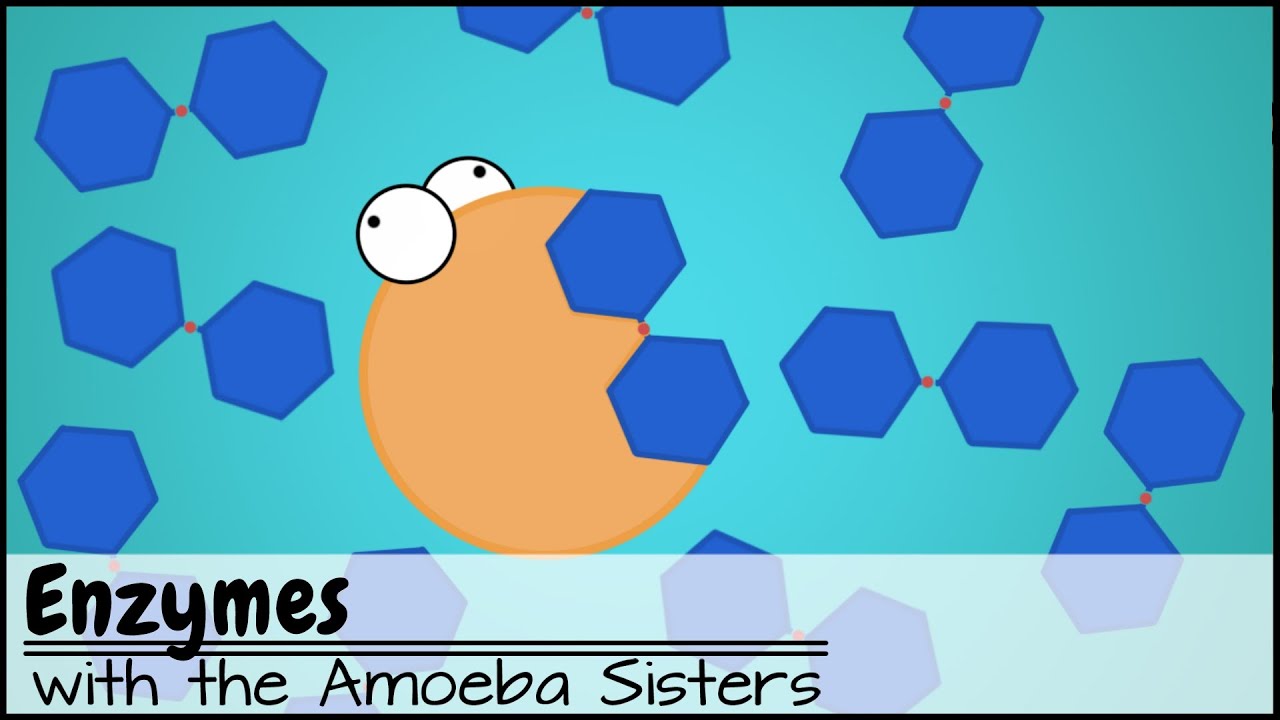
This video explains the function and importance of enzymes, which are primarily proteins that act as biological catalysts. It uses the Pac-Man analogy to illustrate how enzymes have specific active sites that bind to substrates, facilitating chemical reactions. The video highlights that enzymes speed up reactions, are not consumed in the process, and have optimal conditions for activity. It also introduces cofactors and coenzymes as helpers and explains denaturation when enzymes are exposed to unfavorable environments. Finally, it touches upon the role of enzymes in digestion and their significance in medical research and disease.
How was this?
Save this permanently with flashcards, quizzes, and AI chat
Chapters
- Most enzymes are proteins, similar to how Pac-Man characters are specific entities in a game.
- Enzymes possess a uniquely shaped 'active site' designed to bind to specific molecules called 'substrates'.
- This binding is highly specific, meaning only certain substrates fit into an enzyme's active site.
- Induced fit allows the active site to slightly change shape for a more perfect, temporary bond with the substrate.
Understanding the specific binding mechanism of enzymes is crucial because it explains how they can selectively target and process molecules within the body.
The Pac-Man character and the pebbles it consumes, illustrating the enzyme (Pac-Man) and substrate (pebbles) relationship.
- Enzymes significantly accelerate chemical reactions that could occur slowly on their own.
- They achieve this by lowering the activation energy required for a reaction to proceed.
- The enzyme facilitates the conversion of substrates into 'products'.
- Enzymes are not used up during the reaction and can be reused multiple times, acting as catalysts.
Enzymes are essential for life because they make biological processes happen quickly enough to sustain living organisms.
The enzyme lactase breaks down lactose (a sugar) into simpler sugars that the body can digest, a process that would be too slow without the enzyme.
- Enzymes sometimes require assistance from other molecules to function effectively.
- Cofactors are typically inorganic ions that help enzymes.
- Coenzymes are organic molecules, often derived from vitamins, that assist enzymes.
- These helpers can bind to the enzyme or substrate, aiding in the conversion process.
Recognizing the need for cofactors and coenzymes highlights that enzyme function is often part of a larger, collaborative biochemical network.
While not explicitly named, the concept of helpers binding to the enzyme or substrate to facilitate its job is the core idea.
- Each enzyme functions best within a specific range of temperature and pH.
- Deviations from these optimal conditions can disrupt the enzyme's shape and function.
- Denaturation occurs when an enzyme loses its specific three-dimensional structure, rendering it inactive.
- This loss of shape prevents the enzyme from binding to its substrate.
Understanding optimal conditions and denaturation explains why environmental factors are critical for biological processes and how disruptions can lead to dysfunction.
An enzyme in the stomach requires a highly acidic pH to function; if placed in a neutral environment, it would denature and stop working.
- The digestive system relies heavily on various enzymes like lipase (for fats), amylase (for starch), and protease (for proteins).
- Lactose intolerance is an example of a condition caused by insufficient production of the lactase enzyme.
- Many diseases are linked to the overproduction or underproduction of specific enzymes.
- Enzymes play a vital role in regulating numerous bodily processes and are a focus of medical research.
The widespread involvement of enzymes in digestion and disease underscores their fundamental importance to health and medicine.
People with lactose intolerance cannot efficiently break down lactose because they lack sufficient lactase enzyme.
Key takeaways
- Enzymes are biological catalysts, mostly proteins, that dramatically speed up chemical reactions necessary for life.
- The specific shape of an enzyme's active site determines which substrate it can bind to, enabling selective action.
- Enzymes are not consumed in reactions and can be reused, making them efficient workers in biological systems.
- Factors like temperature and pH are critical for enzyme function; extreme conditions can cause enzymes to denature and become inactive.
- Enzymes are crucial for digestion and many other bodily functions, and their malfunction can lead to diseases.
- Cofactors and coenzymes can assist enzymes, highlighting the complex interactions within biochemical pathways.
Key terms
EnzymeProteinActive siteSubstrateProductCatalystLactaseLactoseCofactorCoenzymeDenaturationpH
Test your understanding
- How does the specific shape of an enzyme's active site relate to its function?
- Why are enzymes considered catalysts, and what does this mean for biological processes?
- What happens to an enzyme if it is exposed to a pH or temperature outside its optimal range?
- Explain the role of enzymes in digestion, using an example like lactase.
- What are cofactors and coenzymes, and how do they contribute to enzyme activity?