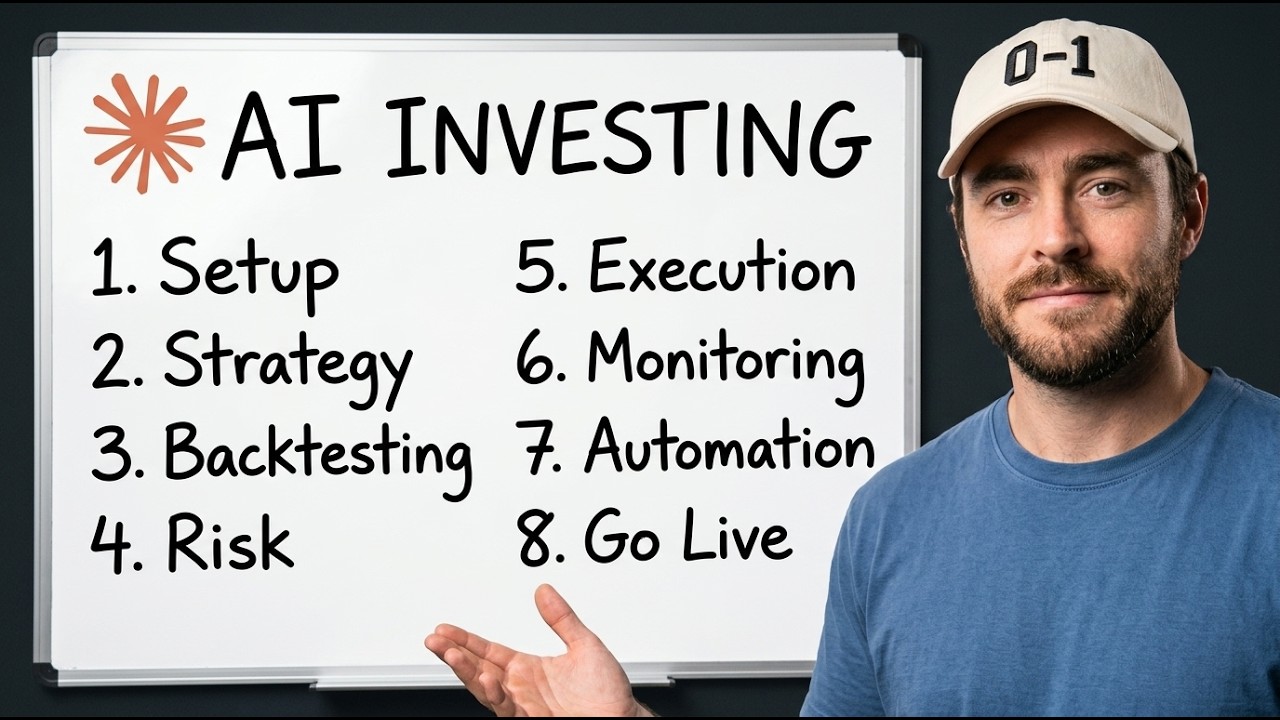
The Complete AI Trading System (Full Course)
Lewis Jackson
Overview
This video course introduces a comprehensive AI trading system designed to automate investment strategies. The creator shares a system that significantly grew their personal portfolio, emphasizing the importance of understanding the underlying logic rather than just copy-pasting. The course covers setting up AI agents, backtesting strategies, risk mitigation, trade execution, feedback loops, and cloud deployment. It also delves into technical aspects like APIs and MCPS for data integration and interaction with trading platforms like TradingView, and provides a one-shot prompt to install the entire system. The ultimate goal is to transform users from gamblers into 'the house' by building a robust, self-improving trading system.
Save this permanently with flashcards, quizzes, and AI chat
Chapters
- The course presents an AI trading system that has yielded significant personal portfolio growth.
- Understanding the system's logic and mental models is crucial for effective implementation and better results.
- The entire system, including copy-paste prompts, will be provided to the viewer.
- The course is structured into eight sections covering the system's components and functionality.
- A 'strategy' is like a sports car (e.g., a trading algorithm), while the 'system' is the infrastructure (e.g., roads, traffic rules) that enables or constrains it.
- A high-quality system (like well-built roads) allows a powerful strategy (like a Ferrari) to perform optimally and safely.
- Trade intent originates from the strategy when conditions are met, but the system acts as a gatekeeper, enforcing rules like risk limits before a trade is executed.
- The system's rules are crucial for preventing losses from unforeseen circumstances or poorly defined strategy conditions, highlighting the need for thorough rule-setting and paper trading.
- APIs (Application Programming Interfaces) allow different software systems to communicate and exchange data, often requiring an API key for access.
- An API facilitates a data loop, where data from external sources (like weather or financial markets) is fed into your system.
- MCPS (Machine Control Programs) are used when a platform, like TradingView, doesn't offer a suitable API for direct interaction.
- MCPS enable an AI agent to interact with a platform's interface by directly analyzing its underlying code, providing real-time data and control without relying on slower methods like screenshots.
- The course utilizes Claude code, often within an Integrated Development Environment (IDE) like Cursor for better project management, to build and run the AI trading system.
- Key steps involve setting up Claude in 'code mode' with bypassed permissions for autonomous operation.
- The TradingView MCP can be installed by copying and pasting a provided prompt into the Claude code terminal.
- The system can be configured to display specific charts, add indicators, and even generate trading strategies as Pine Scripts directly within TradingView.
- Traditional backtesting can be flawed due to 'look ahead bias,' where future information influences past performance evaluation.
- Proper backtesting requires mitigating look ahead bias to accurately reflect how a strategy would have performed with only historical data available at the time.
- Factors like slippage and trading fees can significantly erode perceived profits, necessitating their inclusion in strategy calculations.
- A risk engine, incorporating elements like drawdown limits and confidence scales, is vital for transforming from a gambler to 'the house,' ensuring trades are only made under defined, favorable conditions.
- The AI system incorporates a feedback loop for continuous learning from both profitable trades and losses.
- Reflection on good and bad trades helps the AI build confidence scores for different data points and market conditions.
- This machine learning process allows the AI to adapt its strategy over time, leading to more frequent and better trades.
- Paper trading is essential for encountering unexpected scenarios and refining rules before risking real capital.
- A 'one-shot prompt' is provided to install the entire AI trading system, including all skills, MCPs, and API connections.
- The installation process automates the setup of backtesting tools, data integration (e.g., Alpha Vantage), and strategy implementation.
- Users can either use a pre-defined strategy (like a golden cross strategy for SPY) or input their own custom strategy.
- The system can be configured for paper trading initially, with the option to transition to live trading after sufficient validation and confidence are established.
Key takeaways
- A robust AI trading system requires both a powerful strategy and a well-designed, constraining system infrastructure.
- APIs and MCPS are critical technical components for enabling AI agents to access data and interact with trading platforms.
- Thorough backtesting, accounting for look ahead bias and transaction costs, is essential for realistic strategy evaluation.
- Risk mitigation through defined rules and limits is paramount to long-term success, turning the user into 'the house' rather than a gambler.
- Continuous learning and reflection are built into the AI system, allowing it to adapt and improve its trading performance over time.
- Paper trading is a crucial intermediate step to identify and address unforeseen issues before deploying real capital.
- The provided one-shot prompt simplifies the complex installation of the entire AI trading system, making advanced capabilities accessible.
Key terms
Test your understanding
- What is the fundamental difference between a trading 'system' and a trading 'strategy', and why is this distinction important?
- How do APIs and MCPS enable an AI trading system to interact with external data and platforms like TradingView?
- Explain the concept of 'look ahead bias' in backtesting and how it can lead to inaccurate performance evaluations.
- Why is a risk engine crucial for an AI trading system, and what are some components that might be included in such an engine?
- How does the AI system learn and improve over time, and what role does paper trading play in this process?