Day4 1 Rolling Three Hour Line Apex 3 Cody
Mo Del
Overview
This video demonstrates a live, candle-by-candle analysis of a trading day using a 'rolling three-hour line apex' strategy. The presenter walks through various market scenarios, explaining how to identify 'line signatures' and 'apex signatures' based on price action within specific hourly (H1, H2, H3) and quarter (Q1, Q2, Q3, Q4) intervals. The core concept is to predict the market's direction over a three-hour period and adapt as new price data emerges, emphasizing a systematic, rule-based approach grounded in mathematical probability rather than pure theory. The session highlights how to manage expectations, identify continuations versus reversals, and the importance of consistent application of trading rules.
Save this permanently with flashcards, quizzes, and AI chat
Chapters
- The video focuses on analyzing price action hour by hour within a rolling three-hour window.
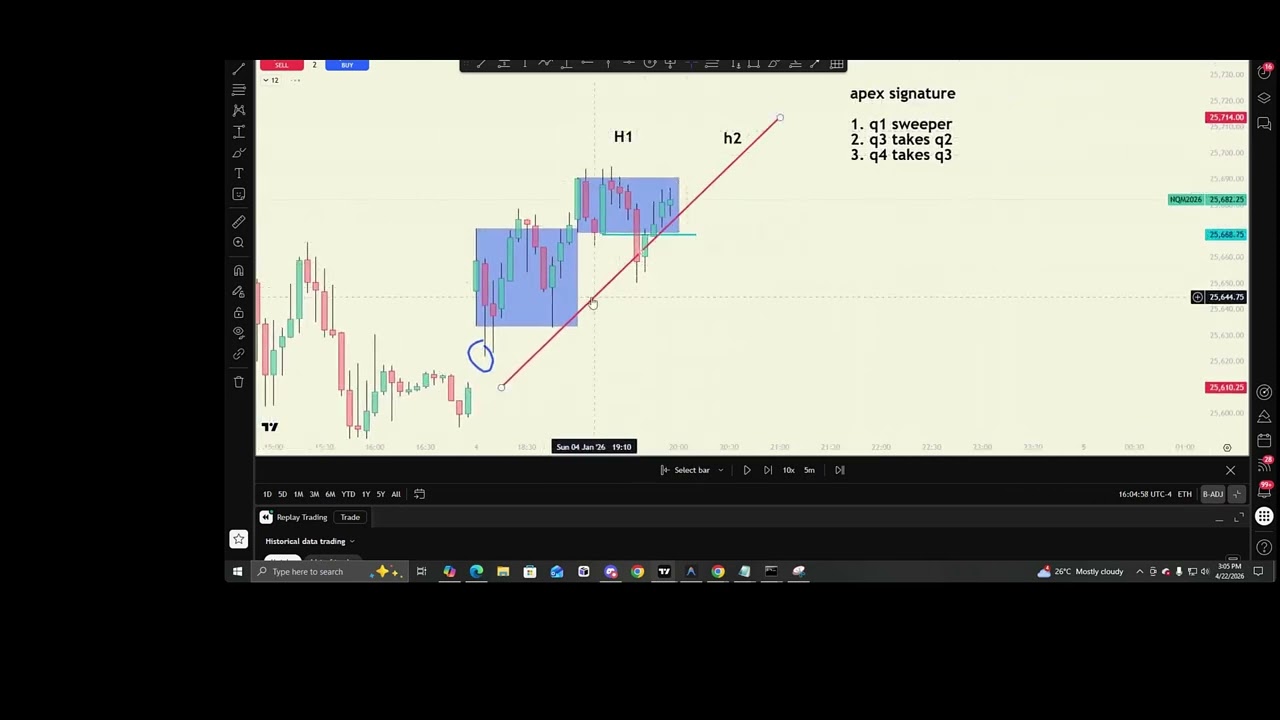
- Key concepts include 'line signatures' (predictable directional moves) and 'apex signatures' (specific patterns indicating potential reversals or continuations).
- The analysis is interactive, with the presenter asking viewers to identify patterns and expectations in real-time.
- The goal is to apply a systematic approach to trading based on observed patterns and probabilities.
- Apex signatures, such as 'Q3 takes Q2' or 'Q1 sweeper', signal significant price action events.
- When an apex signature occurs, the current hour (e.g., H2) often becomes the new H1, resetting the analysis window.
- The occurrence of an apex signature prompts a re-evaluation of the expected market direction.
- Even after an apex signature, the expectation is often for continuation rather than immediate reversal, especially if the market is in an inside bar formation.
- An 'inside bar' occurs when the current hour's price action is contained within the previous hour's range, indicating indecision.
- A 'wick rejection' happens when price briefly moves beyond key levels (like the midpoint or open price) but fails to sustain the move, often signaling a continuation in the original direction.
- When an inside bar forms, the original trading expectation (e.g., line up or line down) is maintained until proven otherwise, as continuation is statistically more probable.
- Breaching key levels like the midpoint and open price with force can indicate a wick rejection, but confirmation is needed, especially on inside bars.
- The 9:00 AM hour is treated as a fresh start (H1), regardless of previous action, due to market skew and the influence of the 9:30 AM event.
- During the 9:00 AM hour, the presenter disregards typical quarter analysis, focusing instead on the candle's close color (bullish or bearish) to predict the direction.
- The presenter shares data analysis showing that 'Q1 sweepers' strongly correlate with apex signatures, while 'perfect lines' and 'false05' patterns lean towards directional continuation.
- The 'none' classification in the data refers to inside bars, which statistically favor continuation.
- The core principle is repetition: applying the same set of rules consistently across different trading sessions and scenarios.
- The goal is not to be right 100% of the time but to be on the right side of the market more often than not, combined with proper risk management.
- Traders should identify which systems (rolling three-hour, candle science, etc.) best fit their style and build a personalized trading plan.
- The presenter emphasizes that the system is built on math and probability, not just theory, and encourages self-testing.
Key takeaways
- Market analysis should be systematic, breaking down price action into hourly and quarterly intervals to identify predictable patterns.
- Apex signatures signal potential turning points or significant moves, often requiring a reset of the analysis window.
- Inside bars and wick rejections are key indicators of market indecision and continuation probabilities.
- The 9:00 AM hour has unique characteristics that require a modified analytical approach.
- Trading success relies on consistent application of a rule-based system and mathematical probability, not on predicting every single move.
- Understanding the data behind trading patterns (like Q1 sweepers leading to apexes) builds confidence and reinforces the system's logic.
- Traders should adapt the provided systems to their personal style and risk tolerance to build an effective trading plan.
Key terms
Test your understanding
- How does identifying a 'line signature' differ from identifying an 'apex signature' in terms of market expectation?
- What is the significance of an 'inside bar' in the context of a rolling three-hour analysis, and how should a trader typically react to it?
- Explain the unique approach to analyzing the 9:00 AM hour compared to other hours in the trading day.
- Why is it important to understand the mathematical basis and data behind trading patterns like Q1 sweepers and apex signatures?
- How can a trader adapt the presented systematic approach to fit their personal trading style and risk management strategy?