This ONE Candle Will CHANGE Your Trading | Candle Range Theory (CRT)
Nitro Trades
Overview
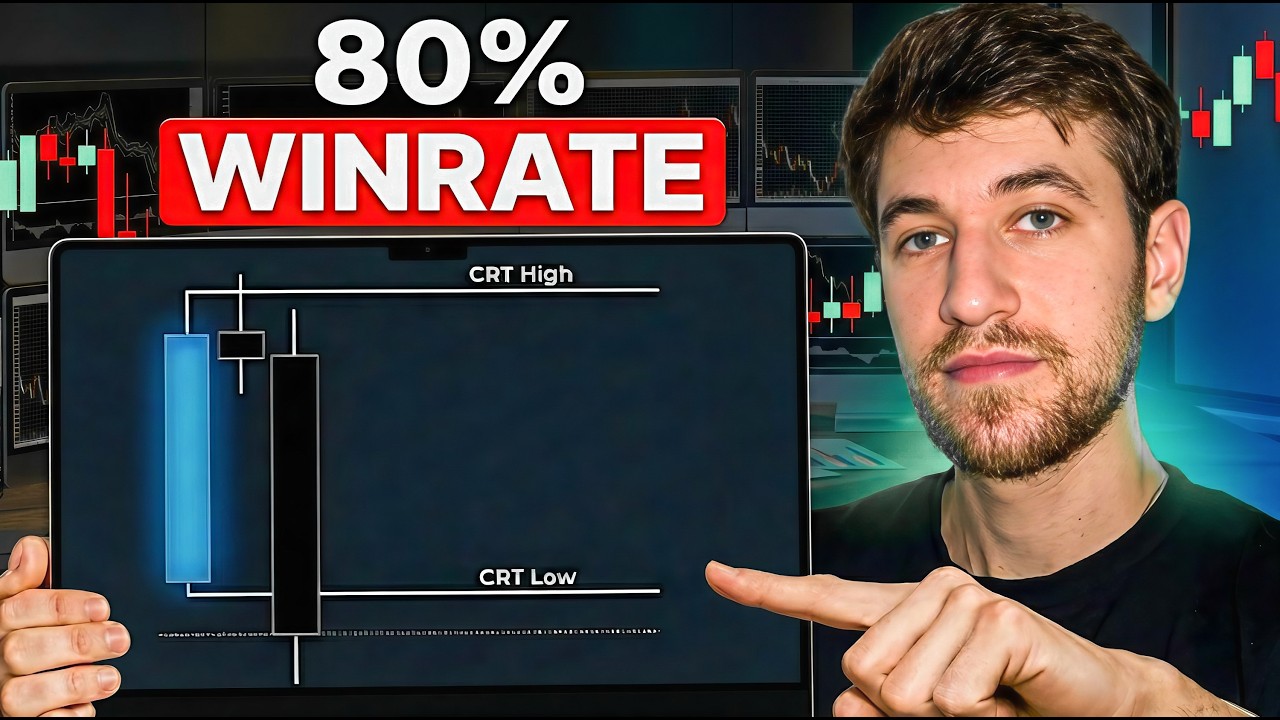
This video introduces Candle Range Theory (CRT), a trading strategy focused on identifying and executing a single, high-probability trade setup each day. The core concept involves marking the high and low of a previous candle, waiting for a price break and reversal back within that range, and then entering a trade on the break of the subsequent candle's midpoint, targeting the opposite end of the initial range. The strategy emphasizes trading with the prevailing market trend and is best applied during specific trading sessions, particularly the New York session. The presenter stresses the importance of discipline, taking only the 'perfect' setup, and backtesting the strategy for verification.
Save this permanently with flashcards, quizzes, and AI chat
Chapters
- CRT is a simple, high-probability trading setup designed to be taken once per day.
- The strategy focuses on identifying a specific three-candle sequence.
- The goal is to execute one perfect trade and then stop trading for the day to avoid overtrading.
- Many traders incorrectly apply CRT by taking too many setups or marking ranges incorrectly.
- Select a time frame: 1-hour, 30-minute, or 15-minute (1-hour often yields higher quality, 15-minute is more frequent).
- Step 1: Mark the high and low (including wicks) of the most recent completed candle.
- Step 2: Wait for price to break either the high or low and then reverse, with the colored part of the candle closing back inside the marked range.
- Step 3: Identify the third candle, which should make a U-shaped reversal towards the opposite end of the initial range.
- Entry Trigger: On a lower time frame (1-2 minute), enter when price breaks the high of the second (reversal) candle (for a long trade) or the low (for a short trade).
- The market moves to fill outstanding orders (liquidity).
- When price breaks an extreme (high or low), it's often to 'pick up' orders (e.g., sell orders at a high).
- After collecting these orders, the market needs to 'deliver' them to the other side (e.g., sell to buyers at the opposite extreme).
- CRT captures this movement where price seeks to complete a full range move after an initial liquidity grab and reversal.
- Entry is taken on the break of the middle (second) candle's high or low on a lower time frame.
- The Take Profit (TP) target is the high or low of the initial (first) candle in the sequence.
- The Stop Loss (SL) is adjusted to achieve a 1.5:1 or 2:1 risk-to-reward ratio.
- The strategy is applicable across all trading sessions but is most effective during the New York session (starting around 9:30 AM EST).
- Always align CRT trades with the overall market trend.
- Identify the trend by observing higher highs and higher lows (uptrend) or lower highs and lower lows (downtrend) on higher time frames (e.g., 1-hour).
- If the market is in a strong uptrend, only look for bullish CRT setups (longs).
- If the market has shifted to making lower highs, bias towards bearish CRT setups (shorts).
- Avoid trading against a strong, established trend.
- The video demonstrates live examples of CRT on MNQ during the New York session.
- It highlights the importance of patience and waiting for the specific setup to form.
- The presenter encourages viewers to backtest the strategy themselves on historical data.
- The strategy should ideally be tested in live markets for a period (week/month) to build confidence.
Key takeaways
- Candle Range Theory (CRT) is a high-probability trading strategy focused on a specific three-candle pattern.
- The core of CRT involves a price break and reversal back within the previous candle's range, followed by a move to the opposite extreme.
- Always trade CRT in alignment with the dominant market trend identified on higher time frames.
- Discipline is paramount: take only the first valid CRT setup of the day and then stop trading.
- The strategy relies on the market's tendency to seek liquidity and fill orders at price extremes.
- Accurate identification of the initial candle's range (including wicks) and the entry trigger on the second candle is critical.
- Backtesting and live market practice are essential to validate and master the CRT strategy.
Key terms
Test your understanding
- What are the three essential steps to identify a Candle Range Theory (CRT) setup?
- Why is it important to trade CRT setups in the direction of the overall market trend?
- How does the concept of 'liquidity' explain the effectiveness of CRT?
- What is the specific entry trigger for a CRT trade, and where is the typical take-profit target set?
- How can a trader determine if the market trend has shifted, and why is this crucial for applying CRT?