1:05:05
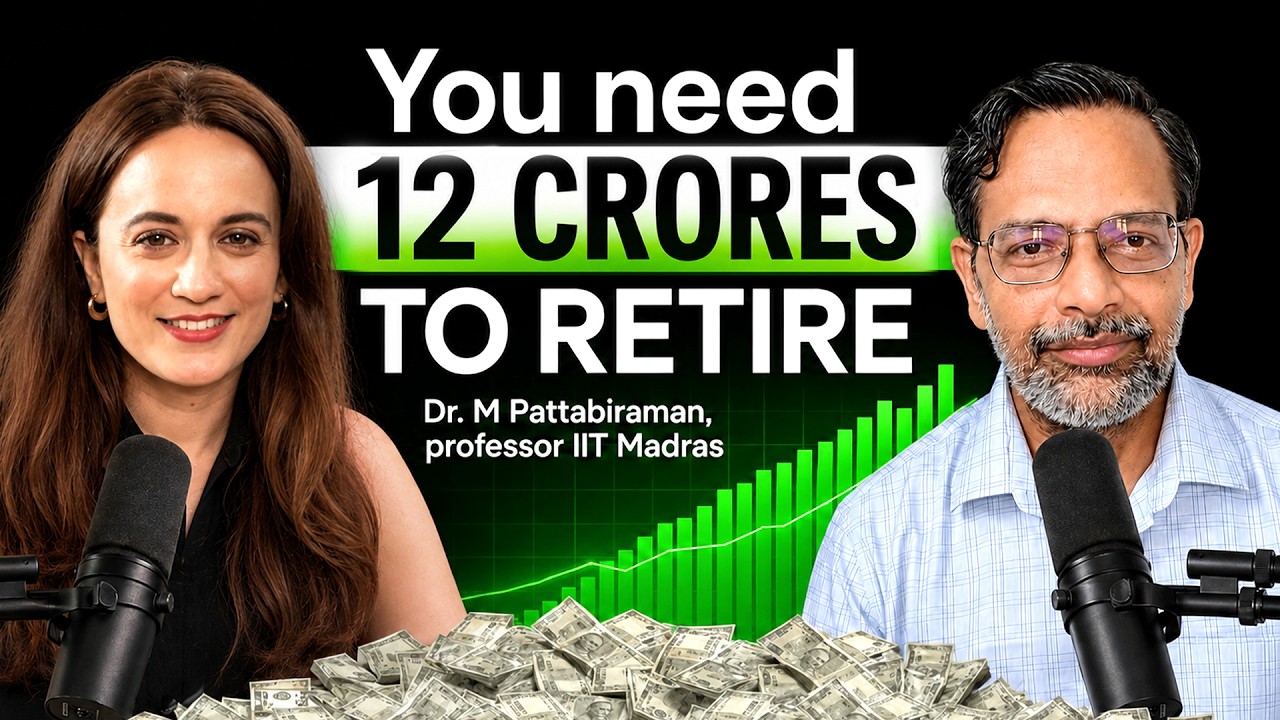
Why You Need ₹12 Crores to Retire in India | Dr. Pattabiraman On Sonia Shenoy Podcast
Sonia Shenoy
Overview
This video features Dr. Pattabiraman discussing retirement planning and personal finance in India. He debunks the myth of a single, large retirement corpus like 40 crores, emphasizing that the required amount depends on individual lifestyle, inflation assumptions, and expected returns. Dr. Pattabiraman advocates for a disciplined, long-term investment approach, favoring index funds for simplicity and cost-effectiveness. He also touches upon behavioral finance, the importance of sacrifice, and the evolving landscape of work due to AI, offering insights into building wealth and achieving financial independence.
How was this?
Save this permanently with flashcards, quizzes, and AI chat
Chapters
- The exact retirement corpus needed is highly personal and depends on individual lifestyle, inflation, and investment return assumptions.
- A corpus of 1 crore might support a lifestyle of approximately 25,000 rupees per month, but this is insufficient to combat inflation over the long term.
- To fight inflation, a corpus must either grow through capital market risk or lifestyle must be significantly reduced.
- A thumb rule for retirement planning is to assume 7% inflation and that expenses double every 10 years.
Understanding that retirement needs are not one-size-fits-all helps individuals avoid unnecessary fear and focus on personalized planning.
If essential expenses are 1 lakh per month today, they could be 48 lakhs annually by the time of retirement in 20 years, suggesting a corpus of around 11-12 crores.
- For long-term needs (10+ years), investing in equity is advisable, especially during sideways or down markets.
- For short-term needs (2-3 years), equity investments are inappropriate; safer options should be considered.
- A simple, low-maintenance portfolio can be constructed with 50-60% in Indian index funds (e.g., Nifty 100, Nifty 500).
- Discipline in investing, including increasing investment amounts regularly (like a 'step-up SIP'), is crucial for wealth building.
Adopting a disciplined, long-term investment strategy, particularly in index funds, can lead to consistent wealth creation without excessive effort.
Instead of relying on automated SIPs, individuals should manually push themselves to invest as much as possible each month and track their progress.
- Experiencing periods of no returns (like 2 years) is normal in the market and can be a good time to invest for those with long-term goals.
- Fear of market downturns or job displacement due to AI is legitimate but should not lead to inaction or irrational despair.
- The key to ignoring market noise is having a clear financial plan and sticking to it.
- Behavioral finance highlights that personal finance is personal; individuals should find solutions that work for them rather than blindly following others.
Understanding the psychological aspects of investing and maintaining a clear plan are essential for weathering market volatility and achieving financial goals.
New investors seeing no returns for two years should view it as a normal market cycle and a good opportunity to invest if their need for the money is far away.
- Index funds are often hard to beat over the long term, making them a cost-effective and simple investment choice.
- Active funds require accepting periods of underperformance (2-3 years) and can involve overlap and higher costs.
- A large allocation to a specific flexi-cap fund (like PPFAS) can be acceptable if it provides downside protection and reasonable long-term returns.
- Non-action (after careful planning) is different from inaction; it means not unnecessarily tinkering with a well-structured portfolio.
Choosing between active and passive investing depends on an investor's tolerance for complexity, cost, and the willingness to accept potential underperformance.
Dr. Pattabiraman holds a significant portion of his portfolio in the PPFAS Flexi Cap fund because he likes its downside protection, even if it doesn't always outperform during market rallies.
- Diversifying across asset classes like international equity and gold can be beneficial but adds complexity to portfolio management.
- Rebalancing involves selling assets that have performed well and buying those that have underperformed to maintain the desired asset allocation.
- The primary goal of rebalancing is to contain portfolio volatility and align it with risk appetite and future needs.
- Having too many asset classes can make it harder to manage and rebalance effectively, potentially leading to behavioral mistakes.
Strategic rebalancing is crucial for managing risk and ensuring a portfolio remains aligned with long-term financial goals, despite the behavioral challenges involved.
If equity grows to 60% and fixed income shrinks to 40%, rebalancing requires selling 10% of equity and moving it to fixed income to return to a 50/50 split.
- Building true generational wealth is challenging, as subsequent generations may not earn as much or may pursue different career paths.
- The key differentiator between those who achieve financial freedom and those who don't is often the willingness to sacrifice immediate wants for future needs.
- Personal finance is deeply personal; individuals must define their own goals and find strategies that align with their values, not just follow trends.
- Sacrifice doesn't feel like sacrifice if it stems from a personal commitment to a goal, rather than external pressure.
Achieving financial goals, whether personal or generational, requires a conscious decision to prioritize future needs through sacrifice and personal commitment.
Students at IIT are not necessarily more intelligent but are willing to sacrifice time, energy, and effort to pass rigorous entrance exams.
- Financial independence provides options and the ability to help others, such as eliminating debt or covering medical expenses for loved ones.
- A frugal mindset, deeply ingrained, can persist even after achieving financial success, leading to contentment rather than excessive spending.
- True contentment comes from within and doesn't necessarily require an increased lifestyle with increased income.
- Slowing down the pace of life and reducing lifestyle expectations can significantly lower the amount of money needed for happiness.
Financial independence offers freedom and the capacity to positively impact others, while contentment is achieved through internal satisfaction rather than external consumption.
Dr. Pattabiraman's family, despite having expensive equipment like cameras, buys them infrequently, prioritizing long-term value over frequent purchases.
Key takeaways
- Retirement planning is highly individualized; avoid relying on generic large corpus numbers.
- Long-term investing in equity, especially during market downturns, is crucial for wealth creation.
- Index funds offer a simple, low-cost, and effective way to build a diversified portfolio.
- Discipline, consistent investment, and regular increases in investment amounts are more important than just setting up an SIP.
- Behavioral challenges like fear and FOMO can derail financial plans; a clear, personal plan is the best defense.
- Rebalancing your portfolio is essential for managing risk and maintaining alignment with your goals.
- Achieving financial independence provides freedom and the ability to help others, often stemming from personal sacrifice.
- Contentment and a slower pace of life can significantly reduce the amount of money needed to live a fulfilling life.
Key terms
Retirement CorpusInflationIndex FundEquity InvestmentAsset AllocationRebalancingBehavioral FinanceFinancial IndependenceGenerational WealthContentment
Test your understanding
- How does inflation impact the required retirement corpus, and what thumb rule can be used for estimation?
- What is the difference between investing for short-term versus long-term needs, and what asset classes are appropriate for each?
- Why are index funds often recommended over actively managed funds, and what are the implications for investors?
- What behavioral challenges can hinder an investor's progress, and how can one overcome them?
- What does financial independence mean to Dr. Pattabiraman, and how does it enable him to impact others' lives?