17:52
SIMPLE End Of Day Forex TRADING Strategy
Stacey Burke Trading
Overview
This video explains a simple end-of-day Forex trading strategy focused on identifying high-probability trades by analyzing the opening range of the week and leveraging daily average true range (ATR) to manage risk and target potential moves. The strategy emphasizes simplicity, discipline, and staying on the correct side of the moving average, aiming for a favorable risk-reward ratio, particularly for traders who cannot monitor the market throughout the day. It highlights using the first two days of the week to establish potential weekly highs or lows and then looking for trade opportunities that align with the established trend and moving average direction.
How was this?
Save this permanently with flashcards, quizzes, and AI chat
Chapters
- The Average True Range (ATR) indicates the average daily, weekly, or monthly price movement for a currency pair.
- Pairs like Pound/Yen typically have average daily ranges of 150-250 pips, and weekly ranges of 400-600 pips.
- Knowing these ranges helps traders understand potential market movement and set realistic expectations.
- Higher ATR suggests more volatility and potential for larger price swings.
Understanding the typical price range of a currency pair helps in setting realistic profit targets and managing risk by knowing how much the market typically moves in a given period.
The speaker uses Pound/Yen, noting its average daily range is around 150-250 pips and weekly range is 400-600 pips, indicating potential for significant moves.
- End-of-day trading can offer better risk-reward ratios (e.g., 3:1 or higher) compared to intraday trading.
- It requires less screen time, making it suitable for traders who cannot constantly monitor the market.
- By entering trades before a significant move, traders can potentially achieve higher profits with lower risk.
- Lower spreads are more impactful on smaller intraday moves; end-of-day trades can absorb spreads more easily.
This approach allows traders to potentially capture larger market moves with less time commitment and a better risk-reward profile, which is advantageous for those with other daily obligations.
Instead of risking 25 pips for a potential 25-50 pip gain in day trading, end-of-day strategies can aim for 200+ pips with a similar or smaller risk.
- The first two days of the week (Monday and Tuesday) often establish the high or low for the entire trading week.
- Traders should identify and mark the high and low of Monday and Tuesday on their charts.
- This 'opening range' can act as a significant support or resistance level for the rest of the week.
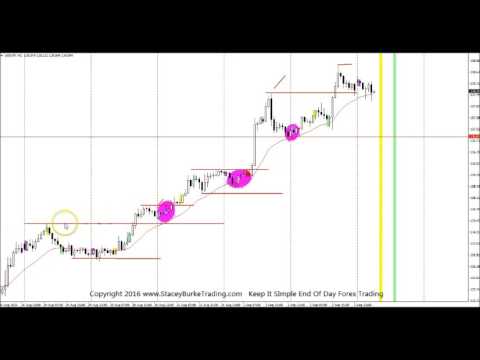
- The 20-period moving average is used as a trend filter; trades should ideally align with the direction of the moving average.
Leveraging the opening range provides a high-probability framework for identifying potential weekly turning points and setting up trades that align with the dominant weekly trend.
If Monday's high is established, and the market later consolidates back towards the moving average on Wednesday, a trader might look for a long entry, expecting the price to eventually retest or break Monday's high.
- Look for a breakout of the opening range, followed by a pullback towards the moving average.
- Enter trades only when the price is on the 'correct' side of the 20-period moving average (e.g., above for longs).
- Set a stop-loss below the pullback low (for longs) or above the pullback high (for shorts), typically risking no more than 50-75 pips (approx. half daily ATR).
- Target a 3:1 risk-reward ratio or exit the trade before the end of the week, especially before major news events like payrolls.
This structured approach to entry, stop-loss placement, and target setting helps manage risk effectively and increases the probability of achieving a profitable trade outcome.
On a Wednesday, if Tuesday's low was the weekly low and the market is trending up above the moving average, a trader might enter long near the moving average, risking below Tuesday's low, and targeting a 3:1 reward.
- If a clear setup isn't present, it's better to stay out of the market or look for a different currency pair.
- The strategy should be simple, duplicatable, and applied consistently week after week.
- Traders should pay attention to price action changes that might signal a slowdown or reversal.
- Discipline and a winning mindset are crucial for long-term success in trading.
Consistency in applying a simple strategy and maintaining emotional control are key to navigating market volatility and achieving sustainable trading results.
If the market is choppy or doesn't show a clear trend aligned with the moving average after the opening range is established, the trader should refrain from taking a trade.
Key takeaways
- The Average True Range (ATR) is a vital tool for understanding a currency pair's volatility and potential price movement.
- End-of-day trading can offer superior risk-reward ratios and requires less active screen time than intraday trading.
- The highs and lows of the first two days of the trading week often act as significant support or resistance for the remainder of the week.
- Always trade in the direction of the 20-period moving average to align with the prevailing trend.
- Limit your risk per trade to a maximum of 50-75 pips, which is roughly half of the average daily ATR.
- Aim for a minimum 3:1 risk-reward ratio on your trades.
- Simplicity, discipline, and consistency are the cornerstones of a successful trading strategy.
Key terms
Average True Range (ATR)End-of-Day TradingOpening RangeMoving Average (20-period)Risk-Reward RatioPipVolatilitySupport and ResistanceTrend Filter
Test your understanding
- How does the Average True Range (ATR) help a trader decide on potential trade targets and risk management?
- What are the primary advantages of employing an end-of-day trading strategy compared to intraday trading?
- How can the trading activity of the first two days of the week be used to identify potential high-probability trade setups?
- Why is it important to align your trades with the direction of the 20-period moving average when using this strategy?
- What is the recommended maximum risk per trade, and how does it relate to the daily ATR?